Lashes by the Million: The False Eyelash Goes Frank
In 1964 a television panellist declared it the year of the frank false eyelash. By 1968 Americans were buying more than twenty million pairs a year, most of them made by one British firm.
In short
False eyelashes reached a twentieth-century high in the 1960s: Eylure, a British firm founded by two film makeup artists in 1947, made most of the lashes sold under other houses’ names, and American sales passed 20,000,000 pairs a year by 1968.
- 7min read
- 6chapters
- 7sources
On 27 September 1964 David Aylott, co-founder of a British eyelash company, appeared on the CBS panel game What’s My Line. One of the panellists, Dorothy Kilgallen, was wearing a pair of his lashes, and on air she said that this “is the year of frank false eyelash. Women don’t even bother pretending any more that they’re not fake”.[1]
The false eyelash was not new. What the 1960s changed was who wore one, how many were sold, and whether anyone minded being seen in them.
From the Stage
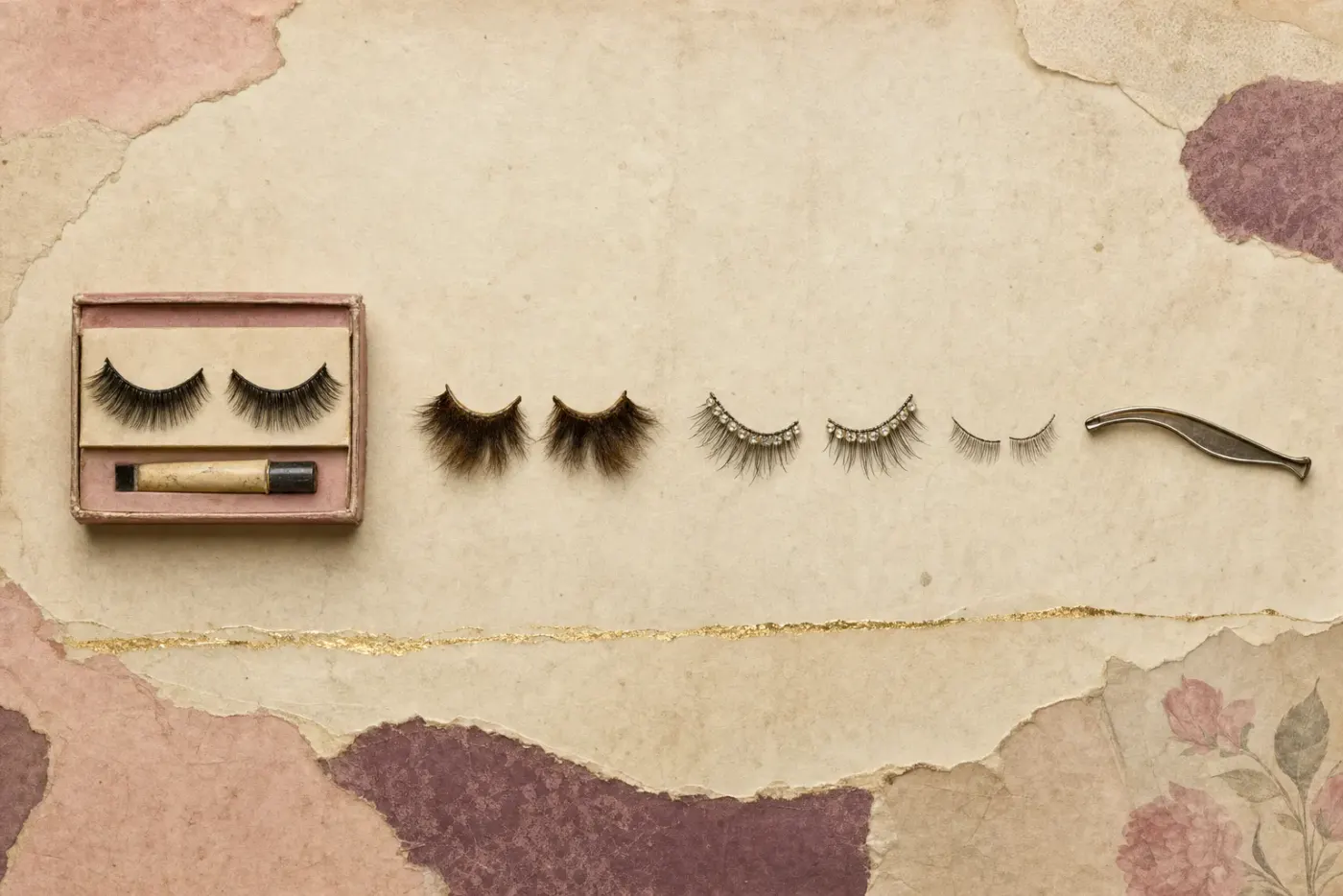
Strip lashes — hair fixed to a backing and glued along the lid — were sold in boxed pairs from the first years of the twentieth century, but became fashionable only between the wars, probably, the historian of the trade suggests, because Hollywood’s makeup artists spread them through the films.[2] Eylure began in that world. David and Eric Aylott were film makeup artists who made lashes as a sideline between pictures, and founded Eylure Ltd in March 1947.[3]
Their first advertisement, in The Stage that July, offered lashes in four shades boxed with a tube of adhesive, Lashfix, made of latex and water; unlike the spirit gum used in the theatre, it stretched with the eyelid. The first customers were expected to be actresses.[3]
Big Eyes in a Pale Face
The fashion that carried the lashes off the stage had been building since the war. As lipsticks moved from deep reds to paler pinks, the centre of the face moved from the mouth to the eyes, and in the 1960s the trend culminated, in Bennett’s phrase, in “the European look of big eyes in a pale face”, worn by models such as Jean Shrimpton and Twiggy.[4] Both emphasised eye makeup and wore false lashes; in 1963 Shrimpton demonstrated her routine in British Vogue with lashes from Eylure.[5]
The cinema helped. The release of Cleopatra in 1963 stimulated sales, and David Aylott made much of having designed Elizabeth Taylor’s eye makeup for it — though he worked on the film only while it was being made at Pinewood, before production moved to Rome.[5][4]
Made by One, Sold by Many
Most houses that sold false lashes did not make them. By 1968 American sales had passed 20,000,000 pairs a year, sold under the names of Elizabeth Arden, Helena Rubinstein, Revlon, Yardley, Max Factor and others, and most of those lashes were made by Eylure in Britain, Belgium or Malta.[6] Revlon’s Private Eyelashes of 1966 came from Eylure; Gala of London added black and brown lashes in 1967, probably from the same source.[7][8]
Eylure’s biggest market was the United States, and its exports earned it a Queen’s Award to Industry in 1966.[9] It had competition there. The Andrea Mass Company, founded in 1964, bought its lashes cheaply from South Korea, and before long most of the world’s false eyelashes were made in countries such as South Korea and India, where labour cost less.[6]
False lashes usually look best if you use only three-quarters or half so they give a fringing to the outer edge of the eye.
Easier to Wear
Much of the decade’s selling went into making lashes easier to put on and keep. Eylure brought out self-adhesive lashes in 1963, a lash applicator in 1964 and a lash-cleaning kit in 1966, and by the end of the decade made more than thirty styles in real hair or fur.[11] The “mink” of the period was usually seal skin, and some lashes came set with paste jewels for the evening.[12] Some women now wore false lashes on the lower lid as well as the upper — which Bennett calls a new development for the time.[12]
The instructions grew more confident as the lashes became ordinary. “That is all there is to it,” the Australian Women’s Weekly told its readers in 1968. “The entire application takes less than two minutes.”[12]
Into the Trash Can
Not everyone in the industry approved. Estée Lauder, whose eye collection of 1969 included a mascara promising “Naturally longer, glossier eyelashes, no need to fake it”, was against false eyelashes and did not sell them.[13] And for the women who protested outside the Miss America pageant in Atlantic City on 7 September 1968, false eyelashes belonged in the Freedom Trash Can, with “bras, girdles, curlers, false eyelashes, wigs, and representative issues of Cosmopolitan, Ladies’ Home Journal, Family Circle, etc.”[14]
Wearers met smaller problems. The glue could cause occasional allergic reactions, and lashes reused again and again gathered glue and dirt along the band.[15] The Food and Drug Administration still counts false eyelashes and their adhesives as cosmetics, and still reminds wearers that the eyelids are delicate.[16]
What Is Not Known
The figure of twenty million pairs comes from an Australian women’s magazine of 1968, as quoted by the historian; it is a period estimate rather than an audited count.[17] No source used here says how many women in Britain or Europe wore false lashes, or how often.
Popular accounts give Twiggy lower lashes drawn on beneath the eye. The sources here name her only as a wearer of strong eye makeup and of false lashes, and they do not say who first wore false lashes on the lower lid.[17][18] Kilgallen’s remark that women had stopped pretending is evidence of what one television panellist said in 1964, not of what most women did.
Sources
- [1, 3, 5, 9, 11, 18]Eylure Cosmetics and Skin, 2019.View source (opens in a new tab) Accessed 2026-09-25.
- [2, 4, 6, 10, 12, 15, 17]False Eyelashes Cosmetics and Skin, 2018.View source (opens in a new tab) Accessed 2026-09-26.
- [7]Revlon (post 1960) Cosmetics and Skin, 2012.View source (opens in a new tab) Accessed 2026-09-26.
- [8]Gala of London Cosmetics and Skin, 2024.View source (opens in a new tab) Accessed 2026-09-25.
- [13]Estée Lauder (post 1960) Cosmetics and Skin, 2023.View source (opens in a new tab) Accessed 2026-09-26.
- [14]Fifty Years Ago, Protesters Took on the Miss America Pageant and Electrified the Feminist Movement Smithsonian Magazine, 2018.View source (opens in a new tab) Accessed 2026-09-22.
- [16]Eye Cosmetic Safety US Food and Drug Administration.View source (opens in a new tab) Accessed 2026-09-22.
Filed under