Naturally ’62: Black Is Beautiful and the Other Natural
In 1962 a fashion show in Harlem put Black models on the runway in their natural hair, under the words “Black Is Beautiful”. The same year, the mass market sold “natural” makeup in shades made for lighter skin.
In short
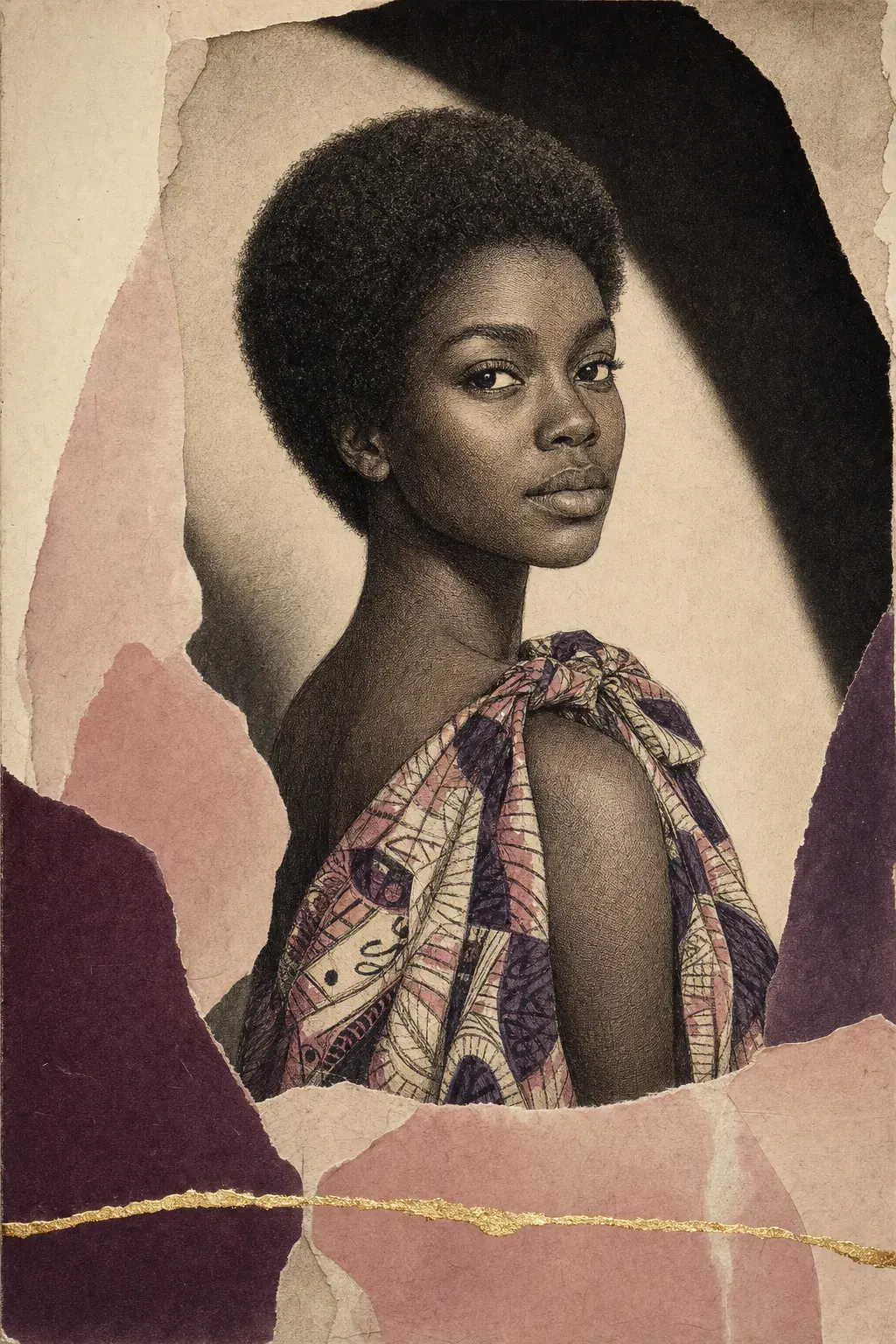
Naturally ’62, a fashion show staged in Harlem in 1962 by Kwame Brathwaite’s African Jazz Art Society and Studios, put the Grandassa Models on the runway in their Afros under the tagline “Black Is Beautiful”, the phrase of a movement that affirmed the variety of skin colours in the African American community.
- 7min read
- 6chapters
- 7sources
In 1962 the word “natural” was put to two different uses. In Harlem a fashion show called Naturally ’62 put a group of Black models on the runway wearing their Afros and traditional African fabrics, under the tagline “Black Is Beautiful”.[1] In the same year Revlon launched a mass-market makeup called Natural Wonder, in seven shades.[2]
The two had nothing to do with each other, and that is the reason to set them side by side. One was an argument about whose face counted as beautiful. The other was a product, and the question of whose face it was made for had not yet reached the shade card.
The Show
Naturally ’62 was staged by the African Jazz Art Society and Studios, a Harlem and Bronx cultural group that the photographer Kwame Brathwaite had co-founded in the 1950s with his older brother Elombe, and which in 1962 turned to fashion with a group of its own, the Grandassa Models.[3] The Studio Museum in Harlem describes the society as a group of designers, writers and artists, and the Grandassa Models as Black women who advocated for natural Black beauty.[4]
The show was held at the Purple Manor, a jazz club in Harlem.[3] Brathwaite’s account of its purpose, given to the New Yorker in 2019, was plain: “We said, ‘We’ve got to do something to make the women feel proud of their hair, proud of their blackness.’”[3]
A Phrase for a Movement
The phrase outgrew the show. Brathwaite’s obituary in Hyperallergic credits Naturally ’62 and the annual shows that followed with carrying “Black is Beautiful” into a national movement, and his photographs of the models were soon on jazz record covers, among them Lou Donaldson’s Good Gracious! of 1963 and Freddie Roach’s Brown Sugar of 1964.[5]
The National Museum of African American History and Culture describes what the movement asked for: an appreciation of the Black past as a worthy legacy, and pride in contemporary achievement. It “affirmed natural hairstyles like the ‘Afro’ and the variety of skin colors, hair textures, and physical characteristics found in the African American community.”[6]
Across this country, young black men and women have been infected with a fever of affirmation. They are saying, ‘We are black and beautiful.’
The Other Natural
At the makeup counter, “natural” meant something else. Revlon’s brush-on powders — Blush-On from 1962, then Brush-On Eyeshadow, Brow Beautiful and Sweeping Beauty, sold together as “The Beautiful Young Brush-Ons” — were, in its historian’s account, part of the company’s response to the natural look.[8] Natural Wonder, its medicated line for young buyers, came in seven shades in 1962 and ten by 1964: Light, Misty Rose, Creamy Ivory, Cream Beige, Soft Beige, Tawny Beige, Toasted Beige, Creamy Peach, Rachel and Suntan.[8]
The makeup that would be the best-selling in the country by 1968 was narrower still. Cover Girl launched in 1961 in three shades, Light, Medium and Dark, and by 1964 had four, which in Bennett’s judgement left it suitable only for lighter skins.[9]
Makeup for darker skin was sold in the decade, but not by these lines. Flori Roberts dates its own range to 1965 and calls it the first cosmetics brand developed specifically for women of colour, and the first such brand in major department stores — the company’s own claims, which this archive weighs elsewhere.[10]
Two Arguments
The two naturals stood for different demands. “Black Is Beautiful” was a claim about the standard itself: whose hair, whose features and whose skin counted. A shade range is a demand that an industry make products for customers it has not been serving. A company could answer the second while leaving the first exactly where it was, and the shade lists of the decade’s best-selling mass-market lines show that it had not yet answered the second.
The movement’s own answer did not depend on the industry at all. Its photographs, record covers and runways made the case with faces rather than with products.
Atlantic City
Six years after Naturally ’62 the two arguments were made on the same night. On 7 September 1968 women’s liberation activists protested outside the Miss America pageant in Atlantic City, and at midnight, a few blocks away, the first Miss Black America competition was held — created, in the Smithsonian’s account, because the Miss America pageant would not accommodate Black women and Black beauty.[11]
Its winner, Saundra Williams, put the case simply. “Miss America does not represent us because there has never been a black girl in the pageant,” she said afterwards. “With my title, I can show black women that they too are beautiful.”[11]
What Is Not Known
None of the sources used here describes makeup at Naturally ’62. Whether the Grandassa Models wore any, and what, is not recorded in them; they describe hair, dress, music and the photographs, and an account of the show’s faces would need sources this archive does not hold.[12][13]
They also differ about the society behind it: the Studio Museum calls it the Africa Jazz Arts Society and Studio and says Brathwaite created it; Hyperallergic names the African Jazz Art Society and Studios and says he co-founded it with his brother.[12][13] And neither settles where the phrase began. One records “Black Is Beautiful” as the show’s tagline; the other credits the shows with making it a national movement, which is a different claim from having coined it.[12][13]
Sources
- [1, 4, 12]Kwame Brathwaite The Studio Museum in Harlem.View source (opens in a new tab) Accessed 2026-10-03.
- [2, 8]Revlon (post 1960) Cosmetics and Skin, 2012.View source (opens in a new tab) Accessed 2026-09-26.
- [3, 5, 13]Kwame Brathwaite, “Black Is Beautiful” Photographer, Dies at 85 Hyperallergic, 2023.View source (opens in a new tab) Accessed 2026-10-03.
- [6, 7]Black is Beautiful: The Emergence of Black Culture and Identity in the 60s and 70s Smithsonian Institution.View source (opens in a new tab) Accessed 2026-10-03.
- [9]Cover Girl Cosmetics and Skin, 2016.View source (opens in a new tab) Accessed 2026-09-26.
- [10]About Us Flori Roberts (company website).View source (opens in a new tab) Accessed 2026-09-22.
- [11]Fifty Years Ago, Protesters Took on the Miss America Pageant and Electrified the Feminist Movement Smithsonian Magazine, 2018.View source (opens in a new tab) Accessed 2026-09-22.
Filed under