The Finished Face
A lipstick that promised to stay, colour sold by the season, and makeup sold between the questions on prime-time television: the decade that built the machinery of modern beauty.
HOM · Era1950 – 1959Polish & Persuasion
All of The 1950s Era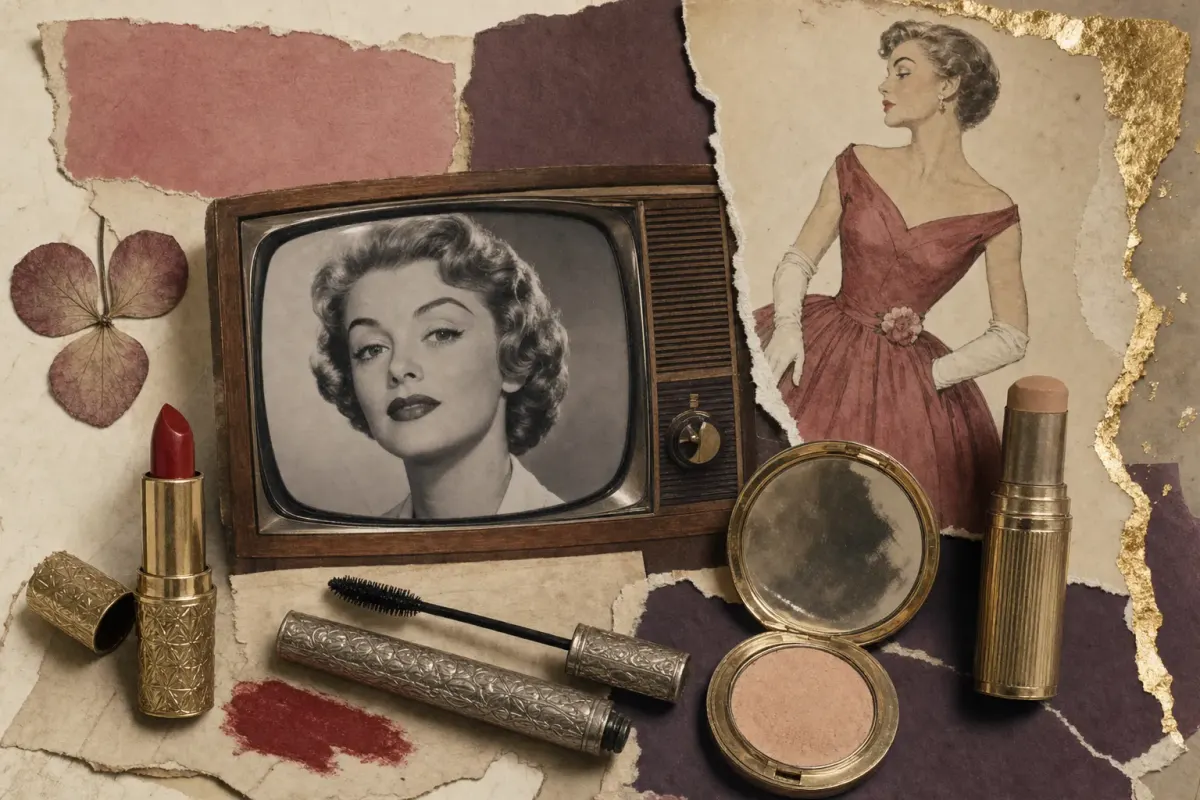
In short
The 1950s opened with Hazel Bishop’s long-lasting lipstick and the race it started, sold colour by the season and makeup on prime-time television, and ended with the automatic mascara moving attention from the mouth to the eye.
- 9min read
- 8chapters
- 16sources
The 1920s made makeup public. The 1950s made it a machine. In ten years the cosmetics business acquired almost everything it still runs on: a lipstick sold on the promise that it would stay where it was put, colour sold by the season, whole television programmes bought to sell a shade, and new formats — the stick foundation, the automatic pencil, the mascara with its applicator inside the case — that made a complete face quick enough to do every morning.
The face itself was finished in the literal sense: an even, matte base, a drawn brow and line, mascara and a defined red mouth, each step with a product made for it. What follows is less the story of a look than of the industry that learned to sell one.
The Lipstick That Promised to Stay
The decade opened on the mouth. Hazel Bishop, a chemist who had graduated from Barnard in 1929, put a long-lasting lipstick on sale in 1950, and on its first day at Lord & Taylor in New York the store sold out of the line.[1] Her own description of the formula was exact: it took its colour “from pigment plus stain, rather than from stain alone.”[1]
She is often credited with inventing the indelible lipstick, which she did not do[1] — staining lipsticks were already in production, glycol-based ones among them from the late 1920s.[2] What she started was a race. Revlon answered with Indelible-Creme in 1951 and later with Living Lipstick, and Coty brought out “24” in 1955.[2][3] In 1953 the Federal Trade Commission agreed that words such as “indelible” and “smear-proof” could be used in advertising only with the word “type” attached, and Revlon dropped Indelible-Creme the same year.[2][3]
Colour as a Season
Revlon’s larger answer to a durable product was to make it go out of date. Fire and Ice, launched in the autumn of 1952, attached a lipstick and a matching nail enamel to a mood and a moment: Richard Avedon photographed Dorian Leigh for it, and Vogue built its November issue around the campaign.[4]
A shade that belongs to a season is not used up but superseded, and the purchase can repeat without the product failing. Every seasonal colour story since descends from that idea.[5]
After six months of using a show, we’ve skimmed the audience. Lipstick is used by all women. Our policy is to shift every six months, so that we hit different groups.
Sold Between the Questions
Hazel Bishop was built on broadcasting. Its marketer, Raymond Spector, began in 1950 with spot radio announcements in fifty-seven markets, moved to spots on television and then to sponsoring whole programmes; by 1953 the company was the largest television cosmetics advertiser in the United States, and by 1954 it had spent more than $2.3 million on television.[7]
Revlon took the method further. In June 1955 it became the sole sponsor of CBS’s The $64,000 Question, which on one evening drew up to 55 million viewers.[8] Revlon’s sales rose from $33.6 million to $51.6 million that year, with the show on air for only six months of it, and reached $110.4 million by 1958, when the programme ended.[9] Its share of the lipstick market rose from 15 to 28 per cent while Hazel Bishop’s fell from 28 to 24.[7]
The cost of owning a programme came later. Producers of Revlon’s quiz shows described repeating questions when “the sponsor had requested a particular outcome of a match,” and by October 1958 the Question was off the air.[10][8]
A Product for Every Step
The decade’s quieter achievement was to give each step of the face a product of its own. Max Factor’s Pan-Stik, a foundation in a stick, was introduced in 1947 and released for general sale in 1948; its Erace concealer stick followed in 1954 — often called the first stick concealer, which it was not.[11] Revlon’s Dreamy Eye Make-up of 1950 packaged mascara, eye shadow and a pencil for both brow and line, and Maybelline sold an Automatic Eyebrow and Eyeliner Pencil from 1954.[12][13]
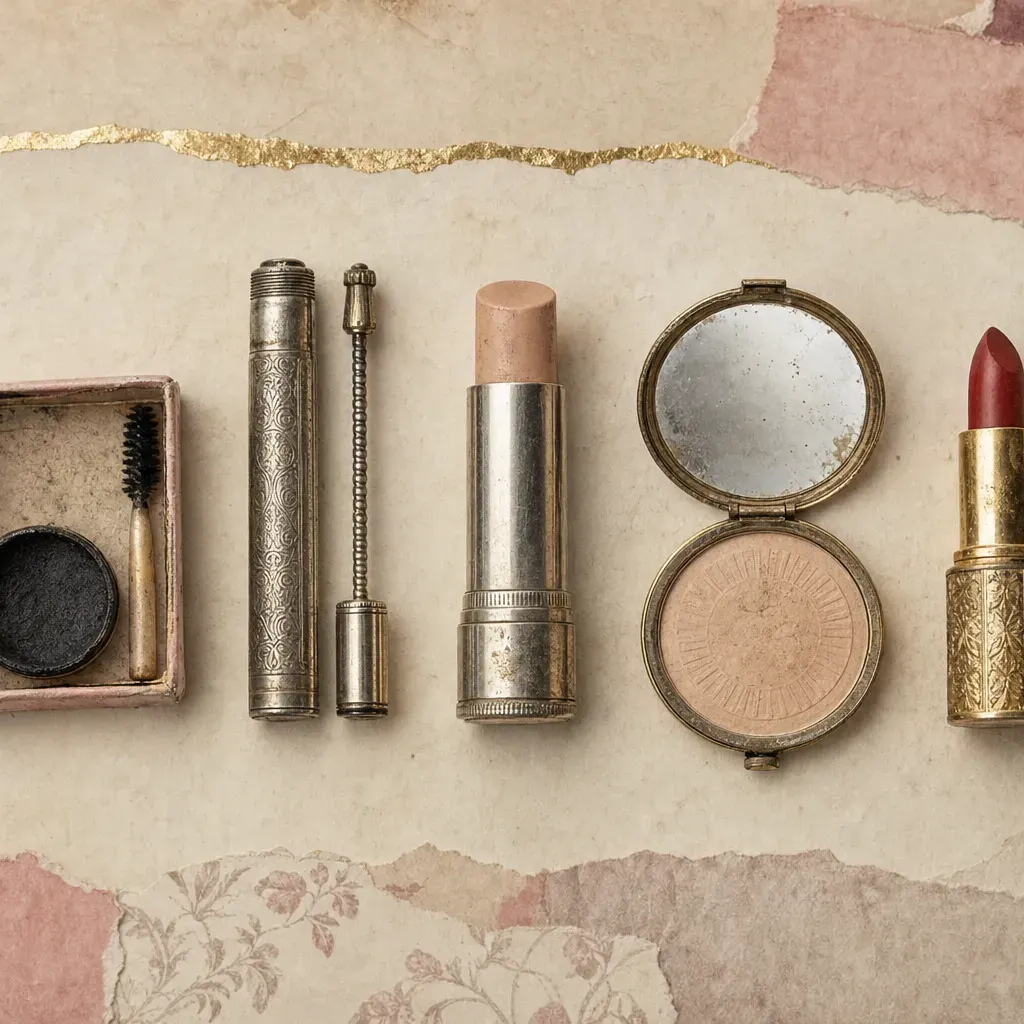
Mascara changed most. For decades it had come as a cake of pigmented soap worked with a wet brush — wetted, often enough, with spit.[14] In 1957 Helena Rubinstein’s Mascara-Matic put a cream mascara in a case with a grooved metal rod inside it, and by 1958 Maybelline, Max Factor and Revlon sold automatic mascaras of their own, Maybelline’s with a brush.[15]
Made for the Camera, Sold to Everyone
Television changed what a base had to do as well as how it was sold. In 1954 Max Factor made versions of Pan-Cake and Pan-Stik for black-and-white and for colour cameras, under which untreated skin showed “varying degrees of blotchiness,” and its Hi-Fi range of 1955 was sold on the strength of that colour-television research.[16] Hi-Fi was a general make-up range, the firm’s first since the 1920s.[17]
It was the pattern Pan-Cake had set with Technicolor twenty years earlier, now running through a medium that was in the buyer’s own living room: a product engineered for a camera, then sold to everybody on the strength of where it came from.
The Finished Face
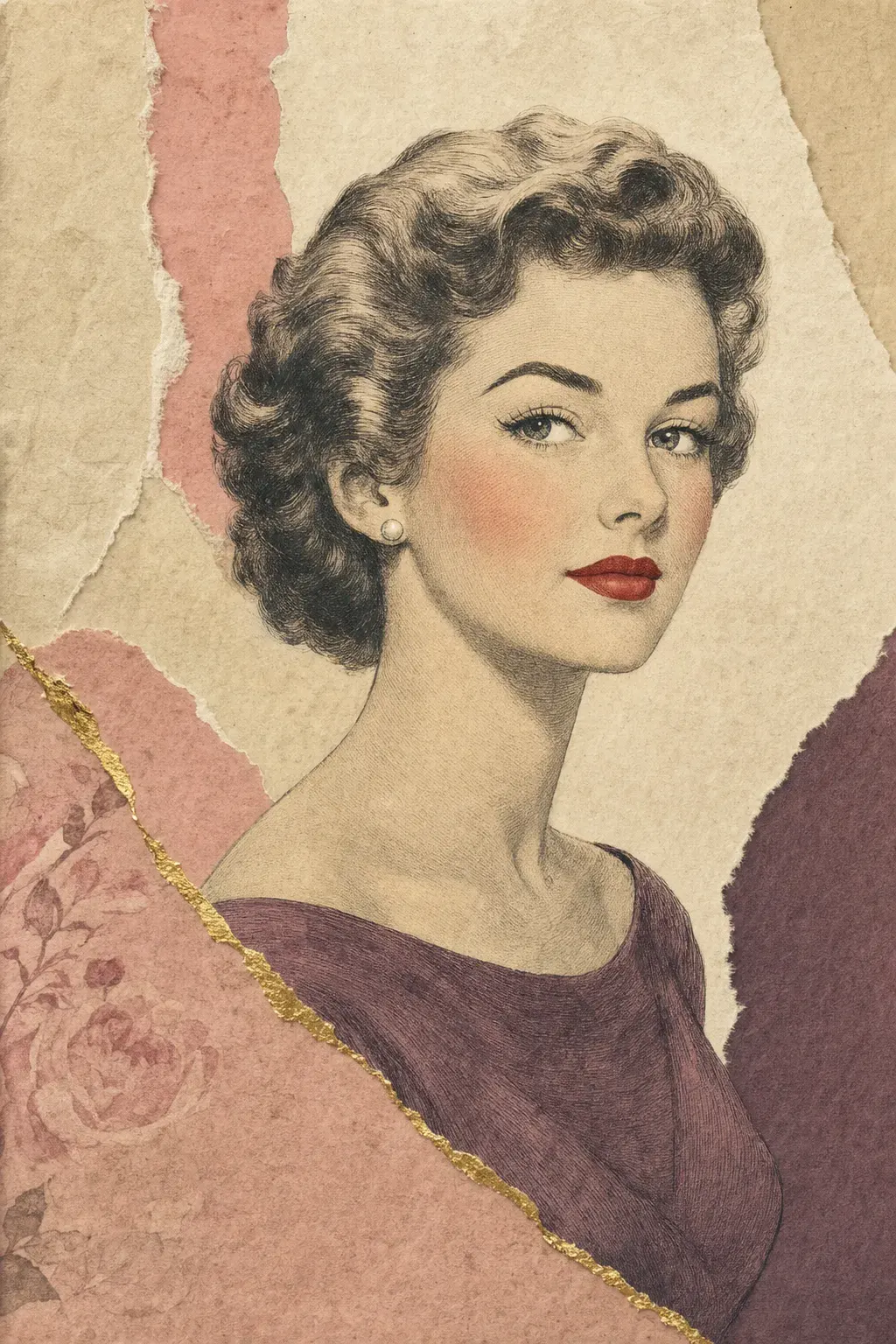
Put together, the decade’s products describe the face it sold: an even, matte base from a stick or a cake, a brow and a line drawn with a pencil, mascara on the lashes and a red mouth from a lipstick that promised to stay.[18][19] The plate here is reconstructed from those products rather than from any one woman’s routine, and the steps beside it say what each one takes to do now.
By the end of the decade the emphasis was already moving. In the late 1950s lipsticks went paler while mascara, eyeliner and eye shadow came into colourful use[20] — Maybelline’s Magic Mascara came in Royal Blue and Jade Green as well as black, and Max Factor’s Wand Mascara in Blue, Blue-Green and Lavender.[21][18] The mouth had opened the decade. The eye would carry the next one.
Built Alongside
Black women’s beauty businesses grew alongside this industry rather than inside it. In Harlem, Rose Morgan’s House of Beauty employed twenty-nine people and served about a thousand customers a week; she sold her own line of cosmetics and staged fashion shows, and in February 1955 ten thousand people came to the opening of her new salon.[22]
In 1958 Eunice Walker Johnson — secretary-treasurer of Johnson Publishing, and the woman who had named Ebony — began the Ebony Fashion Fair, a touring show that she created, produced and directed, and that took Black models on the road, through the Jim Crow South among other places, until 2009.[23][24] Makeup that matched her models proved hard to find, and in 1973 Johnson started Fashion Fair Cosmetics to supply shades for deeper skin tones.[25][23]
What Is Not Known
Several of the decade’s most repeated details do not survive checking. Dates of “firsts” disagree from source to source: Pan-Stik is given as 1947 or 1948, depending on whether its introduction or its general release is meant, and Mascara-Matic, though it began the decline of the cake, was not the first mascara sold with its own applicator.[26][27]
The look is harder to document than its products. Popular accounts give the decade a “doe eye” and a strongly arched brow; this archive has not found a source it can cite for either as a dated fashion, which is why the plate above is built from the products the decade sold rather than from that shorthand.
Nor do the sources cited here settle how much the Revson brothers knew of the rigging of the programme they paid for. They record a sponsor that reviewed every aspect of the show each week, and producers who described outcomes the sponsor had requested; they record no finding against either brother, and this account asserts none.[28]
Sources
- [1, 6, 7]Hazel Bishop Cosmetics and Skin.View source (opens in a new tab) Accessed 2026-09-22.
- [2]Indelible Lipsticks Cosmetics and Skin.View source (opens in a new tab) Accessed 2026-09-22.
- [3, 4, 9, 12, 19]Revlon (1945–1960) Cosmetics and Skin (updated 6 June 2024), 2012.View source (opens in a new tab) Accessed 2026-10-03.
- [5]Fire and Ice: The Story of Charles Revson William Morrow, 1976.
- [8]The $64,000 Question PBS (WGBH).View source (opens in a new tab) Accessed 2026-10-03.
- [10, 28]Charles Revson PBS (WGBH).View source (opens in a new tab) Accessed 2026-10-03.
- [11, 17, 18, 26]Max Factor (1945–1960) Cosmetics and Skin, 2026.View source (opens in a new tab) Accessed 2026-09-22.
- [13, 21]Maybelline Cosmetics and Skin, 2010.View source (opens in a new tab) Accessed 2026-09-25.
- [14]Cake (Block) Mascara Cosmetics and Skin (first posted 29 April 2013, updated 29 August 2025), 2013.View source (opens in a new tab) Accessed 2026-09-25.
- [15, 27]Automatic Mascara Cosmetics and Skin (updated 29 August 2025), 2018.View source (opens in a new tab) Accessed 2026-10-03.
- [16]Max Factor and Television Cosmetics and Skin (updated 21 November 2024), 2009.View source (opens in a new tab) Accessed 2026-10-03.
- [20]Eye Shadow Cosmetics and Skin.View source (opens in a new tab) Accessed 2026-10-03.
- [22]Morgan, Rose Meta 1912(?)– Encyclopedia.com (Gale).View source (opens in a new tab) Accessed 2026-10-03.
- [23]Inspiring Beauty: 50 Years of Ebony Fashion Fair — Biographies Exhibition pages, 5 February to 3 May 2015, 2015.View source (opens in a new tab) Accessed 2026-09-25.
- [24]The Ebony Fashion Fair: Changing History On The Catwalk NPR, 2014.View source (opens in a new tab) Accessed 2026-10-03.
- [25]50 Years of Couture: New Exhibit Celebrates Fashion Empire NBC News, 2017.View source (opens in a new tab) Accessed 2026-10-03.
Continue in The 1950s Era
Polish & Persuasion
Browse all 9 articles