Mascara Leaves the Cake: The Automatic Mascaras of 1957
For decades mascara meant a block of pigmented soap and a wet brush. In 1957 it moved into a case with its applicator inside, and it never moved back.
In short
Helena Rubinstein’s Mascara-Matic of 1957 — cream mascara in a glass vial with a grooved metal rod that held the colour once the rest of the rod was wiped clean — began the decline of cake mascara, and Maybelline’s Magic Mascara of 1958 used a brush instead.
- 6min read
- 6chapters
- 7sources
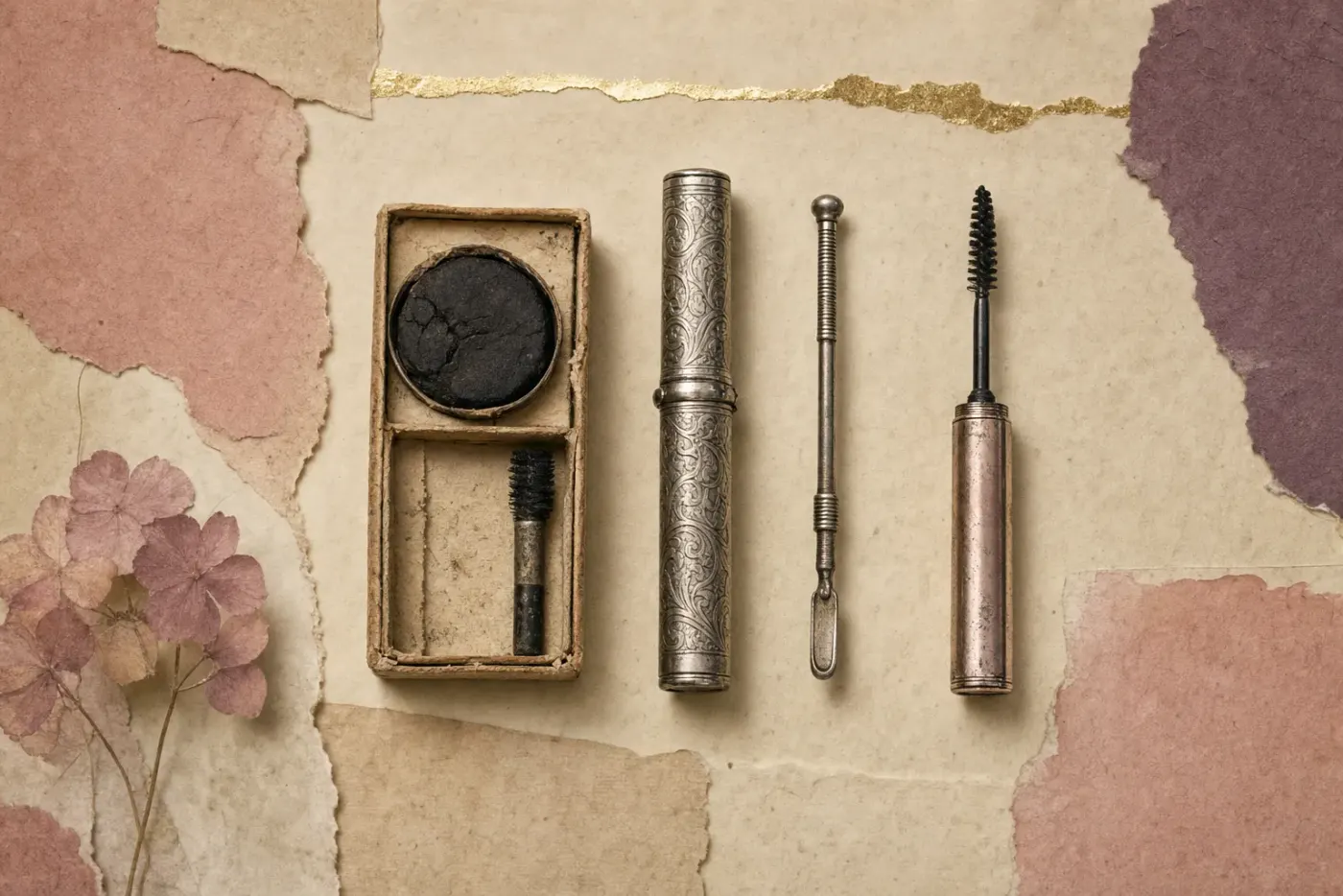
Buying mascara used to mean buying a cake: a block of pigment milled into soap and pressed into a small box, sold with a tiny brush.[1] To use it, you wet the brush, scrubbed it across the cake and worked the colour onto the lashes. Water was the polite way to wet the brush. Many women used spit, which is why the product was nicknamed “spit black.”[1]
Within a few years at the end of the 1950s the cake gave way to something every mascara still resembles: a liquid colour in a case, with its applicator stored inside.
The Cake and Its Maker
The cake was cheap, sold at the lower end of the market, and it remained the most popular form of mascara until the 1960s.[2] Its most successful maker was Maybelline, whose name had been on a cake of eyelash colour since 1917 and which held about three-quarters of the American mascara market in 1947.[3]
The format asked a good deal of its user: a separate brush to keep clean, and water — or something less polite — every time it was used.
The Grooved Rod
Helena Rubinstein’s Mascara-Matic, introduced in 1957, did away with the cake and the separate brush together. The mascara was a cream, held in a glass vial inside a metal case; the applicator was a metal rod with grooves that held the mascara once the rest of the rod had been wiped clean.[4] It was advertised as brushless, and patented in the United States as number 3,033,213.[4]
The design answered the cake’s faults at once. A cream kept sealed in its own container did not dry out — cream mascaras were usually sold in tubes for exactly that reason — and an applicator stored inside it needed no water at all.[5]
Not the First
Mascara-Matic is often described as the first mascara with its own applicator. It was not. In 1939 Parfum Ronni of New York sold a cream mascara with a saw-shaped applicator attached to its lid, and a 1939 patent for a similar device, granted to Frank L. Engel Jr., had expired by the time Rubinstein’s appeared.[6]
What Mascara-Matic began, in the judgement of the historian whose work this account relies on, was the decline of the cake.[7] Its importance lies in what it started, not in what it invented.
The grooved rod did not last. The case it came in did.
Everyone Follows
The response came within a year. In 1958 Maybelline — still the largest mascara maker in the country — launched Magic Mascara, applied not with a grooved rod but with a brush, in Velvet Black, Royal Blue, Jade Green and Sable Brown.[8][9] Max Factor’s Wand Mascara of the same year came in eight shades, including Blue, Blue-Green and Lavender; Revlon had an automatic mascara of its own by 1958, and Dorothy Gray and Aziza followed around 1959.[10][11]
The historian of these products calls Maybelline’s the first spiral brush he knows of, and its launch the beginning of the end for other types of mascara.[11][9] The rod had opened the category; the brush took it.
“Automatic” was already a selling word by then. Maybelline had sold an Automatic Eyebrow and Eyeliner Pencil since 1954,[8] and Revlon had brought out a Waterproof Cream Mascara in 1957, the year of Mascara-Matic.[12] What the late 1950s sold, step by step across the face, was the removal of preparation.
From the Mouth to the Eye
The shade names tell the rest. A decade that opened with a race to make lipstick stay on the mouth closed with blue, green and lavender on the lashes. In the late 1950s and early 1960s lipsticks went paler, while mascara, eyeliner and eye shadow came into colourful use.[13]
The next decade would make the eye the feature that carried the whole face, and it would do so with tools that had arrived, ready to use and needing no water, in the last three years of this one.
What Is Not Known
Prices are not given in the sources used here. Nor is it settled what Revlon called its 1958 mascara: the same historian names it Roll-On Mascara on one page and Brush-On Mascara on another.[14][15]
The claim, repeated in many places, that Helena Rubinstein invented the mascara wand is not supported by the sources here. Her applicator was a rod rather than a brush, and it was not the first applicator sold with a mascara.[15]
Sources
- [1, 2, 7]Cake (Block) Mascara Cosmetics and Skin (first posted 29 April 2013, updated 29 August 2025), 2013.View source (opens in a new tab) Accessed 2026-09-25.
- [3, 8]Maybelline Cosmetics and Skin, 2010.View source (opens in a new tab) Accessed 2026-09-25.
- [4, 6, 11, 15]Automatic Mascara Cosmetics and Skin (updated 29 August 2025), 2018.View source (opens in a new tab) Accessed 2026-10-03.
- [5, 9]Liquid and Cream Mascaras Cosmetics and Skin, 2014.View source (opens in a new tab) Accessed 2026-10-03.
- [10]Max Factor (1945–1960) Cosmetics and Skin, 2026.View source (opens in a new tab) Accessed 2026-09-22.
- [12, 14]Revlon (1945–1960) Cosmetics and Skin (updated 6 June 2024), 2012.View source (opens in a new tab) Accessed 2026-10-03.
- [13]Eye Shadow Cosmetics and Skin.View source (opens in a new tab) Accessed 2026-10-03.
Filed under