Masks, Screens and the Law
A mouth hidden behind a mask and an eye made up above it, a face held up to a phone, and the largest expansion of American cosmetics law in eighty-four years: the decade so far.
HOM · Era2020 – TodayMasks & Mandates
All of The 2020s Era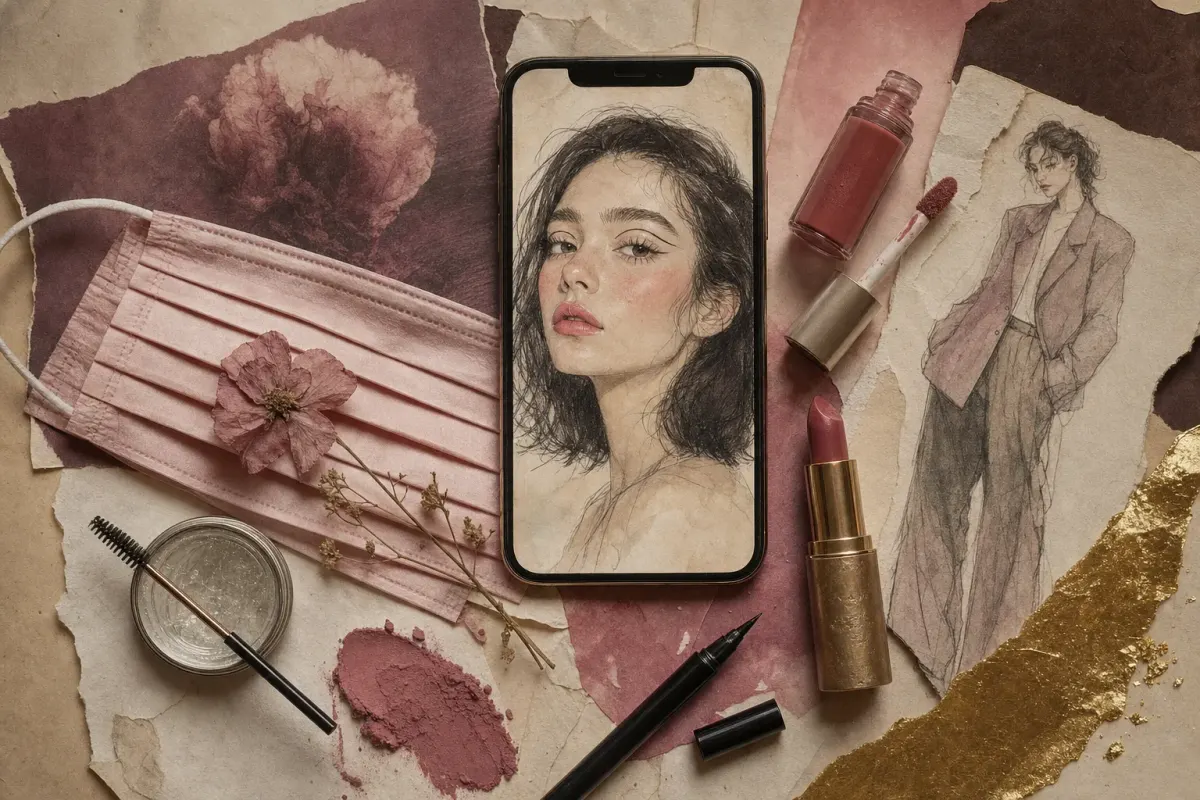
In short
The 2020s opened with lipstick sales falling behind masks while eye makeup held up, gave the FDA its widest new powers over cosmetics since 1938 in the Modernization of Cosmetics Regulation Act of December 2022, and saw the European Union restrict added microplastics — loose glitter at once, makeup by 2035.
- 9min read
- 7chapters
- 21sources
The 1950s sold a finished face on television. The 2020s began by hiding half of one. For a year and more the mouth went behind a mask and the eyes carried what makeup there was; then the face came back, onto a phone held at arm’s length, in front of buyers younger than the industry had courted before.
Around it the rules changed. American cosmetics law gained the largest expansion of its federal reach since the 1930s, China stopped requiring animal tests for most imported ordinary cosmetics, and Europe set the dates by which plastic microparticles must leave its makeup. What follows runs to the autumn of the decade’s seventh year, and stops where the record does.
The Face Above the Mask
In the spring of 2020 masks covered the lower face, and lipstick paid for it. In the four weeks to 11 April, McKinsey’s tracking of Amazon sales in the United States showed lip care and colour falling further than any other beauty segment, sales down 15 per cent and prices down 28.[1] Eye cosmetics on the same platform rose 5 per cent, and in Britain, by NPD Group’s figures, eye shadow’s share of the prestige beauty market grew from 22 to 25 per cent during lockdown.[2] In Canada NPD recorded a 75 per cent fall in prestige lip colour sales in April alone.[3]
The “lipstick index” — Leonard Lauder’s theory, coined after the September 11 attacks, that small luxuries sell in hard times — had always been, in Fortune’s words, “shaky, but compelling”, and that summer Fortune wondered whether face masks had killed it off.[1] The mouth came back in stages: in the four weeks to 18 April 2021 the market researcher IRI counted American lipstick sales more than 80 per cent up on a year before, though still short of their pre-pandemic level, and Walmart told CNN that its shoppers preferred long-wear lipsticks that did not rub off inside a mask.[4]
A lot of kids were able to hide behind masks, and now there’s no masks and there’s also so much happening on their phones with their face front and center.
The Law Reaches the Counter
For most of a century American cosmetics law barely moved. The Food, Drug, and Cosmetic Act of 1938 had given the FDA authority over cosmetics, but in the agency’s own account that authority “saw limited expansion between 1938 and 2022”: no one had to register a cosmetics facility, list a product or report a serious adverse event.[6] “This changed on December 29, 2022,” when Congress enacted the Modernization of Cosmetics Regulation Act, known as MoCRA.[6]
The Act made manufacturers and processors register their facilities and renew every two years, made the company named on the label list each product with its ingredients, and required serious adverse events to be reported within 15 business days; it gave the FDA the power to order a recall and required companies to keep records showing their products were safe.[7] By 30 June 2026 the FDA counted 16,398 active facility registrations and 1,298,361 active product listings.[8] Its old voluntary programme had received 35,102 listings.[6]
What the Act did not do matters as much. Cosmetics other than colour additives still need no FDA approval before they are sold,[9] and a registration number “does not indicate FDA approval”.[8] The law also told the agency to write rules on manufacturing practice, fragrance-allergen labelling and testing talc for asbestos. The agency’s page on the Act, as updated in August 2026, lists a draft guidance for the first, nothing published for the second and, for the third, a proposed rule of December 2024 that was withdrawn in November 2025.[7][10]
The Test Waived
Beijing, meanwhile, took a requirement away. For years companies selling in China had been obliged to have their products or ingredients tested on animals in laboratories approved by the National Medical Products Administration, even when they had been judged safe elsewhere,[11] and some companies, cruelty-free brands among them, had stayed out of the market rather than accept it.[12] Ordinary cosmetics made in China had been exempt since 2014.[11][12]
On 4 March 2021 the NMPA finalised new rules on registration dossiers, and from 1 May imported general cosmetics no longer had to be tested on animals — provided the maker held a good-manufacturing-practice certificate issued by its own government and a safety assessment could prove the product safe.[13] The waiver concerned testing before sale; special-use cosmetics such as hair dyes and whitening products stood outside it.[11] In the United States the FDA’s position was simpler: animal testing “is not a requirement for marketing a cosmetic product”.[14]
The Shorter Screen
The tutorial moved again. In lockdown TikTok became, in CNN’s phrase, “a popular destination for trending beauty products, parodies, tutorials and hacks” — among them #Soapbrows, brows shaped with a spoolie and a bar of soap.[15] The same machinery could turn on itself. In 2020 the “fox eye”, makeup imitating a lifted, almond-shaped eye, was criticised as cultural appropriation,[15] and early in 2023 “de-influencing” videos began telling viewers what not to buy.[16]
By 2024 the audience was younger. “Sephora kids” was the name given to tweens filmed crowding into the chain’s stores for skincare brands promoted by influencers, and dermatologists warned of rashes, allergic reactions and even burns from products made for older skin.[17] PBS NewsHour reported that households with children aged six to twelve had spent almost $2.5 billion on facial skincare the previous year, 27 per cent more than the year before.[18] In California a bill that would have barred the sale of some anti-ageing products to children under 13 failed to advance in the State Assembly in May 2024.[19]
Sustainability Becomes Law
On 25 September 2023 the European Commission adopted a restriction on synthetic polymer microparticles — solid plastic particles of five millimetres or less — added to products.[20] Its announcement named loose glitter, with microbeads, among the first measures, applying when the restriction entered into force twenty days later.[21]
Makeup was given longer. Rinse-off cosmetics have until 17 October 2027 and other leave-on products until 17 October 2029; makeup, lip and nail products have until 17 October 2035, and from 17 October 2031 any that still contain the particles must say so on the pack: “This product contains microplastics.” The Commission justified the twelve years by the higher cost of reformulating such products and their comparatively low contribution to emissions.[20]
The luxury end made promises of its own. When Louis Vuitton’s first makeup line went on sale in August 2025, under Pat McGrath, its creations were “designed to be refillable”, and its designer said brass and aluminium had been chosen “to minimize the use of plastic and increase the lifetime of the products”.[22] A refill is a brand’s undertaking. A restriction with a date is the law’s.
The Face of the Decade
The decade’s face is reconstructed here from what was reported and sold. Above the mask it was brows brushed up and colour used freely around the eyes: CNN’s review of 2020 listed smoky purple eye shadow, floating eyeliners, statement brows and spider lashes.[23] When the mouth came back, the head of makeup innovation at the Estée Lauder Companies told CNN in May 2021 that “Satin lipsticks are exploding as we speak”.[24]
The skin was made up to look like skin. Rare Beauty’s best-seller was a liquid blush,[25] and Hailey Bieber, whose Rhode launched in June 2022 and was close to a million lip treatments sold by August 2023, was behind a widely shared trick of blending its glazing fluid with a foundation stick for a dewier finish. “We are a skin care-first brand,” she told Glossy; “lip care is skin care.”[26] The steps beside the plate say what each part of the face takes to do now.

What Is Not Known
The pandemic figures do not add up to one number. They come from different firms measuring different countries and channels — McKinsey on Amazon in the United States, NPD in Britain and Canada, IRI in American stores — and the sources here give no worldwide figure for how far lipstick fell. Whether the lipstick index ever held is itself doubtful: by NPD’s figures, lipstick sales fell nearly 10 per cent in 2009, at the height of the previous crisis.[27]
Much of the decade’s law is unfinished. When MoCRA’s rules on manufacturing practice, fragrance allergens and talc will be final was not public when this was written; the FDA has said only that it will propose a new talc rule.[28] Where a pot of loose cosmetic glitter falls — among the products barred in 2023, or among the makeup given until 2035 — is not settled by the regulation, which never uses the word glitter.[29] How far China’s waiver reached depended on exporting governments issuing the certificate it asked for, and in March 2021 one Australian chief executive was still asking his to agree what that was.[30]
Nor do the sources say how much of the “Sephora kids” buying was makeup rather than skincare; the reporting describes mostly serums and creams.
Sources
- [1, 27]Face masks may have killed off the ‘lipstick index.’ What’s the lipstick index? Fortune, 2020.View source (opens in a new tab) Accessed 2026-10-03.
- [2, 15, 23]2020 biggest beauty trends: DIY self-care, ‘Zoom face,’ genderless makeup CNN Style, 2020.View source (opens in a new tab) Accessed 2026-10-03.
- [3]Lipstick sales are in decline. The issue? Masks The Globe and Mail, 2020.View source (opens in a new tab) Accessed 2026-10-03.
- [4, 24]Lipstick sales just jumped more than 80% CNN Business, 2021.View source (opens in a new tab) Accessed 2026-10-03.
- [5, 18]Tween skincare obsession fuels industry boom and raises concerns PBS NewsHour, 2024.View source (opens in a new tab) Accessed 2026-10-03.
- [6]How FDA is Implementing Landmark Cosmetics Legislation to Positively Impact Public Health U.S. Food and Drug Administration (FDA Voices), 2026.View source (opens in a new tab) Accessed 2026-10-03.
- [7, 14]Modernization of Cosmetics Regulation Act of 2022 (MoCRA) U.S. Food and Drug Administration.View source (opens in a new tab) Accessed 2026-10-03.
- [8]Registration & Listing of Cosmetic Product Facilities and Products U.S. Food and Drug Administration.View source (opens in a new tab) Accessed 2026-10-03.
- [9]FDA Authority Over Cosmetics: How Cosmetics Are Not FDA-Approved, but Are FDA-Regulated U.S. Food and Drug Administration.View source (opens in a new tab) Accessed 2026-10-03.
- [10, 28]Testing Methods for Detecting and Identifying Asbestos in Talc-Containing Cosmetic Products; Withdrawal (FR Doc. 2025-21407, 90 FR 54604) Federal Register, 2025.View source (opens in a new tab) Accessed 2026-10-03.
- [11]China Cosmetic Animal Testing Regulations ChemLinked (Cosmepedia).View source (opens in a new tab) Accessed 2026-10-03.
- [12, 30]China Drops Animal Testing Requirement for Most Imported Cosmetics Caixin Global (from the Australian Financial Review), 2021.View source (opens in a new tab) Accessed 2026-10-03.
- [13]Recap of 2021 Top 10 Cosmetic Regulatory News in China ChemLinked, 2021.View source (opens in a new tab) Accessed 2026-10-03.
- [16]TikTok ‘de-influencers’ are urging viewers to buy less PBS NewsHour (Associated Press), 2023.View source (opens in a new tab) Accessed 2026-10-03.
- [17]The ‘Sephora kid’ trend shows tweens are psyched about skincare. But their overzealous approach is raising concerns CNN Business, 2024.View source (opens in a new tab) Accessed 2026-10-03.
- [19]California bill that aimed to combat tween skin care overuse fails to move forward NBC News, 2024.View source (opens in a new tab) Accessed 2026-10-03.
- [20, 29]Commission Regulation (EU) 2023/2055 of 25 September 2023 amending Annex XVII to Regulation (EC) No 1907/2006 (REACH) as regards synthetic polymer microparticles Official Journal of the European Union, L 238, 27.9.2023, p. 67, 2023.View source (opens in a new tab) Accessed 2026-10-03.
- [21]Protecting environment and health: Commission adopts measures to restrict intentionally added microplastics (IP/23/4581) European Commission press corner, 2023.View source (opens in a new tab) Accessed 2026-10-03.
- [22]Louis Vuitton unveils La Beauté Louis Vuitton, a new creative universe led by Dame Pat McGrath LVMH, 2025.View source (opens in a new tab) Accessed 2026-09-25.
- [25]Selena Gomez's Net Worth: Is She Really a Billionaire? TIME, 7 September 2024, 2024.View source (opens in a new tab) Accessed 2026-09-25.
- [26]Hailey Bieber on Rhode's expanding lip empire Glossy, 24 January 2025, 2025.View source (opens in a new tab) Accessed 2026-09-25.
Continue in The 2020s Era
Masks & Mandates
Browse all 11 articles