The Open Shelf: Sephora Comes to New York
For most of the century somebody else held the tester. In July 1998 a French chain opened on Broadway in SoHo and handed it to the customer.
In short
Sephora opened its first American store at 555 Broadway in SoHo in July 1998: 8,100 square feet and 190 brands set out for customers to test for themselves, in a French self-service format that LVMH had bought the year before and that the department-store houses watched with interest and some doubt.
- 6min read
- 6chapters
- 5sources
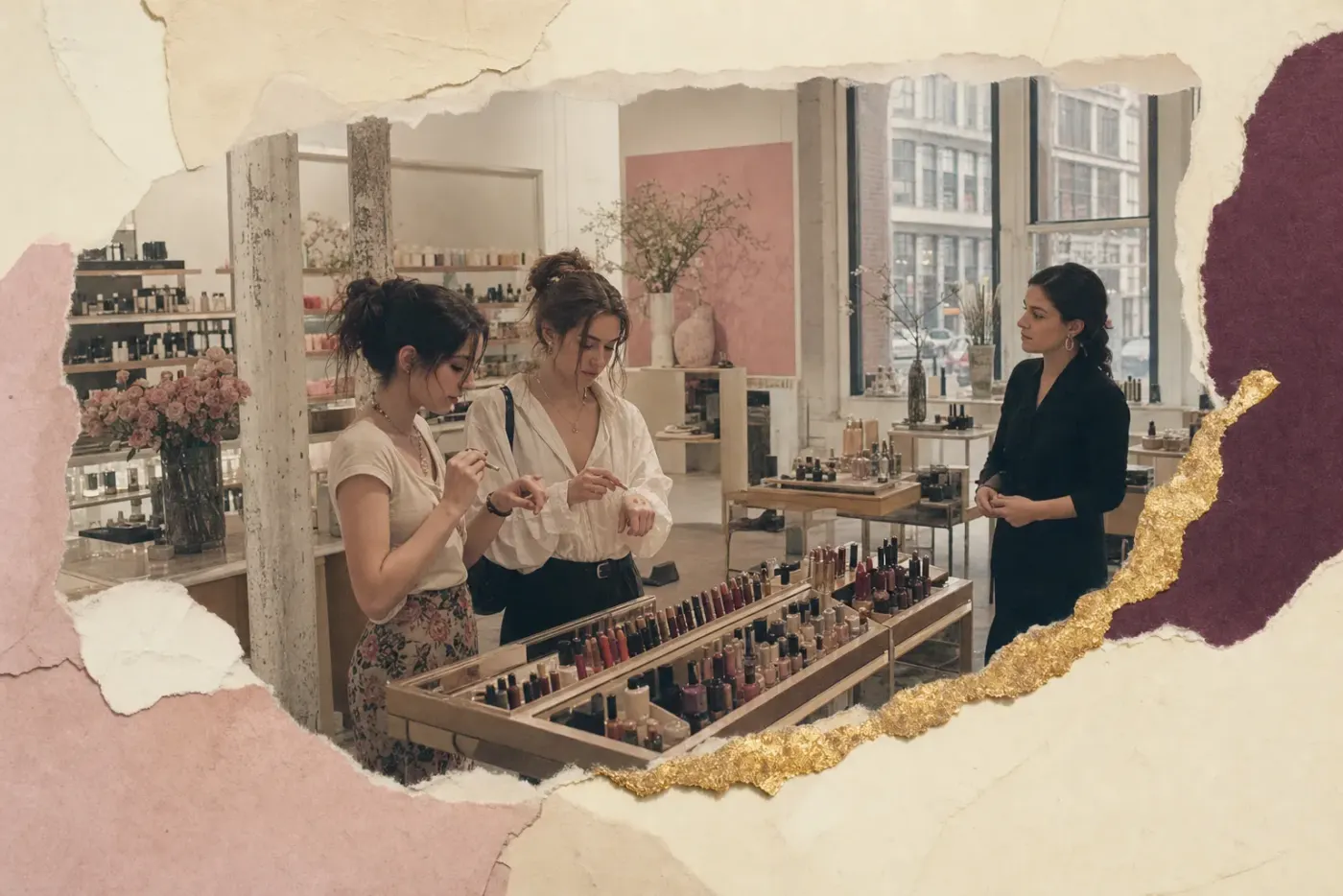
On a Thursday in July 1998 a French chain made its American debut, in the words of the trade paper that covered it, “to the blare of dance music and the ka-ching of cash registers.”[1] Sephora’s store on Broadway in SoHo held 8,100 square feet of perfume and makeup, set out in the chain’s open-sell format, with the products within the customer’s reach.[1][2]
The department-store houses came to the opening party to look at it. Not all of them were sure what they were looking at.
The Counter It Challenged
The model Sephora set itself against was the service counter. In France, as elsewhere in Europe, perfume and cosmetics were sold chiefly through department stores, where the sales staff typically represented a single brand and generally earned commission on what they sold. Self-service had spread through groceries and supermarkets, but not to the perfume counter.[3]
That counter had its own economy of samples and gifts, and at the opening in SoHo the chairman of Estée Lauder would ask how a shop that offered none would compete.[4]
Shop 8
The format came from Limoges. Dominique Mandonnaud opened a single perfume shop there in 1969, and in 1979 a larger store called Shop 8, built on his “assisted self-service” formula: a large, open selling space, products within the customer’s reach, and perfumes and cosmetics arranged by product family rather than by brand, so that rival houses stood side by side on the same shelves.[5]
In September 1993 Mandonnaud’s company bought the Sephora chain, 38 shops largely in the Paris region, from Britain’s Boots for FRF 360 million, about $61 million, and renamed itself and its stores Sephora. A flagship on the Champs-Élysées followed, roughly three times the size of the average shop, and in July 1997 LVMH Moët Hennessy Louis Vuitton bought the business for the equivalent of €344 million.[5]
Broadway
The American launch went to DFS Group, which was adapting the concept for the Americas and Asia-Pacific; it had formed its Sephora development team the previous November, and the first store opened in mid-July.[6] The site was 555 Broadway, in a SoHo that some had taken to calling Skin Row for its cosmetics shops and spas. The store opened with 190 brands and a stated goal of $10 million in sales in its first twelve months.[6][7]
Its executives said the first day beat the plan. Guests at the party the night before, the paper recorded, were “taken aback by the vast size of the store and the massive selection of products.”[6]
The Houses Look On
The established houses were careful. Leonard Lauder, chairman of the Estée Lauder Companies, appeared delighted with the store but questioned how what the paper called its “gift-free merchandising philosophy” would stand up in the malls. “Down here, it will be phenomenal,” he said of SoHo. “But the question is how it is going to fare when it moves into more competitive surroundings — when it’s in malls with department stores and their gift-with-purchase promotions.”[8]
Daniel Brestle, president of Estée Lauder USA and Canada, put it as a trade-off: manufacturers had to decide “if the tradeoff in space and location is worth the exposure.” Frank Toskan of M·A·C, whose cosmetics were not carried at Sephora and sold from a shop a block away, called it “a concept that will take time to prove itself.”[8]
I think it’s going to change the way cosmetics are sold. I love the fact that you don’t know what to buy first.
What the Shelf Changed
It took time, as Toskan had said, but not much by the standards of retail. Sephora.com went live on 14 October 1999, and the first catalogue went out in 2000.[10] By the middle of the next decade the chain had more than 150 stores in the United States.[11]
For the makeup artists’ lines of the 1990s the open shelf became a second route to the customer. NARS has been sold at Sephora in the United States since the late 1990s,[12] and by 2014 Urban Decay was selling about three-quarters of its volume through chains such as Sephora and Ulta.[13] The adviser did not vanish. She became someone the customer could choose to ask.
What Is Not Known
The day of the opening is not quite fixed. The trade paper’s report, dated Friday 17 July 1998, describes a debut “on Thursday”, which would make it the 16th; the same paper’s timeline of 2023 gives 17 July.[14][15]
Nor do the sources agree on when Sephora began. The company history used here dates the chain’s first Paris shop to 1970 and the Sephora name to 1976, while the company’s own description, printed in the same history, calls it a concept “founded in France in 1969”, the year of Mandonnaud’s first shop in Limoges.[16] The sales figures here are goals and estimates reported by the trade press, not audited results, and the executives’ remarks were made at a party.
Sources
- [1, 4, 6, 8, 9, 14]France’s Sephora Makes the SoHo Connection WWD, 17 July 1998, 1998.View source (opens in a new tab) Accessed 2026-10-03.
- [2, 3, 5, 11, 16]Sephora Holdings S.A. International Directory of Company Histories, via referenceforbusiness.com.View source (opens in a new tab) Accessed 2026-09-22.
- [7, 10, 15]A Sephora U.S. Timeline WWD, 30 June 2023, 2023.View source (opens in a new tab) Accessed 2026-10-03.
- [12]How Nars Made Its Orgasm Last 20 Years The Business of Fashion, 19 July 2019, 2019.View source (opens in a new tab) Accessed 2026-09-26.
- [13]Urban Decay’s Metro Moves Orange County Business Journal, 7 September 2014, 2014.View source (opens in a new tab) Accessed 2026-10-03.
Filed under