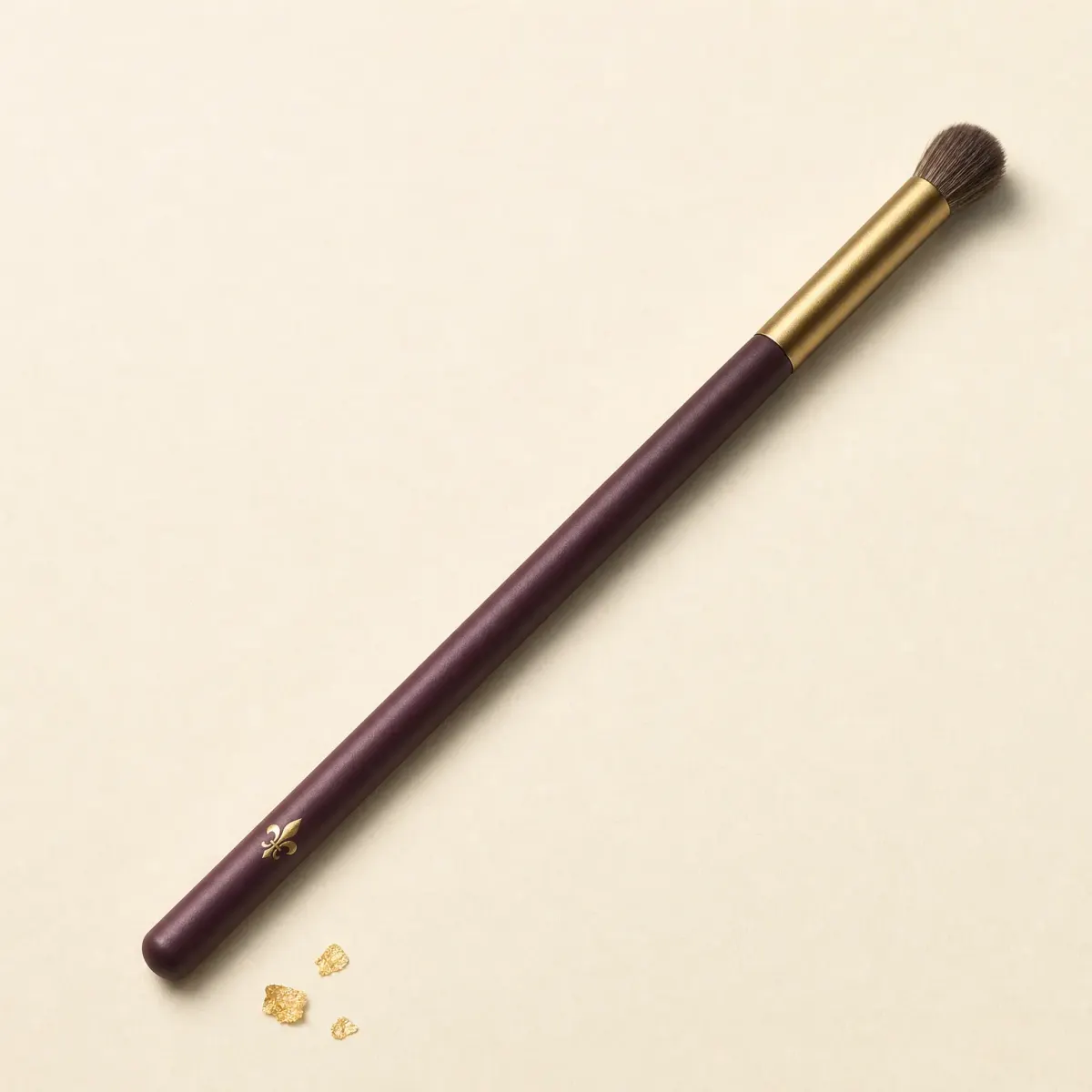
Domed blending brush
A small, rounded, fairly dense eye brush that places colour and softens it in the same stroke. How it differs from the fluffy blender, how to choose and use one — and how a handful of domes became the reference brushes.
A domed blending brush is a small eye brush with a rounded, fairly dense head, used to press eyeshadow into the crease or onto the lid and then soften its edges in small circles.
Our picks
Chosen across the forms of the dense, rounded eye brush, from small tight domes to large soft ones, in goat hair, mixed fibres and synthetic, under whatever name each maker sells it, from drugstore to prestige. Each opens where its maker sells it: on Amazon, or at the house’s own shop; one Australian house ships from its own shop abroad.
As an Amazon Associate I earn from qualifying purchases. Affiliate links — we may earn a commission at no extra cost to you. How this works
Oval blenderPrestige MAC Cosmetics
217 Synthetic Blending Brush
Sold as a blending brush; its densely packed fibres in an oval put it among the domes, for shading or blending powder or cream.
- Densely packed
- Oval shape
- Synthetic
Lid domeDrugstore ColourPop
Medium Dome Brush
An inexpensive medium dome for shadow over the whole lid, for eye primer, or for carving out the brow bone.
- Domed
- Whole lid
Rounded headMid-range Sigma Beauty
E25 Blending Brush
Pat shadow on with the flat of the head, then blend it out with the tip.
- Slightly firm, rounded
- Flattened ferrule
- Synthetic
Goat-hair roundPrestige Hakuhodo
J142BkSLN Eyeshadow Round
The Kumano maker’s round goat-hair eye brush, which it counts among its best-sellers, for base colour, blending and highlight.
- Goat hair
- Round
- Base, blend, highlight
Round-domedDrugstore NYX Professional Makeup
Pro Crease Brush
Sold as a crease brush, but described by its maker as round-domed, for blending colour into the crease.
- Round-domed
- Synthetic
Firm domeMid-range Anastasia Beverly Hills
A3 Pro Brush – Firm Shader Brush
A small, dense dome that packs shadow on the lid, while its tip defines the crease.
- Dome-shaped
- Densely packed
- Synthetic
Densely domedPrestige Hourglass
Nº 9 Domed Shadow Brush
Densely packed, domed bristles for definition with control.
- Domed
- Densely packed
Outer creaseDrugstore L.A. Girl
Domed Crease Brush
An inexpensive dome for blending colour onto the outer crease.
- Dome-shaped
- Outer crease
Large domeMid-range Spectrum Collections
Pantherine A70 Large Domed Shader Brush
A large, soft dome whose tapered shape fits the eye socket, for blending and diffusing.
- Domed
- Tapered dome
- Soft
Dense and roundedPrestige By Terry
Tool-Expert Eye Shader Brush
A dense, rounded head that deposits colour precisely and builds it from a wash to full intensity.
- Dense, rounded head
- Powder, cream or liquid
Pro domeDrugstore Crown Brush
Pro Dome Crease C526
A densely packed, rounded head from a professional brush maker, for blending shadow along the crease and the outer corner.
- Densely packed
- Rounded head
- Crease
Fingertip domeMid-range Bdellium Tools
Golden Triangle 767 Round Blender
A small, dense, rounded head that its maker likens to a fingertip, for blending and for eye bases.
- Small, dense, rounded
- Vegan synthetic
Mixed fibreDrugstore KIKO Milano
Eyes 56 Round Blending Brush
An inexpensive round blender of mixed natural and synthetic fibre, for pressed, baked or loose shadow.
- Round
- Natural and synthetic
Medium domeMid-range Glo Skin Beauty
303 Detail Blender Brush
A medium dome of long, soft bristles for even blending on the lid, the crease and the inner corner.
- Medium domed head
- Long, soft bristles
Budget domeDrugstore e.l.f. Cosmetics
Eye Crease Brush
Named for the crease, but described by e.l.f. as a domed bristle brush, for blending the crease and the corners of the eye.
- Domed bristles
- Crease and corners
Dense ovalMid-range Make-up Designory
#330 Shadow Fluff Brush
A soft oval of dense bristles from a makeup school’s own line, for colour over the lid and definition in the crease.
- Soft oval
- Dense bristles
Rounded budgetDrugstore essence
eyeshadow brush
A soft, rounded head for easy application of powder shadow, at the lowest price here.
- Rounded head
- Powder shadow
Tapered domeMid-range Cinema Secrets
D35 Domed Crease Eyeshadow Brush
A tapered dome from a professional make-up house, shaped to fit the eye’s natural crease.
- Tapered dome
- Natural crease
Round shaderMid-range Rae Morris
Jishaku #7.5 Deluxe Round Shader Brush
A round shader from an Australian makeup artist’s own brushes, for the first wash of colour over the whole lid.
- Round shader
- First wash of colour
A domed blending brush sits between the two eye brushes most people know. It is rounder and denser than a fluffy blender and softer than a flat shader: a small dome of fibres, sometimes a little flattened at the ferrule, that holds enough shadow to leave colour where it first touches and is soft enough to blur the edge afterwards. Pressed into the socket and then circled, it lays a crease shade and diffuses it in a single movement.
Density and shape set it apart from its neighbours. A fluffy blender is loose and tapered and mostly softens; a crease brush is narrower and pointed and draws a line; a smudger is shorter and denser still, made for the lash line. The domed brush is the generalist of the set: a base colour on the lid, a transition shade in the crease, a deeper shade at the outer corner and a highlight under the brow can all be done with it.
Choosing one
Read the maker’s description of the head rather than the name on the handle. Domed, rounded, round or oval, and dense rather than fluffy, is the brush this page is about, and makers sell it under many names: MAC’s 217 is a “blending brush”, Anastasia Beverly Hills’ A3 a “firm shader”, NYX’s and e.l.f.’s domes “crease” brushes. The denser the dome, the more colour it places and the smaller the area it covers; a looser one blends more and places less.
Size follows the lid. A dome about as wide as a fingertip suits most eyes; a small, tight one works deep in a hooded or narrow socket, where a larger head would carry colour up onto the brow bone; a large one lays a base shade quickly. Fibre follows the formula. A dense synthetic dome handles cream shadow and eye base as well as powder, and washes clean; Hakuhodo sells round domes of goat hair for powder, and KIKO Milano one of mixed natural and synthetic fibre. Sigma flattens the ferrule of its E25 a little, so the head is wider than it is thick: pressed flat it covers the lid, and turned on its side it fits the crease.
Test it against your palm. A good dome springs back into its curve after it is pressed and does not splay into a fan; one that does is really a fluffy blender, and will place less colour than you want.
Press, then circle
Pick up shadow by tapping rather than swirling, and knock off the excess. Press the dome into the outer third of the crease, then work it in small circles and short back-and-forth strokes towards the centre of the lid, easing the pressure as you go, so that the colour stays densest where it was first placed. For a quick one-brush eye, lay a mid-tone across the lid with the flat of the dome, deepen the outer corner with a second press, and circle the border until it softens.
The dome works with cream shadow too. Warm a little on the back of the hand, press it onto the lid and tap, rather than circle, until the edge softens; a cream base laid this way under powder keeps the powder’s colour closer to the pan. With glitter or pressed pigment, pat rather than sweep, or the dome will scatter the particles down the cheek.
A dense head can overwork shadow. Too many circles lift colour as well as spreading it, and too much pressure bends the dome out of shape, so let the weight of the brush do the blending. Clean it between light and dark shades by swirling it on a towel, wash it once a week, and dry it lying flat so the dome keeps its curve.
Where it came from
The domed eye brush has no inventor on record, and no source read for this article dates the first one. For much of the twentieth century an eye brush often came free with the shadow: pressed eye shadows, the most popular form in the 1960s, were sold in tablets with a foam-tipped applicator or a small brush,[1] and the V&A keeps the packaging of a Hard Candy eye shadow quartet from about 2000 that still came with both a brush and an applicator.[2]
What can be traced is how a few domed brushes, bought on their own, became reference points. In 2025 Allure called MAC’s 217, with its densely packed fibres shaped into a gentle oval, “the gold standard of blending brushes”, with “enough precision to hit the crease directly while still diffusing powder or cream shadows into the smoothest gradient”.[3] Hakuhodo, the brush maker of Kumano in Japan, describes its round goat-hair J142, for base colour, blending or highlight, as one of the best-selling eyeshadow brushes of all time, and now makes a synthetic version as well.[4]
Those are a magazine’s and a maker’s judgements, not sales figures. The shape itself is easier to see. In the carousel it is sold as a blending brush, a shader and even a crease brush, from drugstore to prestige: whatever each house calls it, it is the eye brush that places colour and softens it with the same touch.
The techniques
- Blend
- Soften an edge until one colour passes into the next without a line.
- Pack
- Pat colour onto the lid for full, dense payoff rather than sweeping it.
Sources
- [1]Eye Shadow Cosmetics and Skin, 2019.View source (opens in a new tab) Accessed 2026-09-26.
- [2]Hard Candy, packaging for an eye shadow quartet, Hard Candy Cosmetics, United States, about 2000, museum number E.71:1 to 4-2002View source (opens in a new tab) Accessed 2026-09-26.
- [3]Great Eye Shadow Brushes Could Make All the Difference—Here Are Our Go-Tos Allure, 20 December 2025, 2025.View source (opens in a new tab) Accessed 2026-09-26.
- [4]J142BkSLN Eyeshadow Round [HC0620] Hakuhodo USA.View source (opens in a new tab) Accessed 2026-09-26.
What it is used with
Other kinds of eye brushes
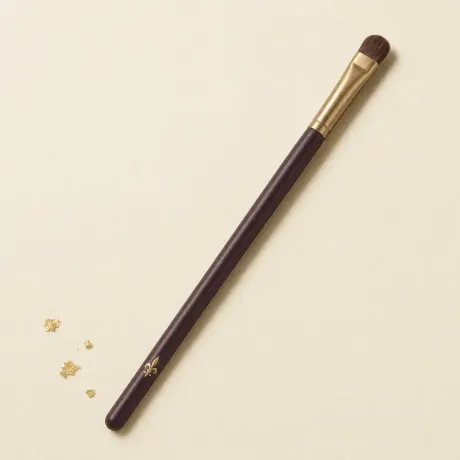
Flat shader brush
A flat eye brush with firm bristles and a rounded edge, for packing colour onto the lid.
Read the guide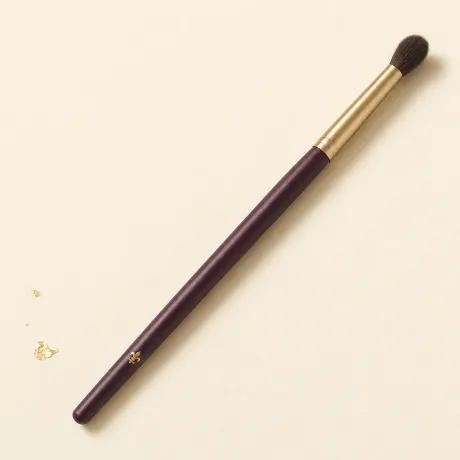
Fluffy blending brush
Long, loose bristles rising to a soft point — the brush that removes edges.
Read the guide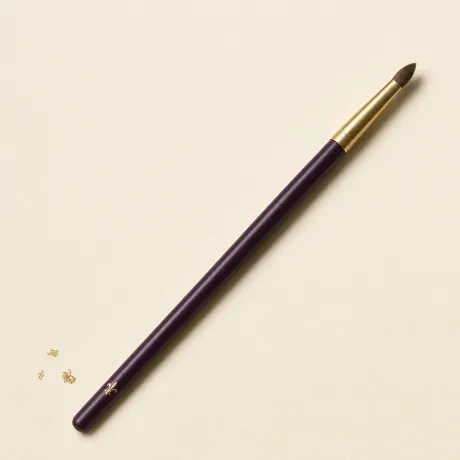
Crease brush
A small, tapered, pointed brush that fits into the socket line.
Read the guide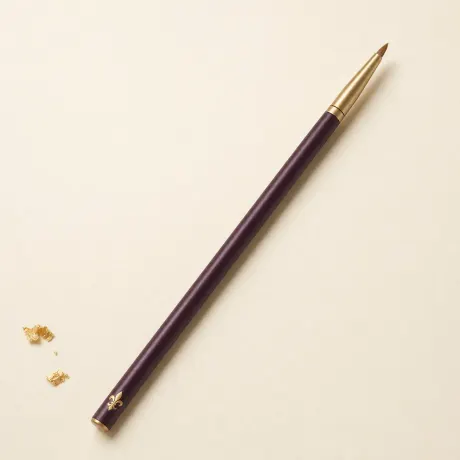
Pencil brush
Tightly packed bristles shaped to a firm point, for detail along the lash line and in the inner corner.
Read the guide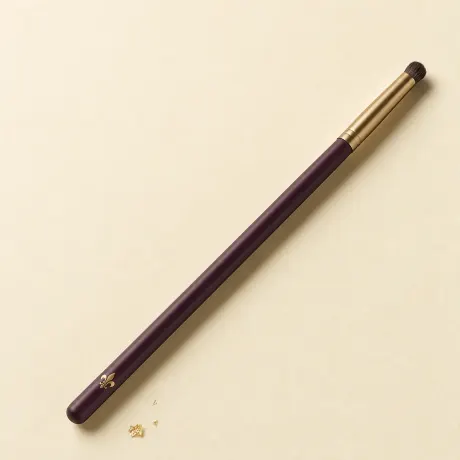
Smudger brush
A short, very dense, slightly domed tuft on a slim eye-brush handle — made to press liner and shadow into the lash line and soften it into smoke.
Read the guide
Angled shading brush
An eye brush cut on an angle, for deepening the outer corner.
Read the guide