Angled shading brush
An eyeshadow brush cut on a slant, made to lay depth into the outer corner and blend it along the crease. How to choose one, how to shade the outer corner — and the stage trick of lengthening the eye that it inherited.
An angled shading brush is an eyeshadow brush whose head is cut on a slant, used to place deeper shadow in the outer corner of the eye and blend it inward along the crease.

Our picks
Every house found selling a single angled eyeshadow brush whose page could be verified, one brush each, in goat hair, mixed fibres and synthetic, from drugstore to prestige, among them two brushes made in Kumano. Few prestige houses make one; most sell domed or tapered eye brushes instead. Each opens at the maker’s own shop; one Australian house ships from its own shop abroad.
Affiliate links — we may earn a commission at no extra cost to you. How this works
Goat hairPrestige Hakuhodo
J125BkSLN Eyeshadow Round & Angled
From the Kumano maker Hakuhodo: goat hair cut to an angle its maker designed for smudging and contouring shadow.
- Goat hair
- Round and angled
- Powder
Budget angleDrugstore Milani
Angled Buffing Eyeshadow Brush
An inexpensive angled brush for contouring shadow and defining the crease, then smoking and blending it out.
- Angled
- Crease definition
Crease and cornersMid-range Bdellium Tools
Golden Triangle 766 Angled Shadow
An angled synthetic brush for placing shadow in the crease and the corners of the eye.
- Angled
- Vegan synthetic
- Crease and corners
Fluffy slopeMid-range Graftobian
OMNIA® Angle Shader Brush
A fluffier angle for soft washes of colour and diffused edges, from a professional make-up house.
- Sloped edge
- Rounded tip
- Vegan fibres
Angled creasePrestige Trish McEvoy
Brush 23 Place & Define
An angled crease brush of goat hair, swept inward from the outer crease and buffed to soften the edges.
- Angled
- Goat hair
- Crease and outer corner
Mixed fibreDrugstore KIKO Milano
Eyes 59 Slanted Blending Brush
An inexpensive slant of mixed fibres for shading the crease and the outer corner, or the whole lid.
- Slanted
- Natural and synthetic
Small angleMid-range Jenny Patinkin
Sustainable Luxury Angled Multi-Blender Brush S
A small angled blender that its maker lines up at the outer corner to stamp a deeper shade and lift it upward.
- Small, angled
- Semi-dense
Socket blenderMid-range Rae Morris
Jishaku #6.5 Angle Eye Blender Brush
An Australian makeup artist’s angled blender for softening shadow from the socket up towards the brow bone.
- Angled
- Socket to brow bone
Outer cornerDrugstore Crown Brush
Angle Shader Brush SS026
Shaped to fit the contours of the eye, for packing and blending powder in the outer corner.
- Semi-dense synthetic
- Outer corner
Multi-taskerMid-range Ofra Cosmetics
Brush #8883 - Angled Eye
An angled brush for detail in the outer corner, transition shades or an all-over wash.
- Angled
- Outer corner or lid
SlopedMid-range rephr
brush 36
A dense, soft, sloped brush handmade in Kumano, by its maker’s account, for one-and-done shadow.
- Sloped
- Natural fibres
- Made in Kumano
An angled shading brush is an eyeshadow brush with its tip cut on a slant. The long side of the slant reaches into the outer corner of the eye and the socket above it; the short side sits against the lid. Set into the corner, it leaves a wedge of deeper colour exactly where the eye turns away from the light; swept inward along the crease with the flat of the cut, it softens that wedge into the lid. One brush places the depth and blends it, and that is the reason for the angle.
It is not a liner. An angled liner brush is thin, stiff and small, cut to draw a line along the lashes; an angled shader is fuller and softer, cut to place and blend shadow. Among the other eye brushes, a flat shader packs colour onto the lid, a domed brush places and softens it, and a crease brush lays a tapered line in the socket. The angled brush is the one shaped for the outer corner, the part of the eye that does most to change its apparent shape.
Choosing one
Look at size and density first. A small, semi-dense head, like Jenny Patinkin’s Angled Multi-Blender S, places colour precisely and suits smaller or hooded eyes, where there is little room between the lashes and the brow. A fluffier one, like Graftobian’s OMNIA angle shader, washes colour over the lid and diffuses it, and suits deep-set eyes with space to work. The steeper the angle, the finer the point it makes in the corner. Where you hold it matters too: gripped near the end of the handle, the brush blends more softly; held close to the ferrule, it places colour more precisely.
Then the fibre. Synthetic fibre handles cream shadow and eye primer as well as powder, and rinses clean. Hair holds powder and lets it go softly: Hakuhodo, in Kumano, makes its J125 of goat hair and says its angle was designed for smudging and contouring, Trish McEvoy makes its Brush 23 of goat hair too, and KIKO Milano mixes natural and synthetic fibres in its Eyes 59.
Finally, check the edge. The cut should be clean and even, and it should spring back to its line after you press it against your hand. An angled brush whose fibres have splayed has lost its edge, and with it the reason to own one; a tired one can still blend, but it can no longer draw the corner.
Shading the outer corner
Start with a transition shade already blended through the crease. Pick up a little of the deeper shade on the long side of the brush, tap off the excess, and set the point of the cut in the outer corner, with the slant running up towards the end of the brow. Press, then sweep the brush inward along the crease about a third of the way across the lid, keeping the long edge in the socket. That lays a sideways V, deepest at the corner and fading as it goes in.
Soften the edges before adding more colour. Turn the brush so that the flat of the cut lies against the lid, work in small movements where the V meets the lid shade, then let what remains on the brush run along the outer third of the lower lashes to join the two. On hooded eyes, place the V a little above the natural fold, looking straight into the mirror with the eye open, so that it shows when the lid is relaxed.
Two mistakes account for most heavy corners: a dark shade carried too far towards the nose, which closes the eye instead of lengthening it, and a V left as two hard lines. Keep the depth in the outer third, build it in thin layers, and wash the brush weekly, drying it lying flat so that the cut keeps its angle.
Where it came from
Lengthening the eye at its outer corner was a stage trick long before a brush was cut for it. James Young’s Making Up, a manual for actors published in New York in 1905, had a line drawn under the lower lashes and another over the upper ones, and then, “from the outer corner of the eye draw two lines to form an angle”. The eyes, he wrote, “may be made larger by extending the lines around the eye, top and bottom, beyond the outer corner, to form a triangle; the space in between will be white and will, from the front of the theatre, look as though it were part of the eye.”[1]
The brush cut to an angle is harder to date, and nothing read for this page names a first. One patent shows the reasoning behind it. Granted to Young-soo Park in 1995, from an application first filed in 1990, it listed the brushes a salon artist or a model had to carry, some “for providing gradations” and others “for providing sharp lines”, and proposed a single brush whose tuft came to an acute angle, able to give both.[2]
That is still how the angled shader works. Its point places the corner, as the stage drew it, and the flat of the cut blends it into a shadow that no longer looks drawn.
The techniques
- Blend
- Soften an edge until one colour passes into the next without a line.
- Pack
- Pat colour onto the lid for full, dense payoff rather than sweeping it.
Sources
- [1]Making Up M. Witmark & Sons, New York; digitized by the Internet Archive, 1905.View source (opens in a new tab) Accessed 2026-09-26.
- [2]US Patent 5,450,865 — Makeup brush United States Patent and Trademark Office, 1995.View source (opens in a new tab) Accessed 2026-09-26.
What it is used with
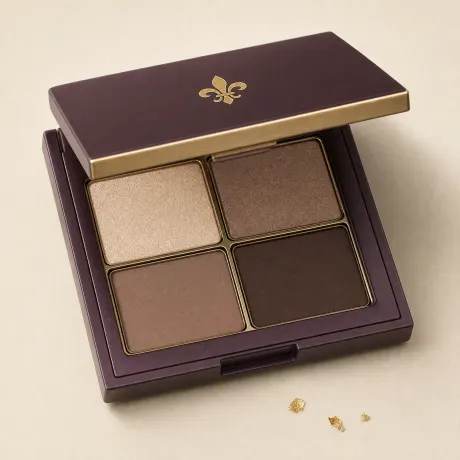
Other kinds of eye brushes
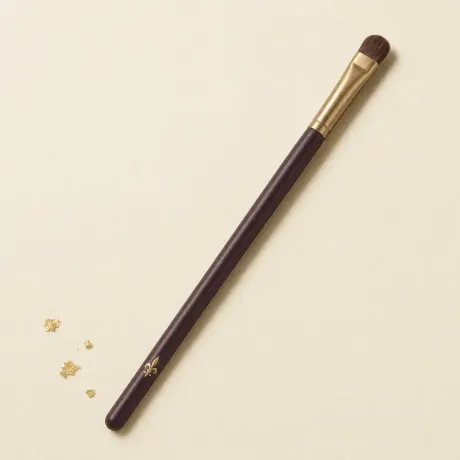
Flat shader brush
A flat eye brush with firm bristles and a rounded edge, for packing colour onto the lid.
Read the guide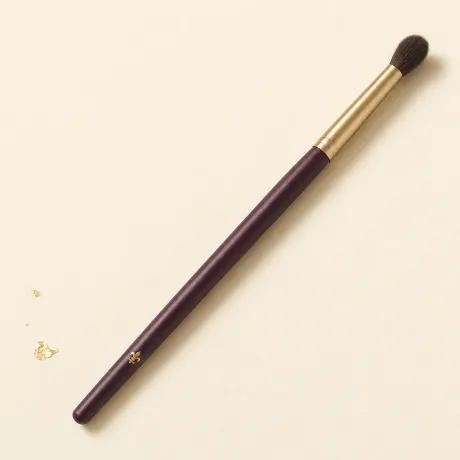
Fluffy blending brush
Long, loose bristles rising to a soft point — the brush that removes edges.
Read the guide
Domed blending brush
A rounded eye brush of medium density that both places and diffuses colour.
Read the guide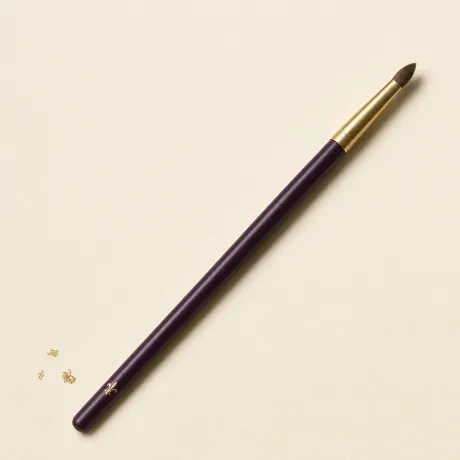
Crease brush
A small, tapered, pointed brush that fits into the socket line.
Read the guide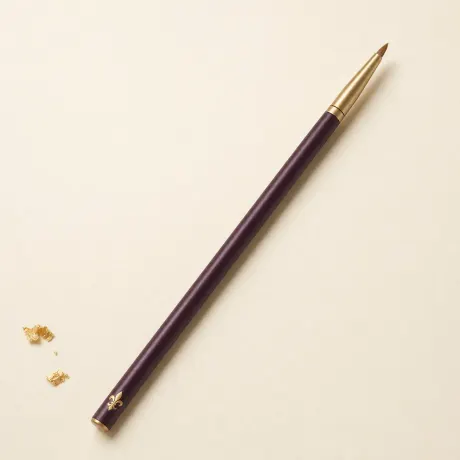
Pencil brush
Tightly packed bristles shaped to a firm point, for detail along the lash line and in the inner corner.
Read the guide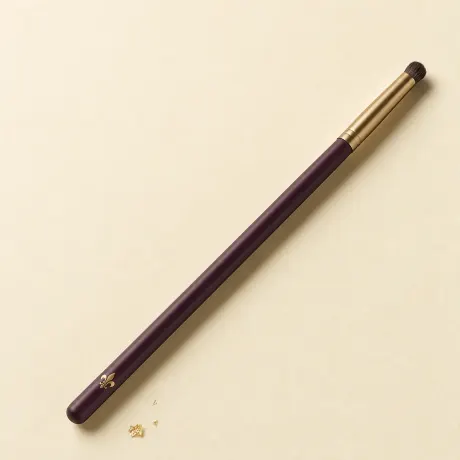
Smudger brush
A short, very dense, slightly domed tuft on a slim eye-brush handle — made to press liner and shadow into the lash line and soften it into smoke.
Read the guide