Angled contour brush
A dense brush cut on a slant, made to lay shadow into the hollow beneath the cheekbone. How to choose one by density and fibre, how to place and blend with it, and how the draughtsman’s stump became a brush.
An angled contour brush is a fairly dense face brush cut on a sharp slant, laid into the hollow beneath the cheekbone, along the jaw or at the temple to place contour and blend its upper edge into the skin.

Our picks
Chosen across the slant and the density, from soft powder brushes to firm ones for cream, in synthetic fibre and in hair, and from drugstore to prestige. Few prestige houses make a contour brush cut on an angle; theirs are rounded or tapered, and belong on other pages. Each opens where its maker sells it: on Amazon, or at the house’s own shop.
As an Amazon Associate I earn from qualifying purchases. Affiliate links — we may earn a commission at no extra cost to you. How this works
Rounded slantPrestige Laura Mercier
Angled Cheek Contour Brush
A slanted head rounded to follow the angle of the cheekbone, for a soft contour that stops short of a line.
- Slanted, rounded
- Contour and highlight
Cheek-huggingDrugstore Real Techniques
Cheek Hugging Contour Brush
An inexpensive sloped head that fits the curve of the cheek, for placing contour or bronzer exactly.
- Sloped, angled
- Synthetic
- Liquid or cream
Soft everydayMid-range Sigma Beauty
F23 Soft Angle Contour Brush
A fluffy angled head for a gentle everyday contour in powder, and the easiest of these to use lightly.
- Soft, angled
- Powder
- Sheer to medium
Cream stampingDrugstore Morphe
M243 Slanted Cream & Liquid Contour Brush
A firm, flat slant for stamping cream or liquid contour into place before it is blended.
- Very dense
- Firm, flat tip
- Cream and liquid
Squirrel and goatPrestige Hakuhodo
G512BkSL Contour Angled
The Kumano maker’s angled contour brush in squirrel and goat hair, used, it says, with light strokes as if lifting excess powder away.
- Blue squirrel and goat
- Powder
Natural fibreMid-range Anastasia Beverly Hills
A18 Pro Brush – Angled Chiseler Brush
A large slanted brush of natural fibres, sold for sculpting with powder.
- Large, slanted
- Natural fibres
- Powder
Compact proDrugstore Crown Brush
Pro Angled Contour C532
A compact, dense slant from a professional brush maker, for a stronger contour at medium to full coverage.
- Compact, dense
- Synthetic
- Powder or cream
Plush angleMid-range Fenty Beauty
Face Shaping Brush 125
A plush angled brush for sculpting, which the house also sells for blush, bronzer and highlighter.
- Plush, angled
- Cream or powder
Budget sculptDrugstore ColourPop
Angled Sculpting Brush
An inexpensive angled brush sold for contour, and made to partner the house’s Bronze Stix.
- Angled
- Contour brush
Two anglesPrestige Trish McEvoy
Brush 81 Place & Define
An angled head for the cheek and an angled precision tip for smaller areas, on one handle of dense natural bristles.
- Dual-ended
- Natural bristles
Slanted veganMid-range Bdellium Tools
Golden Triangle 942 Slanted Contour
A slanted head that hugs the cheekbone, from a professional brush maker, which also sells it for setting powder under the eyes.
- Slanted
- Vegan synthetic
Plush budgetDrugstore wet n wild
Contour Brush
A plush angled brush at the bottom of the price range, shaped to fit the contours of the face.
- Plush, angled
Cream sculptMid-range ILIA
Sculpting Brush
Angled vegan bristles that flex with the face, sold for cream and liquid bronzer and highlighter.
- Angled
- Vegan bristles
- Creams and liquids
JawlineDrugstore KIKO Milano
Face 15 Sculpting Brush
A compact brush with an angled tip, sold for tracing the jaw and the underside of the cheekbone.
- Angled tip
- Compact
- Liquid, cream, powder
Chiselled cheekMid-range Tarte
Sculpting Cheek Brush
An angled cheek brush sold for sculpting rather than blush: chiselling the cheek and adding definition.
- Angled
- Sculpting
Concave cutDrugstore L.A. Girl
Angled Face Brush
A slanted head with a concave cut, sold for a sculpted, defined look at a drugstore price.
- Slanted, concave
Baked formulasMid-range Laura Geller
23 Sculpting Face Brush
A dense angled brush sold for cream, powder and baked formulas alike, all three of which the house makes.
- Angled
- Dense, plush
- Cream, powder, baked
An angled contour brush is a face brush of middle size, denser than a blush brush, whose head is cut on a slant so that one side is noticeably longer than the other. The slant is the point of it. Laid against the face, the long side runs along the hollow beneath the cheekbone and the short side sits above it, so the brush puts contour where a shadow would fall and keeps it from creeping up onto the bone. The density decides how much colour it carries: enough to lay down a band of shadow in one pass, not so much that the band cannot be blended.
Its neighbours look alike and do different work. An angled blush brush is fluffier and looser, made to diffuse colour over the apple and along the bone. A bronzer brush is larger still, for warmth across the broad planes of the face. A tapered sculpting brush comes to a point rather than an edge, and a nose contour brush is a small version of either, for the narrow places. The angled contour brush is the one for the cheekbone, the jaw and the temple.
Choosing one
Start with density. A firm, closely packed head, such as Morphe’s paddle-like M243 or Crown’s compact C532, stamps down a clear band of cream or liquid contour to be blended afterwards. A softer, fluffier one, such as Sigma’s F23, sweeps on a sheer shadow of powder that needs little blending at all, and is much harder to overdo; for a first contour brush, choose the softer kind. Then look at the cut. A sharp slant places a crisp shadow; a gentle one, like Laura Mercier’s slanted, rounded head, follows a rounder cheekbone and leaves a softer edge.
Choose the fibre by the formula. Synthetic fibre is not porous, so it suits cream, liquid and stick contour and washes clean. Hair grips and diffuses powder well, and some houses still use it: Anastasia Beverly Hills makes its A18 of natural fibres for powder, and Hakuhodo cuts its contour brush from blue squirrel and goat. Size should follow the face. On a narrow face or a small cheekbone, a large head spreads the shadow onto the cheek; a compact one keeps it in the hollow.
Placing and blending
Find the hollow first: draw in your cheeks a little, or feel with a fingertip for the underside of the cheekbone. Tap the brush into the contour and knock off the excess, then lay the angle into the hollow with the long side towards the ear and the short side up towards the bone. Start near the ear and stop in line with the outer corner of the eye; a shadow carried further forward drags the face down.
Blend the upper edge in small back-and-forth strokes along the bone rather than across it, so the colour fades upward into the skin. Use what is left on the brush just under the jawbone, and at the temple near the hairline. With cream or liquid, press the product on with the flat of the angle first and blend at once, before it sets; with powder, sweep lightly and build a second layer only where the shadow needs to be deeper. Then step back and look at arm’s length, by a window: a contour that looks right close up often reads as a stripe from across a room.
Keep this brush for shadow. A brush that has carried contour muddies a highlighter, and one that has carried bronzer warms a shadow that should stay cool. Wash it after cream or liquid and at least weekly with powder, and dry it on its side so the angle keeps its line.
Where it came from
Before there was a contour brush there was the stump. Charles Townsend’s Make-up Book of 1899 recommended artists’ stumps to actors for drawing their lines, noting that they “cost but a trifle and save the waste made in sharpening the lining colors”.[1] The stump came from the draughtsman’s box: a cigar-shaped roll of leather, paper or felt, often pointed at both ends, used in drawing to blend and smudge charcoal, chalk or pastel.[2] It could draw a line and then soften it, which is exactly what shading a face asks for.
When contouring moved from the stage to the dressing table, the kits sold for it could come with brushes of their own. Max Factor’s Geminesse, an up-market line launched in 1966 and sold only through selected department stores, included highlighters and shadows to contour the face, an idea that, the historian James Bennett notes, the company had helped originate in the 1930s. Its Contour Supreme was “a trio of subtle highlights and shadows, with an outliner and fill-in brush”.[3] Outline first, then fill: the stage method, sold in a compact.
The angled brush does both jobs with one head: its edge places the shadow and its body softens it. Hakuhodo, the brush maker of Kumano in Japan, tells buyers of its angled contour brush to “use light strokes as if you are removing excess product”.[4] That is the whole technique in a sentence, and it is what the stump was for: to put a shadow exactly where it belongs, and then make its edge disappear.
The techniques
- Contour
- Shade beneath the bone to make it recede, then soften the top edge.
- Blend
- Soften an edge until one colour passes into the next without a line.
Sources
- [1]Make-up Book, or, Guide to the Stage Henry J. Wehman, New York; digitized by the Internet Archive, 1899.View source (opens in a new tab) Accessed 2026-09-26.
- [2]stumps, Art & Architecture Thesaurus J. Paul Getty Trust.View source (opens in a new tab) Accessed 2026-09-26.
- [3]Max Factor (post 1960) Cosmetics and Skin, 2013.View source (opens in a new tab) Accessed 2026-09-25.
- [4]G512BkSL Contour Angled [HC0313] Hakuhodo USA.View source (opens in a new tab) Accessed 2026-09-26.
What it is used with
Other kinds of cheek & sculpting brushes
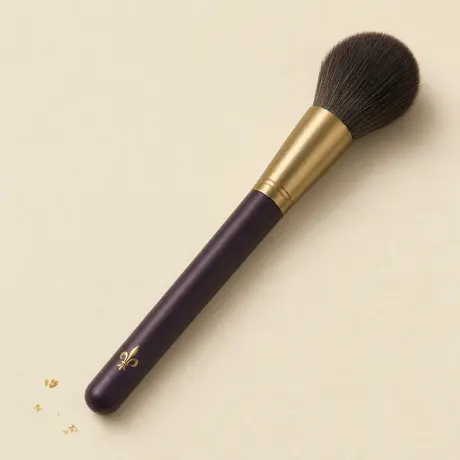
Blush brush
A medium, soft, domed brush sized to the apple of the cheek.
Read the guide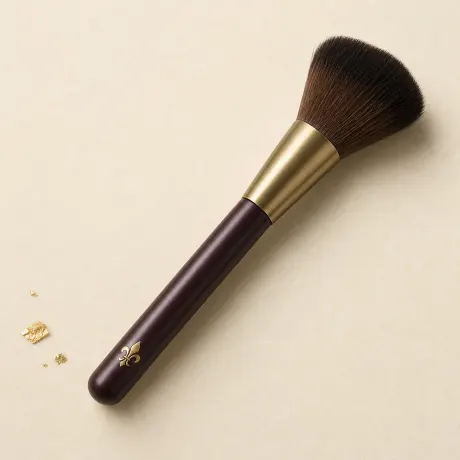
Angled blush brush
A fluffy brush cut on a slant to follow the cheekbone.
Read the guide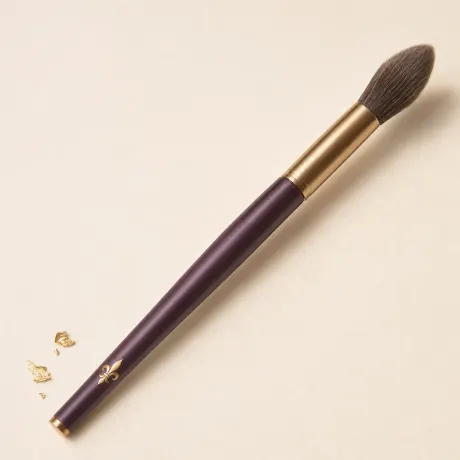
Tapered sculpting brush
A narrow, oval head that tapers to a soft point, for placing shadow exactly and blending it out.
Read the guide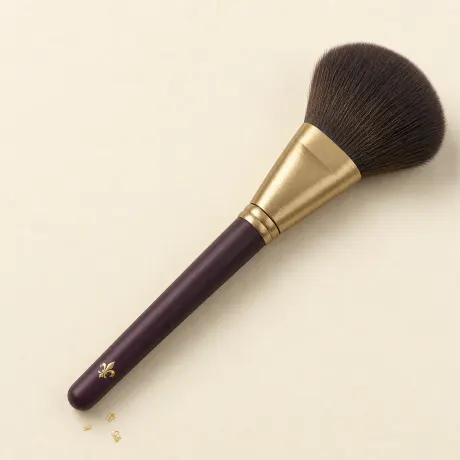
Bronzer brush
A large, loose, slightly flattened brush that diffuses warmth over a wide area.
Read the guide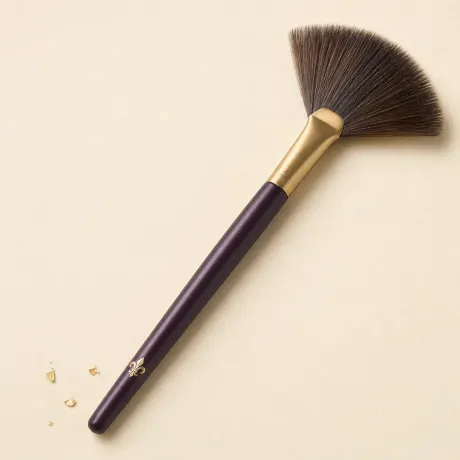
Fan brush
A thin arc of bristles — the lightest touch in the kit — for highlighter and for dusting away fallout.
Read the guide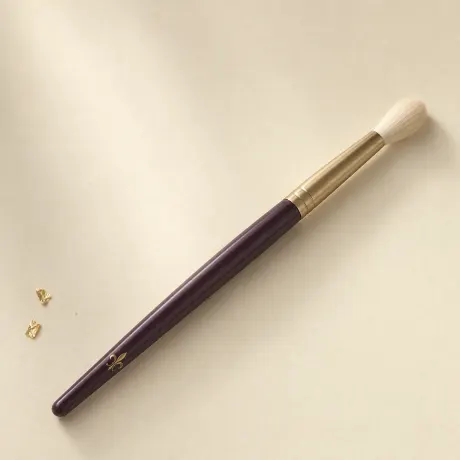
Tapered highlighter brush
A small, soft, pointed brush that puts highlight exactly on the high point.
Read the guide
Nose contour brush
A small, dense, tapered brush for shading narrow areas: the sides of the nose, the hairline, the crease of the chin.
Read the guide