Nose contour brush
A small, dense brush, angled or tapered, for shading the narrow places a cheek brush cannot reach. How to choose one, how to shade a nose without drawing stripes, and the stage lines it descends from.
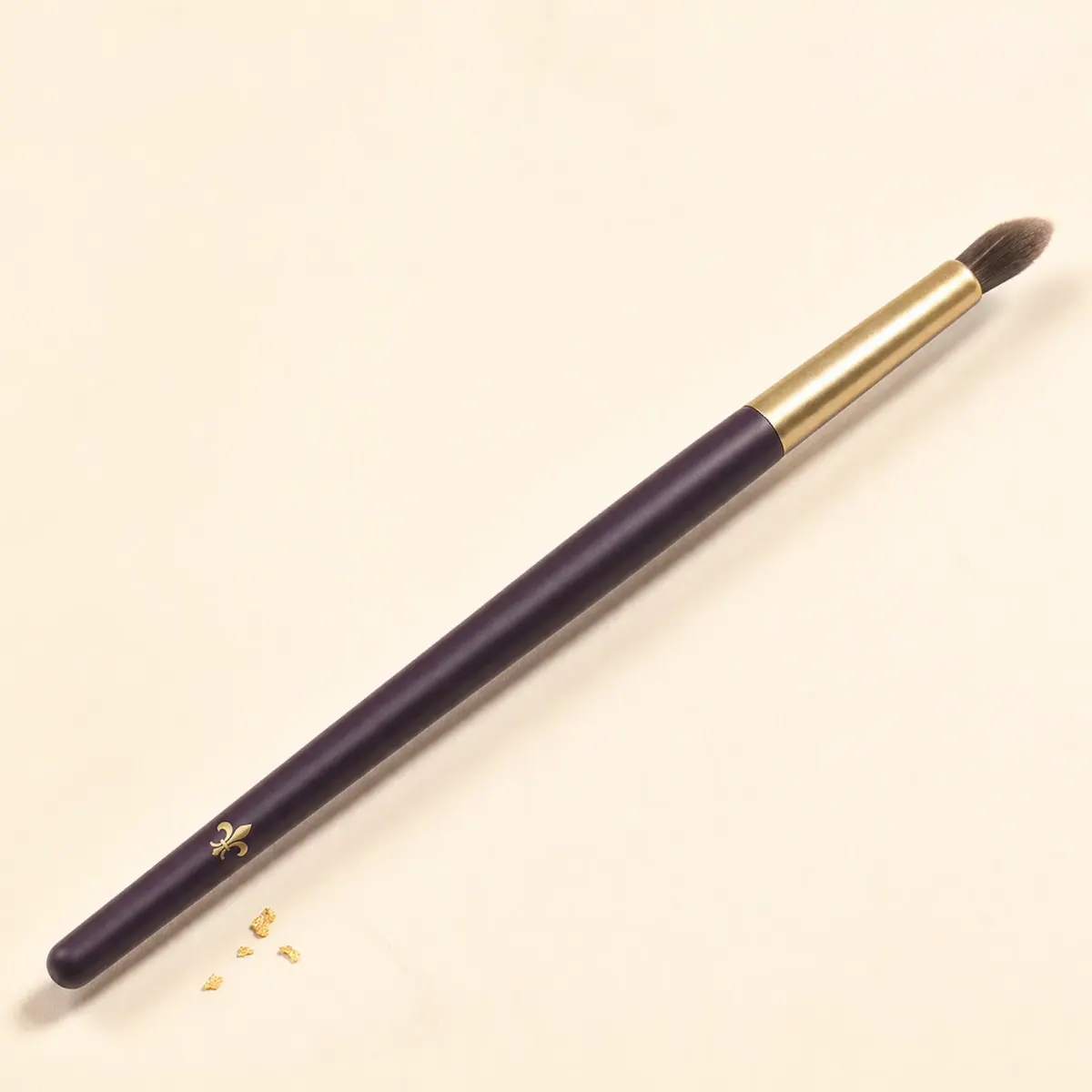
A nose contour brush is a small, fairly dense brush, angled or tapered, used to draw a soft shadow down the sides of the nose and blend it out, and to place contour in other narrow places such as the hairline and the crease of the chin.
Our picks
A brush made and sold for the nose is a recent and narrow kind of tool, and few houses make one. These are the five whose makers sell them for the nose or for fine contour in narrow places, angled and tapered, single and dual-ended, in synthetic fibre and in squirrel hair. Each opens where its maker sells it: on Amazon, or at the house’s own shop.
As an Amazon Associate I earn from qualifying purchases. Affiliate links — we may earn a commission at no extra cost to you. How this works
Cream and powderMid-range Patrick Ta
Major Sculpt Dual-Ended Precision Brush
A makeup artist’s dual-ended brush for fine contour on the nose, with cream or powder.
- Dual-ended
- Nose and eyelids
- Cream and powder
Place and blendDrugstore e.l.f. Cosmetics
Dual-Ended Nose Contour Brush
An inexpensive two-ended tool made for the nose alone: the angled end draws the shadow and the fluffy end blends it.
- Dual-ended
- Angled end
- Fluffy end
Squirrel hairMid-range Piccasso
201 Nose Shading Brush
A small, softly slanted brush of squirrel hair from a Korean brush maker, sold for shading the nose with powder.
- Grey squirrel hair
- Small, slanted
- Bridge, tip and sides
Pointed detailDrugstore Crown Brush
Pro Detail Powder / Contour Brush C530
A small, pointed brush from a professional maker, for contour and powder in the corners of the nose.
- Small, pointed
- Tapered cut
- Powder
Flat slantMid-range Bdellium Tools
Studio 939 Slanted Detailer
A small, flat slant that reaches the crevices beside the nose, and works in the hollows of the cheeks too.
- Small, flat, angled
- Vegan synthetic
- Nose and cheeks
A nose contour brush is a small, fairly dense brush, angled or tapered, with a head about the width of a fingertip or less. It exists because a nose is narrow. A cheek brush laid down the side of the nose puts shadow on the cheek as well, and a fingertip smears it; a small brush can draw a soft line exactly where the side of the nose turns away from the light, and then blend it until only the shade is left. The same brush shades the hairline, the crease under the lower lip and the corners of the jaw.
It is a small version of the contour brushes beside it. An angled contour brush and a tapered sculpting brush do the cheekbone and the jaw; the nose brush does the places they are too big for. Some nose brushes are dual-ended, with a firm end to place colour and a fluffier one to blend it, which suits a job that is almost all blending. A small concealer brush can look similar, but it is flat and made to press product on, not to draw a line and soften it.
Choosing one
Size comes first: the head should be narrower than the side of your nose, or the shadow will spread. Then the cut. A small angled or slanted brush, such as Piccasso’s 201 or Bdellium’s 939, lays an even line down the side of the nose with its edge; a small pointed one, such as Crown’s C530, places colour in the corner beside the nostril and blends in small circles. A dual-ended brush, like e.l.f.’s or Patrick Ta’s, saves swapping tools: one end to place, the other to soften.
Match the fibre to the formula. For cream or stick contour, use synthetic fibre, which does not soak up the product and gives a cleaner line; for powder, hair or synthetic will do, and Piccasso makes its 201 of grey squirrel hair for powder. Firmness matters more than on a cheek brush: a head that bends too easily wanders off the line, while one too stiff drags the colour into a stripe.
How to shade a nose
Use a contour shade only a little deeper than your skin, and very little of it. Start where the side of the nose meets the inner corner of the brow and draw a soft line down each side to just above the nostril, following the nose rather than a straight edge. Blend each line outward, towards the cheek, until it has no edge; the bridge between the two lines stays untouched, so the nose reads as lit down the centre and shaded at the sides. To shorten a long nose, touch a little shadow under the tip and blend it away.
Then check it from the side and in daylight. A line that looks right face-on in a bathroom mirror can look like a streak of dirt in profile or outdoors, and a nose shaded too far round onto the cheek looks broader, not narrower. If the shadow shows as a line, go over it with a clean brush or a damp sponge until it softens. A bump or a wide bridge follows the same rule: shade where the nose should recede, leave light where it should come forward, and use nothing you could see from across a room.
Keep a nose brush clean. A small head holds little, and yesterday’s contour or concealer left in it muddies the line; wash it after every use with cream and weekly with powder.
Where it came from
The stage shaded noses with painted lines, and wrote down how. James Young’s Making Up, published in New York in 1905, advised “thin, straight lines of white down the bridge of the nose”, with the sides shaded “very lightly” in grey, and explained what a white line down the top of the nose does: it “will add to its conspicuousness, as well as make it appear thinner; especially if the sides are slightly shaded with gray”. The tools the same book lists for such work are artists’ stumps, “stumps of paper and leather for making and blending wrinkles and lines”.[1]
An actor saw the limit of the trick. “An almost white line on the bridge of the nose seems to give this feature additional prominence when the actor looks directly toward you,” Cavendish Morton wrote in 1909, “but on getting a view of his profile this illusion disappears.” To change a nose in earnest he built it up with nose paste.[2]
When contouring became a public fashion, the nose was one of the places it went wrong. A Toronto makeup artist told The Globe and Mail in 2015 that people’s noses often “look dirty”; the same article recorded a Revlon trainer’s account of contouring used for years to “narrow their noses”, under an industry ideal of an oval face and a dainty nose.[3] The small brush answers the first problem: synthetic fibre, one brush patent filed in 2019 notes, can be cut to a more precise angle for small detail brushes than natural hair.[4] The second is a question of aim. A nose is shaded best to bring out its own shape, seen face-on and in profile, not to borrow someone else’s.
The techniques
- Contour
- Shade beneath the bone to make it recede, then soften the top edge.
- Blend
- Soften an edge until one colour passes into the next without a line.
Sources
- [1]Making Up M. Witmark & Sons, New York; digitized by the Internet Archive, 1905.View source (opens in a new tab) Accessed 2026-09-26.
- [2]The Art of Theatrical Make-up A. and C. Black, London; Project Gutenberg eBook #56617, 1909.View source (opens in a new tab) Accessed 2026-09-26.
- [3]From on-stage to on-trend, contouring has gone mainstream (and you can thank Kim Kardashian) The Globe and Mail, 27 March 2015, 2015.View source (opens in a new tab) Accessed 2026-09-26.
- [4]US Patent 10,966,513 B2 - Synthetic goat hair brush United States Patent and Trademark Office, 2021.View source (opens in a new tab) Accessed 2026-09-26.
What it is used with
Other kinds of cheek & sculpting brushes
Blush brush
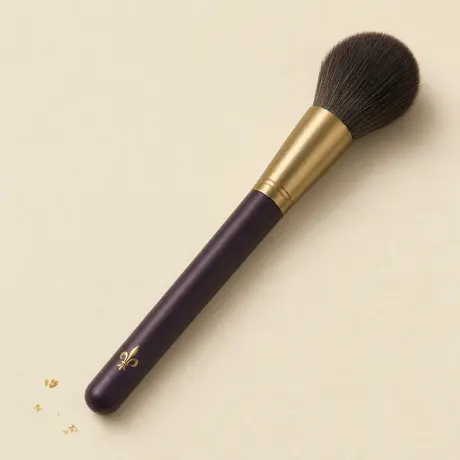
A medium, soft, domed brush sized to the apple of the cheek.
Read the guide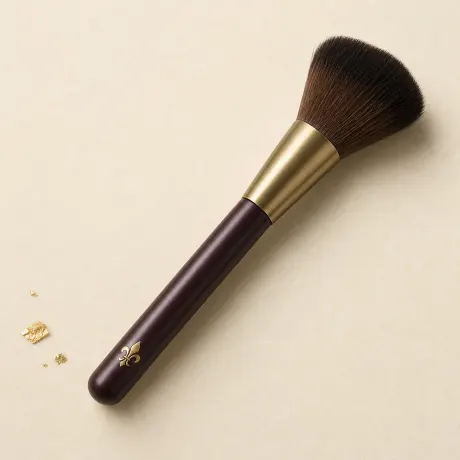
Angled blush brush
A fluffy brush cut on a slant to follow the cheekbone.
Read the guide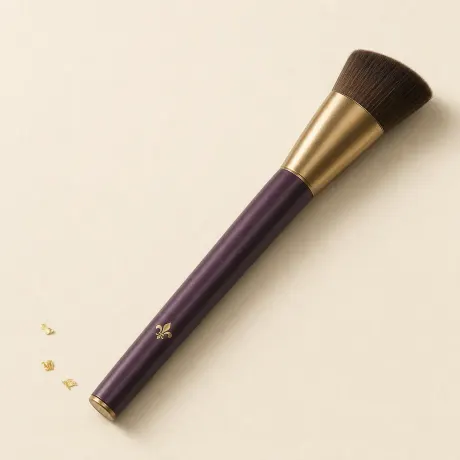
Angled contour brush
A denser brush cut on a sharp slant, for laying contour into the hollow of the cheek.
Read the guide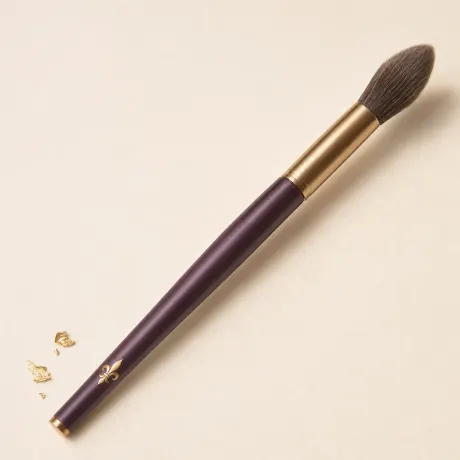
Tapered sculpting brush
A narrow, oval head that tapers to a soft point, for placing shadow exactly and blending it out.
Read the guide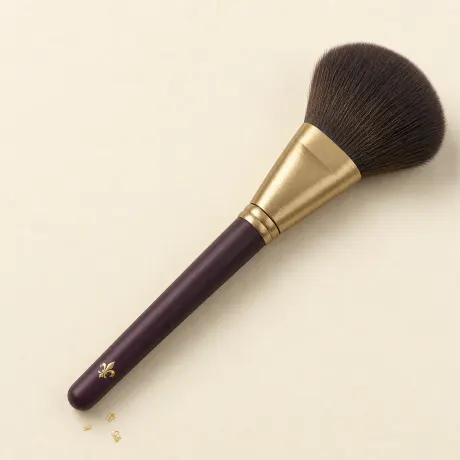
Bronzer brush
A large, loose, slightly flattened brush that diffuses warmth over a wide area.
Read the guide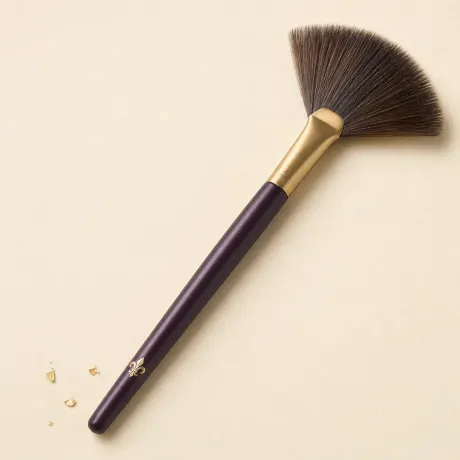
Fan brush
A thin arc of bristles — the lightest touch in the kit — for highlighter and for dusting away fallout.
Read the guide
Tapered highlighter brush
A small, soft, pointed brush that puts highlight exactly on the high point.
Read the guide