Madam C. J. Walker and the Market Nobody Else Would Serve
She sold scalp treatments to women the beauty trade did not acknowledge, and trained the sellers herself.
HOM · Person1867 – 1919Hair-care manufacturer and philanthropist
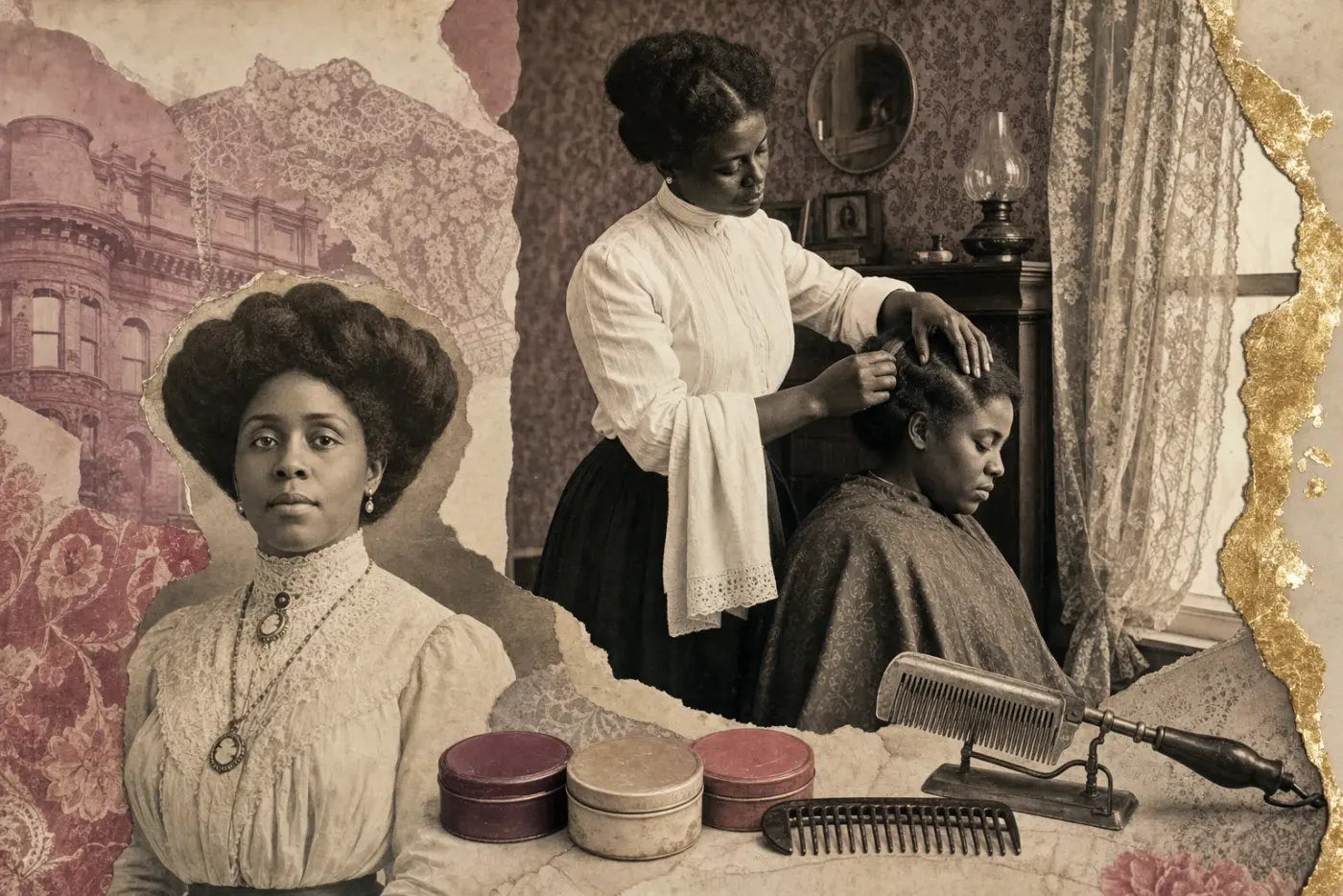
In short
Madam C. J. Walker built a national company on scalp treatments sold by trained agents to Black customers the mainstream beauty trade ignored, and objected in print in 1918 to being described as a straightener of hair.
- 4min read
- 6chapters
- 6sources
Vivien
Your guide through time
Listen to this essay
7 min listenVivien reads our essays aloud, word for word — every date and every name in its place — so you can listen the way you would be walked through a gallery.
An AI voice, designed for History of Makeup
Sarah Breedlove was born in Delta, Louisiana, in December 1867, the first child in her family born after emancipation. Her parents had been enslaved on the plantation where she was born. She was orphaned at seven, married at fourteen and widowed at twenty, and worked for years as a washerwoman in St Louis.[1]
She went on to build one of the most successful Black-owned manufacturing businesses in the United States, selling to customers the mainstream beauty trade did not acknowledge existed. The products were scalp preparations. The business was a network of women.
Before the Company
During the 1890s Breedlove began losing her hair. Scalp disease was widespread at a time when most households had no running water and hair was washed rarely.[2] She consulted her brothers, who were barbers in St Louis, and worked through both homemade remedies and the products already on sale.
Among those products were Annie Turnbo Malone's. Breedlove sold Malone's Poro line as a commission agent in St Louis and in Denver across 1905 and 1906 before launching anything of her own.[3] In January 1906 she married Charles Joseph Walker and began trading as Madam C. J. Walker. The two companies are routinely narrated as a feud; the Smithsonian treats Malone and Walker as parallel founders of an industry rather than as rivals for a single title.[4]
What Was in the Tin
Walker's Wonderful Hair Grower was a medicated ointment. Recorded formulations list precipitated sulphur and copper sulphate in a base of petrolatum, beeswax and coconut oil, perfumed with violet to mask the smell of the sulphur.[5]
Sulphur preparations for the scalp were ordinary in the period and nothing about the chemistry was proprietary. What was particular was the system sold around the tin: a regimen of washing, ointment and combing, taught in person by an agent who had very often been a domestic servant, a cook or a laundress herself.[6]
She called herself a hair culturist, and objected in print when a newspaper described her instead as a straightener of hair.
Culture, Not Straightening
In 1918 Walker told a reporter: Right here let me correct the erroneous impression held by some that I claim to straighten hair. I deplore such an impression because I have always held myself out as a hair culturist.[7] A white newspaper had called her the de-kink queen.
The distinction mattered to her and it is genuinely complicated. The Walker system used a heated steel comb, and a heated comb does straighten hair. Her own framing was therapeutic, and her advertising sold length and scalp health rather than a change of texture. Both of those things are true at once. The wider argument about what hair preparations meant for Black women's autonomy was live in her lifetime, was conducted by Black writers and customers themselves, and has never closed.[8]
The Agents
Walker trained her own sellers rather than relying on shops. Lelia College opened in Pittsburgh in 1908, named for her daughter. In 1910 she moved to Indianapolis and set up a laboratory and a beauty school there, and in September 1911, with the help of the attorney Robert Brokenburr, she incorporated the company, with herself, her daughter and C. J. Walker as its board.[9] By the first national convention of Walker agents, held in Philadelphia in 1917, she was claiming to have trained close to twenty thousand women.[10]
That figure is the company's own and should be read as such. What is documented in the company's books is turnover: gross receipts of $275,937.88 in 1918 and $486,762 in 1919.[11] The purpose-built factory the company is remembered for belongs to neither figure and to no part of her lifetime: it went up at the corner of West Street and Indiana Avenue in 1927, to a design by the Indianapolis firm of Rubush and Hunter, eight years after she died, and it was financed on first and second mortgages that the Depression then made unpayable.[9]
The Millionaire Question
Walker is routinely called the first self-made female millionaire in America, and the Guinness Book of World Records lists her that way. She denied it herself, in a magazine interview and again in a letter to her general manager in March 1918.[13] Her biographer and great-great-granddaughter, A'Lelia Bundles, works from the company's accounts instead, and estimates Walker's personal wealth at between $600,000 and $700,000. The figure of one to two million dollars that gets attached to the business is a counterfactual rather than a valuation: it is a business historian's estimate of what the enterprise would have fetched had it been sold on the date she died.[12]
Bundles has also traced the $14 million figure sometimes attributed to Annie Malone to Malone's obituary in 1957, with no contemporaneous record behind it.[12] Neither fortune is as well documented as the payroll, and the payroll is the more interesting number. That last is this entry's judgement and nobody else's.
Villa Lewaro
Walker commissioned Vertner Woodson Tandy, the first Black architect licensed in New York State, to design a house at Irvington-on-Hudson. She moved into Villa Lewaro in the spring of 1918.[14] She died there on 25 May 1919, aged fifty-one.
She had given to the anti-lynching campaign of the NAACP, to Black schools and to scholarship funds, and her will continued that giving: specific charitable bequests of more than $100,000, and two-thirds of the company stock left in trust, half of it for charity.[15] The house still stands and is a National Historic Landmark.[15]
Sources
- [1, 2, 6, 7, 10, 14]On Her Own Ground: The Life and Times of Madam C. J. Walker Scribner, 2001.
- [3, 11, 12]The Facts about Madam C. J. Walker and Annie MaloneView source (opens in a new tab) Accessed 2026-09-22.
- [4]Annie Malone and Madam C.J. Walker: Pioneers of the African American Beauty IndustryView source (opens in a new tab) Accessed 2026-09-22.
- [5]H03 Madam C.J. Walker and her wonderful hair grower British Journal of Dermatology, volume 188, supplement 4, ljad113.285, 2023.View source (opens in a new tab)
- [8]Hope in a Jar: The Making of America’s Beauty Culture Metropolitan Books, 1998.
- [9, 13, 15]Madam C. J. Walker Papers, Collection M 1250: finding aidView source (opens in a new tab) Accessed 2026-09-22.
Filed under