Cream contour stick
Contour in a twist-up cream stick, drawn on and blended out. How it differs from a bronzer stick, how to choose a formula and a tip, how to blend it without stripes — and the stage greasepaint it descends from.
A cream contour stick is a cool, shadow-coloured cream in a twist-up stick, drawn straight onto the hollows of the face and blended upward to imitate shadow.

Our picks
Chosen to cover the formulas — cream-to-powder and dewy — and the shapes, from chubby sticks to slim pencils and dual-ended sticks, across every budget from drugstore to prestige. Each opens where its maker sells it: at the house’s own shop, at Sephora or on Amazon. You choose your shade on that page; wear claims are the makers’.
As an Amazon Associate I earn from qualifying purchases. Affiliate links — we may earn a commission at no extra cost to you. How this works
Real shadowPrestige Westman Atelier
Face Trace Contour Stick
Shades made to mimic real shadow, set in place with clay so they last through the day.
- Shadow-mimicking tones
- Kaolin clay
BuildableDrugstore Palladio
Build + Blend Contour Stick
An inexpensive creamy stick that builds from a soft shadow to a bold contour.
- Buildable
- Four shades
Built-in brushMid-range Makeup by Mario
SoftSculpt Shaping Stick
A makeup artist’s stick with its own angled brush, for a soft, lifted contour in one tool.
- Natural matte
- Built-in brush
- Seven shades
Dual-endedDrugstore wet n wild
MegaGlo Dual-Ended Contour Stick
Shadow at one end and light at the other, the whole technique in one low-cost stick.
- Dual-ended
- Contour and highlight
Cool taupesPrestige Kevyn Aucoin
The Contrast Stick
Cool and warm browns that the house says were developed from Kevyn Aucoin’s own theory of contouring.
- Creamy matte
- Four shades
Cream to powderMid-range Fenty Beauty
Match Stix Contour Skinstick
A cream that sets to a powder finish, for contour that holds on oily skin.
- Matte
- Cream-to-powder
Matte stickDrugstore KIKO Milano
Sculpting Touch Creamy Stick Contour
A matte stick from the Milan house, including a cool dark brown for deeper skin.
- Matte
- Four shades
Cool-tonedMid-range Milk Makeup
Quick Sculpt
A matte stick in cool shades only, made to look like shadow rather than tan.
- Matte
- Cool-toned
- Claims 8-hour wear
Sculpt or warmPrestige Dior
Dior Forever Skin Contour
Dior’s contour stick; the house sells a separate bronzing stick, which is on the cream-bronzer page.
- Cream stick
- Contour and bronzing
Budget duoDrugstore Revolution Beauty
Fast Base Contour Stick
An inexpensive two-ended stick, contour at one end and highlight at the other.
- Dual-ended
- Four shades
Dewy finishMid-range Anastasia Beverly Hills
Smooth Blur Contour Stick
A gel-like cream with a dewy finish, for dry skin that looks flat under matte contour.
- Cool-toned
- Dewy finish
Pen formatPrestige Victoria Beckham Beauty
Contour Stylus
A slim stick shaped like a pen, for precise lines on the nose, jaw and cheekbone.
- Pen format
- Four shades
Soft focusDrugstore Physicians Formula
Butter Glow & Go Contour Stick
A creamy drugstore stick made with butters, for a softer, less graphic contour.
- Soft-focus
- Murumuru butter
Mature skinMid-range Patrick Ta
Major Sculpt Shape & Shade Anywhere Artistry Stick
A slim creamy stick with a brush tip, which the maker sells for mature skin.
- Built-in brush
- Six sculpting shades
Precision tipDrugstore Morphe
Shapelifter Micro Contour Stick
A slim pencil with a sharpener, for the fine work on the nose and under the lip.
- Precision tip
- Ten shades
Chubby crayonPrestige Clinique
Chubby Stick Sculpting Contour
A fat, twist-up crayon that is hard to overdo, a gentle first contour stick.
- Cream
- For all skin types
British houseMid-range Iconic London
Shape & Shade Sculpting Sticks
A creamy, cool-toned sculpting stick from the London house, for soft definition.
- Cool-toned
- Four shades
Low costDrugstore Beauty Creations
Flawless Stay Contour Stick
A plain twist-up contour stick at the bottom of the price range, in six shades.
- Soft matte
- Six shades
A cream contour stick is contour colour — a cool, greyish or taupe brown, the colour of a shadow rather than a tan — in a cream firm enough to stand in a twist-up case. It is drawn straight onto the face in short lines under the cheekbones, along the jaw and beside the nose, then blended with a brush, a sponge or the fingers until only the shadow is left. Because it is a cream, it melts into foundation rather than sitting on it, which suits dry skin and anyone who dislikes the look of powder.
Its twin on the shelf is the bronzer stick, and the two can look identical until they are swatched. A bronzer stick is warm and adds the colour of a tan where the sun would land; a contour stick is cool and adds depth where a shadow would fall. Some houses sell both, and a few sell a stick they say will do either job, so read the shade descriptions rather than the case. Many contour sticks now have a second end, carrying a highlighter or a blending brush.
Choosing one
Shade first: one or two shades deeper than your skin, neutral to cool, and deep and rich rather than grey on deep skin, where an ashy stick reads as a smudge. Swatch it along the jaw, blend it out and look from arm’s length in daylight; the right shade disappears into a shadow instead of showing as a colour. Then the formula. A cream-to-powder stick goes on creamy and sets to a soft matte within a minute, which makes it longer-wearing and better on oily skin, though it has to be blended quickly. A creamier or dewy stick stays mobile for longer, blends more easily and suits dry skin, but moves more through the day unless it is set.
Then the tip. A chubby, domed stick covers the cheek in one stroke; a slim pencil or stylus is easier to control on the nose, the jaw and the edge of the lips. Dual-ended sticks carry a highlighter at the other end, which is convenient if the two shades suit you and wasteful if only one does. Built-in brushes save a tool in a handbag, though a separate dense brush or sponge usually blends more smoothly at home.
Drawing and blending
Apply after foundation and before any powder. Draw a short line in the hollow under each cheekbone, starting near the ear and stopping in line with the outer corner of the eye, then blend it upward at once with a dense brush or a damp sponge, pressing and buffing rather than dragging. Work one side at a time: a cream-to-powder stick drawn across the whole face before blending will set in stripes.
Along the jaw, draw under the bone from below the ear towards the chin and blend downward, so that the neck carries the shadow away. For the nose, draw two thin lines down the sides from the inner corner of the brow and blend each one outward; a light touch under the tip shortens it. At the temples, a short stroke near the hairline blended back into the hair narrows the forehead.
The failure every makeup artist warns against is the unblended line. Asked about the fashion for contouring, one Toronto makeup artist said that a lot of the time people “just look like they have a roadmap on their face”, with “stripes on their cheeks” and noses that “look dirty”.[1] Blend until you cannot find the edge, check in daylight, and set lightly with translucent powder if the stick is creamy or your skin is oily. For a contour that lasts into the evening, press a matching contour powder over the cream once it has set.
Where it came from
The contour stick is stage make-up in a smaller case. In 1873 Ludwig Leichner, an opera singer with an interest in chemistry, set up a make-up business in Berlin and sold greasepaint in sticks: thick ones for the base, and thinner ones, called liners, for shadowing, highlighting, age lines and brows. With them, shadows and highlights were easier to create under the brighter lighting that had come to the stage.[2] A stage manual of 1901 set out the principle a contour stick still works on: by light and shade “the whole shape, size, and the character of the face may be entirely changed. Thin cheeks can be made round, hollow cheeks full, and fat ones thin and hollow.”[3]
What changed on the way to the dressing table was the scale. Stage contouring had to be bold, because it was seen from a distance; film, magnified in close-up, needed it subtle.[3] A newer chapter began with a photograph. In 2012 Kim Kardashian tweeted pictures taken while the makeup artist Scott Barnes contoured her face, showing the layers of contour before they were blended, and the public, a newspaper reported three years later, had been clamouring for contouring products and tips ever since.[4] The sticks here are that photograph made practical: the actor’s liner, cooled to the colour of a real shadow, and blended until no one can see where it went.
The techniques
- Contour
- Shade beneath the bone to make it recede, then soften the top edge.
- Buff
- Work in small circles with a dense brush until no edge remains.
Sources
- [1, 4]From on-stage to on-trend, contouring has gone mainstream (and you can thank Kim Kardashian) The Globe and Mail, 27 March 2015, 2015.View source (opens in a new tab) Accessed 2026-09-26.
- [2]Greasepaint Cosmetics and Skin, 2010.View source (opens in a new tab) Accessed 2026-09-25.
- [3]Corrective Make-up (Contouring) Cosmetics and Skin, 2020.View source (opens in a new tab) Accessed 2026-09-26.
What to apply it with
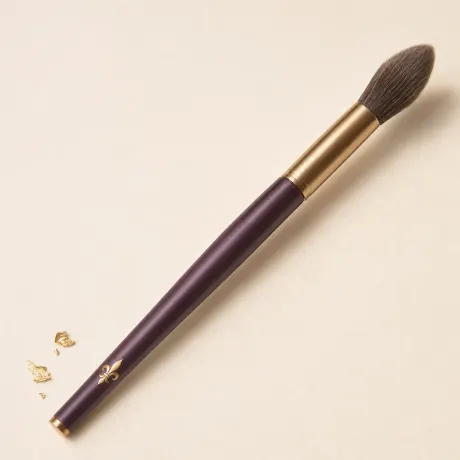
Tapered sculpting brush
A narrow, oval head that tapers to a soft point, for placing shadow exactly and blending it out.
Read the guide
Kabuki brush
A squat, palm-sized brush with a very dense dome of short bristles on a stubby handle, for buffing powders and creams into the skin.
Read the guide
Blending sponge
A soft, teardrop-shaped sponge, used damp, that presses liquid and cream into skin.
Read the guide