Brightening pen
A click pen with a brush tip, holding a thin, light-reflecting concealer that lifts shadow rather than hiding it. What it can and cannot do, where to paint it — and the short history of the pen that defined the form.
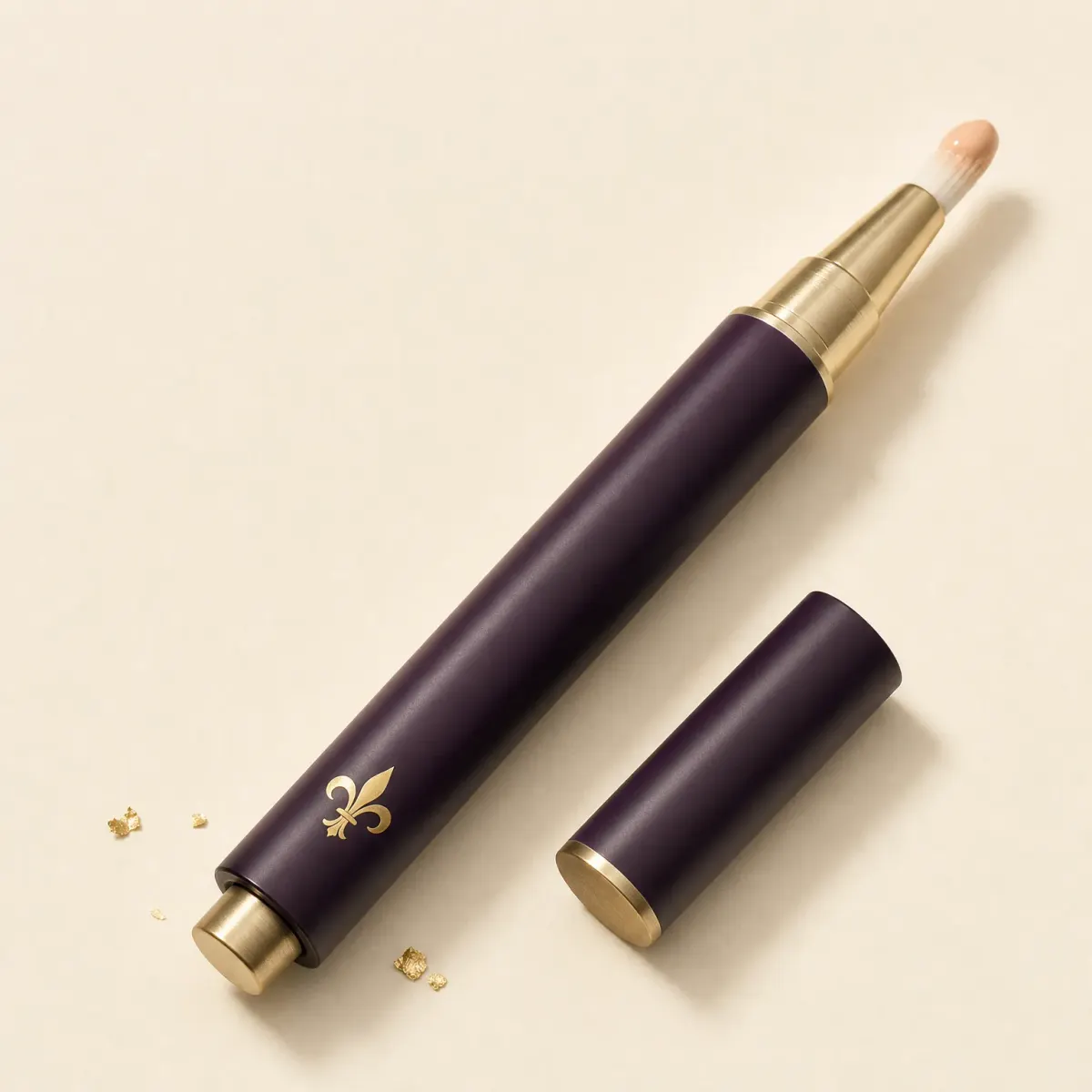
A brightening pen is a light-reflecting concealer of sheer to light coverage in a click pen with a brush tip, painted into shadowed places such as the inner corners of the eyes and the sides of the nose to lift them with light rather than cover them with pigment.
Our picks
Only pens that brighten rather than cover are included, which keeps the list short: it is a narrow format, made mostly by prestige houses. Each opens at the house’s own shop or, for the drugstore pick, on Amazon, and you choose your shade on that page.
As an Amazon Associate I earn from qualifying purchases. Affiliate links — we may earn a commission at no extra cost to you. How this works
The referencePrestige YSL Beauty
Touche Éclat Awakening Concealer Click Pen
The pen Terry de Gunzburg designed for YSL: sheer, light-reflecting, made to brighten rather than cover.
- Light coverage
- Radiant
- Brush tip
IlluminatingPrestige Guerlain
Precious Light Rejuvenating Effect Illuminator
Guerlain’s brush-tipped illuminator, sold to lighten dark areas in a few strokes.
- Illuminator
- Brush tip
Shimmer-freeDrugstore Neutrogena
Healthy Skin Glow Perfector Concealer Pen
An inexpensive click pen that brightens with a soft glow and no shimmer.
- Shimmer-free glow
- Light, buildable
A little more coverPrestige Victoria Beckham Beauty
The Concealer Pen
Light-to-medium coverage with a luminous finish, for shadows that are also a little dark.
- Luminous
- Light to medium
- 19 shades
Light-reflectingPrestige Chantecaille
Le Camouflage Stylo
A brush-tipped pen of light-reflecting pigment for the inner corners and the hollows beneath them.
- Light-reflecting
- Brush tip
A brightening pen holds a thin, fluid concealer charged with light-reflecting pigment in a slim barrel. A click of the button at one end pushes a bead of it into a small synthetic brush at the other. It covers very little. Its work is optical: where a shadow falls — in the inner corner of the eye, the hollow below it, the sides of the nose, the corners of the mouth — it sends light back, and the shadow seems to lift.
That puts it between two neighbours. A liquid concealer covers colour, with pigment dense enough to hide a dark circle or a spot. A highlighter adds visible sheen to the high points of the face. A brightening pen does neither completely: it is sheer, usually free of shimmer, and it works in the low places, not the high ones. It is a finishing touch rather than a base, and it works best used as one. Pens now run from sheer, shimmer-free drugstore formulas to prestige ones with enough pigment for light coverage.
What it will and will not do
Use a pen for shadow, not for colour. It lifts the grey of a hollow: the dip at the inner corner of the eye, the fold beside the nostril, the downturn at the corner of the mouth. It will not hide a blemish, a patch of pigmentation or a deep blue-brown circle, and a light-reflecting veil laid over dark colour can turn it ashy. Cover dark colour first with a concealer that matches, then use the pen on top, only where the shape of the face makes a shadow.
Shade works differently too. Because a pen lifts rather than covers, most people choose one a shade lighter than their skin, or a peach or apricot tone on deeper skin, where a pale pink or ivory one reads as grey. Much lighter than that, it stops looking like light and starts looking like makeup.
Pen or wand
Many under-eye concealers now come in a tube with a doe-foot wand and call themselves brightening, so the choice is a real one. A click pen dispenses a measured bead into a fine brush, which paints a thin line into a narrow place — the inner corner, the crease beside the nose — and keeps the rest of the product sealed until it is needed. A wand carries more at once and suits covering a whole under-eye, but lays down more than a shadow needs.
Pens have drawbacks of their own. The brush stays damp and touches the skin at every use, so it needs wiping; the barrel hides how much is left; and a formula thin enough to pass through the brush is thin by design. If you want coverage as well as light, a pen will disappoint. If you want light, a wand is the blunter tool.
Where to paint it
Click once or twice, no more: the brush holds more than it seems, and a new pen can take several clicks to prime and then deliver too much at once. Paint short strokes into the inner corner of each eye and along the upper edge of the hollow below it, rather than across the whole under-eye. Add a stroke beside each nostril and one at each corner of the mouth if they dip. Then pat with a fingertip until the edges disappear; rubbing wipes the thin film away.
Apply it last, after foundation and any concealer, and leave it unpowdered where you can, since powder dulls the reflection that is the point of it. It can also go on over makeup during the day, patted in on top. Between uses, wipe the brush on a tissue and replace the cap, because the bristles touch skin every time.
Where it came from
The pen is young, but the idea behind it is older. In 1952 the cosmetics firm Harriet Hubbard Ayer launched Ayer Magic, a cream developed by the Hollywood makeup artist Kiva Hoffman and sold as the key to “Shadow-Free Make-up”. The advertisements called it “light … in creamy form”, to be applied to “the shadows and hollows of the face” — the smile lines, under the eyes, the corners of the mouth, the temples. The cosmetics historian James Bennett reads it as film-studio contouring brought to the dressing table, and as the product that took concealers beyond hiding blemishes and into making faces look younger.[1]
The pen itself arrived four decades later. Terry de Gunzburg, a makeup artist who had become creative and marketing director of Yves Saint Laurent Beauté, had been mixing foundation with toner and moisturiser to brighten faces on photographic shoots. In her account to the journalist Jane Larkworthy, a supplier sent a brush-tipped pen by mistake in place of the usual sponge-tipped concealer tube; she asked her laboratory to fit her mixture to it, and insisted that it give almost no coverage. Larkworthy was shown the gold pen, and took one home, in 1992. Touche Éclat launched with a single shade, and de Gunzburg remembers telling YSL: “It’s not a concealer; it’s a highlighter.”[2] The same article counts twelve shades by 2023 and records the pen among the objects in the Museum of Modern Art’s 2017–18 exhibition Items: Is Fashion Modern?[2] The distinction she drew — light, not coverage — is still the one to shop by.
The techniques
- Paint
- Brush or dab liquid colour directly onto the skin or lips.
- Pat
- Tap lightly with a fingertip or damp sponge so product melts in rather than moves.
Sources
- [1]Corrective Make-up (Concealers) Cosmetics and Skin, 2016.View source (opens in a new tab) Accessed 2026-09-25.
- [2]Best in Glow Air Mail, December 2023, 2023.View source (opens in a new tab) Accessed 2026-09-25.
Other kinds of concealer
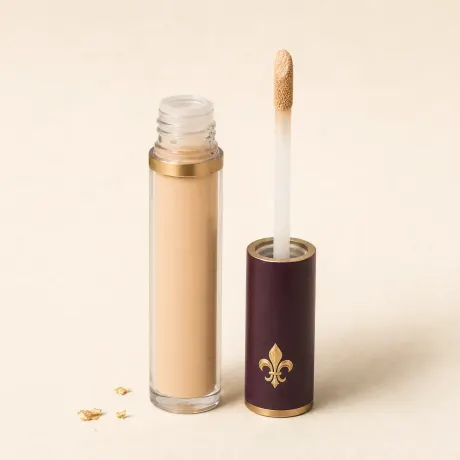
Liquid concealer
A fluid concealer in a wand tube, the most versatile form for the under-eye.
Read the guide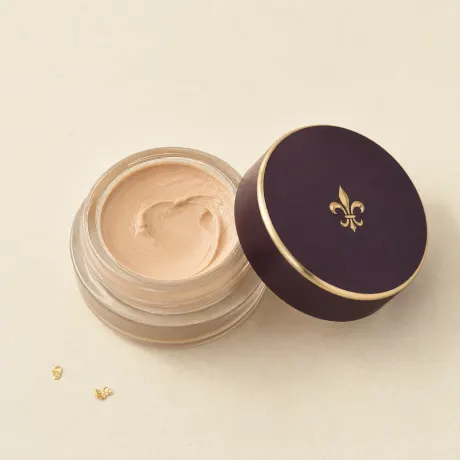
Cream concealer
A thick, high-coverage concealer in a small pot, for blemishes and deep shadow.
Read the guide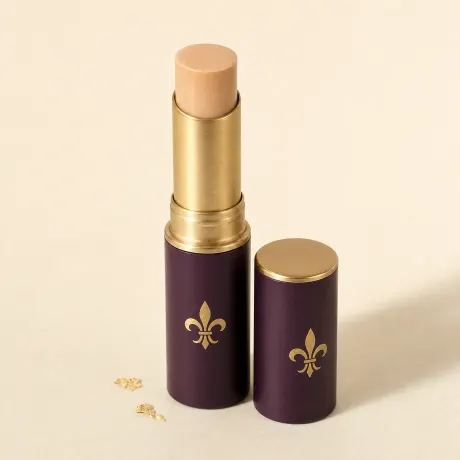
Stick concealer
A firm concealer in a slim twist-up case, for spot coverage.
Read the guide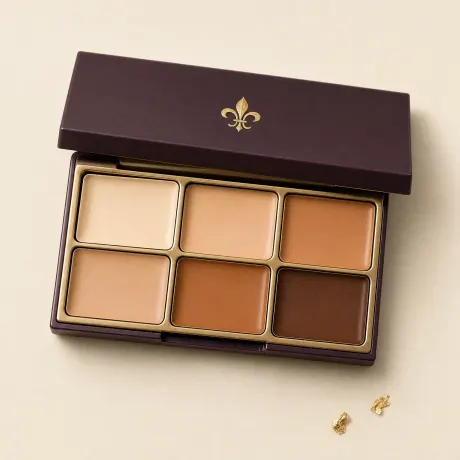
Concealer palette
Several cream concealers in one palette, to mix a match or correct and conceal together.
Read the guide