Velour powder puff
A round of soft velour that presses powder into the skin instead of sweeping it across. How to choose, load and wash one — and how velour took the place of down when powder moved into the compact.
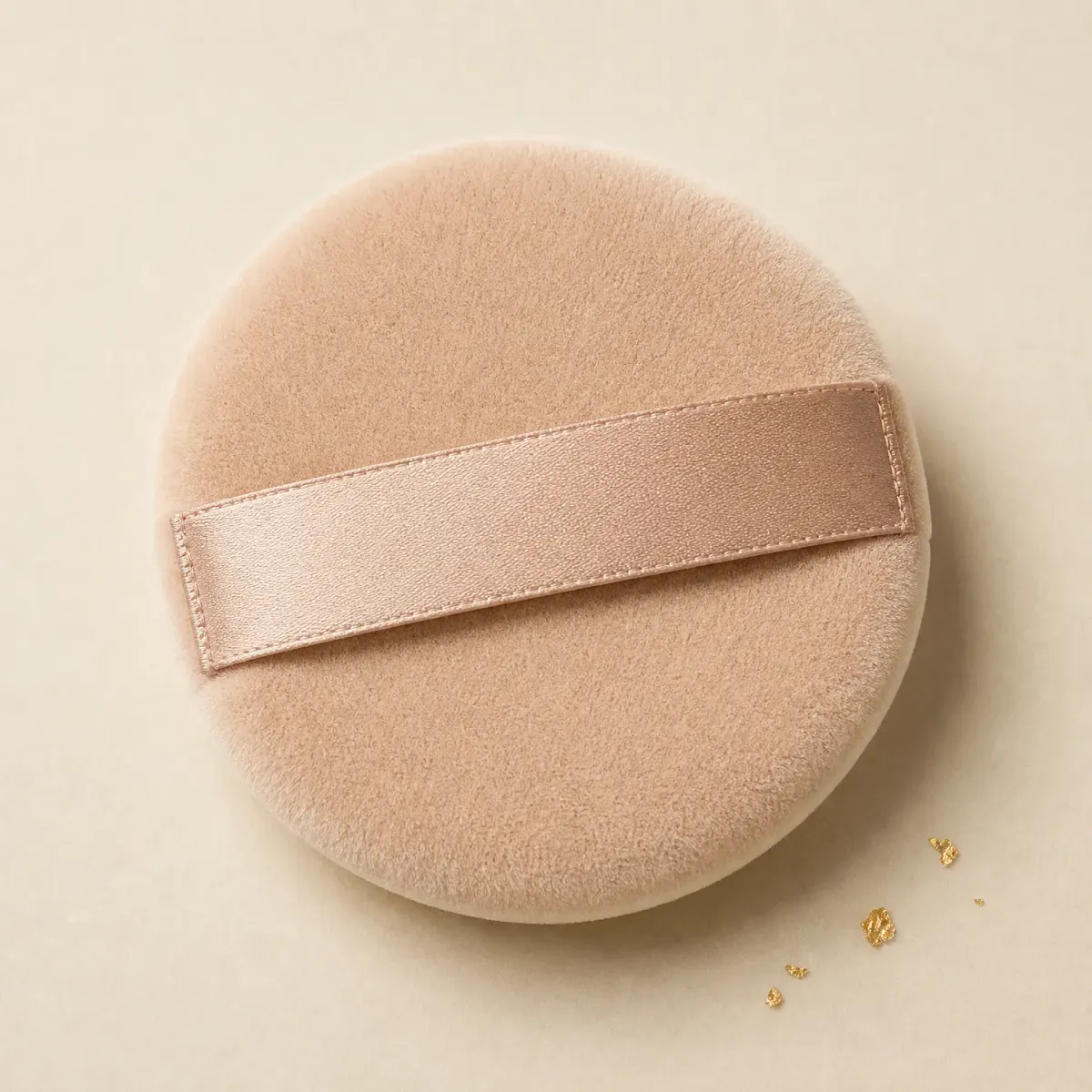
A velour powder puff is a round or oval pad of short, dense pile fabric over a soft filling, with a ribbon band for the fingers, used to press and roll loose or pressed powder onto the skin to set makeup without disturbing it.
Our picks
Chosen across the round puffs makeup houses sell as products of their own — cotton and long-fibred, single and in packs, for the compact and for the dressing table — from drugstore to prestige, with a Japanese house among the American ones. Each opens where its maker sells it: on Amazon, or at the house’s own shop.
As an Amazon Associate I earn from qualifying purchases. Affiliate links — we may earn a commission at no extra cost to you. How this works
Cotton velourPrestige Laura Mercier
Velour Powder Puff
A plain round puff of cotton velour, sold by its maker for setting loose and pressed powder over the whole face.
- Cotton velour
- Loose or pressed
Three-packDrugstore COVERGIRL
Makeup Masters Powder Puffs
Inexpensive round puffs in a pack of three: one for the compact, one for the jar, one in the wash.
- Round
- Three to a pack
BakingMid-range ONE/SIZE
Ultimate Setting & Baking Puff
A large round puff with one straight edge, made for pressing a heavy layer of loose powder under the eyes.
- Precision edge
- Loose powder
- Setting and baking
OvalDrugstore Morphe
All Set Touch-Up Powder Puff
An oval puff with an elastic band and its own case, for touch-ups away from home.
- Oval
- Elastic band
- With case
Artist’s puffPrestige Trish McEvoy
Professional Powder Puff
A makeup artist’s plush round puff, sold for blending out the edges of powder as well as setting.
- Loose or pressed
- Blends lines
Refill puffsDrugstore Ulta Beauty Collection
4 ct. Velour & Satin Puffs
Replacement puffs that fit most compacts, for when the one that came with your powder has worn out.
- Velour and satin
- Fits most compacts
TheatricalMid-range Mehron
Powder Puff
A theatrical house’s velour puff, in face sizes and a larger one for powdering the body.
- Velour
- Face and body sizes
With a caseDrugstore EcoTools
Sea Gems Pearl Puff + Case
A round puff in a shell-shaped case with a mirror, a powder compact without the powder.
- Finger band
- Shell case
- Mirror
Long-fibredPrestige Koh Gen Do
Face Powder Puffs With Case
A Japanese house’s long-fibred puffs, sold for dusting on a finer, lighter veil than dense velour gives.
- Long-fibred
- Two with a case
- Washable
A velour powder puff is a round or oval pad covered in velour, a cut-pile fabric of cotton or polyester, over a soft filling, with a ribbon across the back for the fingers. Powder works down into the pile and comes out again when the puff is pressed, so it sets makeup with more powder, and more firmly, than a brush does, and it presses rather than sweeps, leaving the base beneath it where it was.
The round shape covers the forehead, cheeks and chin in a few presses; folded in half, it reaches under the eyes and the sides of the nose. Its neighbours do other jobs. A powder brush sweeps on a thinner veil. A triangle puff builds the fold in, with a point for the under-eye. A blending sponge and a cushion puff are for liquids. The velour puff is the one that belongs in a compact.
Choosing one
Pile. Short, dense velour holds powder close to the surface and gives a firm, even set. A longer, fluffier pile dusts on a lighter veil; Koh Gen Do sells its long-fibred puffs for exactly that. Cotton velour and polyester both work: what matters is that the pile is soft and does not shed.
Size and band. A face puff is about 8 to 12 cm across and fits a compact; body puffs are larger. Replacement puffs are sold to fit most compacts, which is worth knowing when the one that came with a powder wears out. A ribbon band holds the puff flat across the fingers, and an elastic one grips better when you roll it. Keep two: one for the compact, one for loose powder at home.
How to use it
Load the puff before it touches the face. Tip a little loose powder into the lid of the jar and press the puff into it, then fold the puff in half and rub the two halves together to work the powder into the pile; tap off the excess on the back of the hand. With pressed powder, press the puff onto the cake once and lift it.
Then press it onto the skin and roll it off, starting where makeup moves most: under the eyes, the sides of the nose, the chin, the centre of the forehead. Never wipe, which drags the base with it. To bake, press on a thicker layer under the eyes, leave it for a few minutes and dust away the excess with a brush. Finish by buffing lightly with the clean side of the puff.
Common mistakes
Too much powder. An overloaded puff leaves patches that sit on the skin rather than in it; tap it off every time, and add a second press rather than a heavier first one. Wiping. A puff swept across the face drags the foundation beneath it into streaks; press and roll instead. Powdering over shine. Powder pressed onto oil clumps, so blot first with a tissue or a blotting paper. One puff for everything. A puff that has been in bronzer or a tinted powder colours the next thing it touches; keep a clean one for setting under the eyes.
Washing and replacing
Wash a puff often, because it goes back into the powder every time you use it. Mehron tells buyers of its velour puffs to hand-wash them in warm water with a little gentle laundry detergent, rinse, squeeze and lay them flat to dry. Let a puff dry completely before it goes back into a compact, where a damp one cannot dry at all.
Skin oil travels with the puff, too. A pressed cake that keeps meeting an oily puff turns hard and shiny on the surface and stops giving up powder, so a clean puff also keeps the powder usable. Replace the puff when the pile flattens, mats or sheds, or when the band has stretched, and keep your puff to yourself.
Where it came from
The powder puff is older than the compact. The dressing-table puff of the nineteenth century was made of down, like the two puffs of about 1875 in the Victoria and Albert Museum.[1] Such puffs were called swansdown, although the historian James Bennett notes that the “swan’s down” was in fact goose.[2]
Velour came with pressed powder. Lifting powder from a compressed tablet took pressure that down could not give, so puffs of chamois, lambswool and cotton velour replaced it, and synthetics later: less soft than down, but less likely to spill powder on clothes, and thin enough to fit a slim compact. The compact was hard on them in turn. As the tablet wore down, the sharp, inward-sloping rim of the pan that held it cut into the puff until it was useless.[2] The dressing table changed its puffs as well; the museum’s velour puff of about 1925 is velour backed with pink rayon, on a stick whose handle is a porcelain figurine in a ribbon skirt.[3]
The technique has hardly changed. Instructions for cake make-up published in 1947 were to powder “by patting over the entire face with a puff”, then to turn the puff to its clean side and lightly buff the face to lift the surplus.[4] That is still how to use the puff in any compact today.
The techniques
- Press and roll
- Press a loaded puff onto the skin and roll it off, setting without disturbing the base.
- Press
- Press product onto the skin without dragging, so it stays where it is put.
- Bake
- Leave a thick layer of loose powder to sit for several minutes, then dust away the excess.
Sources
- [1]Powder puff, about 1875 (museum no. AP.275-1875) Victoria and Albert Museum.View source (opens in a new tab) Accessed 2026-09-26.
- [2]Compressed Face Powders Cosmetics and Skin.View source (opens in a new tab) Accessed 2026-09-22.
- [3]Powder puff, England, about 1925 (museum no. T.248-1976) Victoria and Albert Museum.View source (opens in a new tab) Accessed 2026-09-26.
- [4]Pan-Cake Make-up Cosmetics and Skin, 2026.View source (opens in a new tab) Accessed 2026-09-22.
What it is used with
Powder foundation
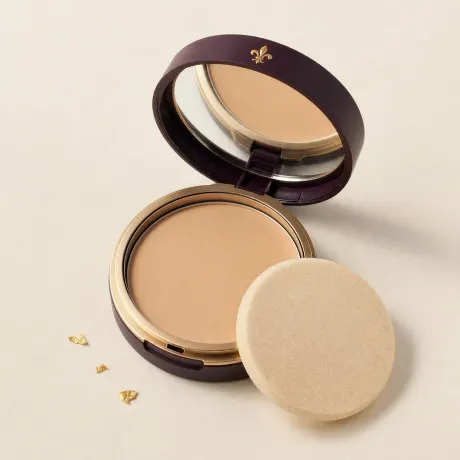
Foundation pressed into a powder cake, for a quick matte base in one step.
Read the guide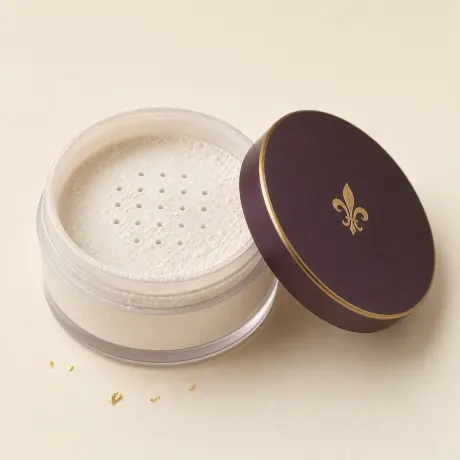
Loose setting powder
A fine loose powder that sets the base, takes down shine and holds everything beneath it in place.
Read the guide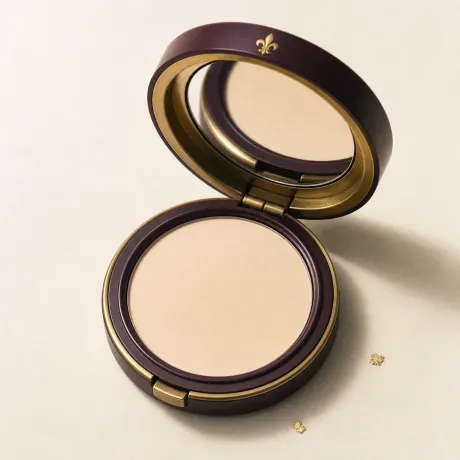
Pressed powder
Setting powder pressed into a compact, for touching up away from the mirror.
Read the guide
Other kinds of powder puffs
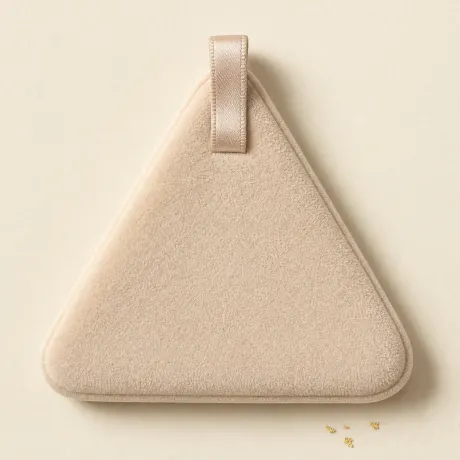
Triangle powder puff
A folded velour puff with a sharp point that reaches under the eye and around the nose.
Read the guide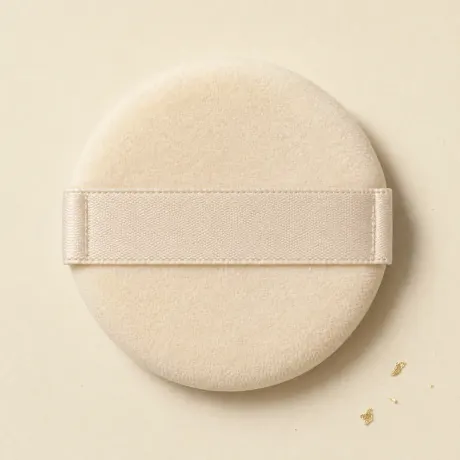
Cushion puff
A springy, flat puff that picks up cushion foundation and taps it on in a thin, even layer.
Read the guide
Swansdown puff
A powder puff of soft down on a short handle — the dressing-table puff of the nineteenth and early twentieth centuries.
Read the guide