Loose setting powder
A fine, unpressed powder laid over base to take down shine and hold it in place. How to choose one, how to use a puff and a brush — and a history that runs from rice starch and white lead to the translucent powder in the jar today.
Loose setting powder is a fine, unpressed powder — translucent or tinted, usually built on talc, silica or starch — pressed or dusted over foundation and concealer to absorb oil, reduce shine and help the base stay in place.

Our picks
Chosen to cover the range of finishes and skin tones — translucent and tinted, matte and radiant, banana and colourless, and powders made for deep skin — across budgets from drugstore to prestige, with houses from France, Japan and the Caribbean beside the American ones. Each opens where its maker sells it — on Amazon or at the house’s own shop — and you choose your shade on that page.
As an Amazon Associate I earn from qualifying purchases. Affiliate links — we may earn a commission at no extra cost to you. How this works
The referencePrestige Laura Mercier
Translucent Loose Setting Powder
Laura Mercier’s colourless powder, long the reference point for a matte set, fine enough to press under the eyes.
- Translucent
- Matte
- 16-hour shine control
The originalDrugstore Coty
Airspun Loose Face Powder
The air-milled powder Coty launched in the 1930s, still on sale; linked here in a translucent shade with extra coverage.
- Translucent
- Extra coverage
Soft radianceMid-range Rare Beauty
Always an Optimist Soft Radiance Setting Powder
For skin that looks flat under matte powder: it sets and softens without dulling.
- No flashback
- Soft finish
- Locking sifter
Four tintsPrestige Givenchy Beauty
Prisme Libre Loose Powder
Four tinted powders in one jar, sold to even out tone as they set and finish.
- Four colours in one jar
- Colour-correcting
Natural finishPrestige Chanel
Poudre Universelle Libre
A fine loose powder in skin shades, made to even the complexion without being seen on it.
- Natural finish
- Tinted shades
BananaDrugstore Maybelline New York
Lasting Fix Banana Loose Setting Powder
An inexpensive banana powder for setting and brightening concealer under the eyes on light to medium skin.
- Banana
- Brightening
- Matte
Deep skinMid-range Juvia's Place
I Am Magic Loose Setting Powder
A loose powder in shades that reach the deepest skin, where a white translucent powder can look ashy.
- Five shades
- Deep-skin shades
Blurring mattePrestige Dior
Dior Forever On Set Powder
A prestige setting powder sold as blurring, with a full day of wear and shine control, for long days and warm weather.
- Blurring
- Matte
- 24-hour wear
Soft focusDrugstore e.l.f. Cosmetics
High Definition Powder
An inexpensive soft-focus powder, sheer enough to sweep over the whole face.
- Soft focus
- Sheer
- Lightweight
Finely milledMid-range ILIA
Soft Focus Setting Powder
A translucent, finely milled powder sold as blurring and shine-controlling, from a skincare-minded house.
- Translucent
- Blurring
- Finely milled
Weightless mattePrestige Shiseido
Synchro Skin Invisible Silk Loose Powder (Matte)
The Japanese house’s weightless translucent powder, in a matte finish.
- Matte
- Translucent
LuminousPrestige NARS
Light Reflecting Loose Setting Powder
For skin that wants setting without looking powdered: a light-reflecting finish rather than a flat one.
- Luminous finish
- Soft focus
Talc-free budgetDrugstore COVERGIRL
Clean Invisible Loose Powder
An inexpensive talc-free powder in several translucent shades, from light to deep.
- Talc-free
- Translucent shades
Flash-friendlyMid-range Sacha Cosmetics
Buttercup Setting Powder
A powder sold on two promises: no white flash in photographs, and no ashy cast.
- Flash-friendly
- No ashy cast
Sheer and naturalPrestige Clinique
Blended Face Powder
A sheer powder with a natural finish, for anyone who finds most setting powders too matte.
- Sheer
- Natural finish
- All skin types
Long wearDrugstore L'Oréal Paris
Infallible Blur-fection Longwear Loose Setting Powder
A drugstore blurring powder sold on its staying power.
- Blurring
- Up to 24h wear
Set or bakeMid-range Kosas
Cloud Set Loose Powder
A talc-free powder sold for both jobs: a light set all over, or a thicker bake under the eyes.
- Talc-free
- Ultra-translucent
- Setting and baking
Talc-freePrestige Hourglass
Veil Translucent Setting Powder
A talc-free translucent powder that sets without adding colour or weight.
- Talc-free
- Translucent
Budget bakingDrugstore wet n wild
Photo Focus Loose Setting Powder
An inexpensive powder made for baking as well as setting, in translucent, banana and deeper shades.
- Setting or baking
- Translucent
ProfessionalMid-range RCMA
No-Color Powder
A professional’s colourless powder, sold as setting makeup without shifting the shade of the foundation beneath.
- Colourless
- No perfume
Oil controlPrestige Bobbi Brown
Sheer Finish Loose Powder
An oil-absorbing, mattifying powder whose yellow-toned shades suit warmer skin.
- Oil-absorbing
- Mattifying
- Vitamin E
Loose setting powder is face powder that has not been pressed into a cake: a dry, fine powder laid over foundation and concealer to take up oil, take down shine and hold the base where it was put. Most are built on talc, silica or a starch, sometimes with a little mica for sheen, and they come in two broad kinds. A translucent powder is close to colourless on the skin, whatever it looks like in the jar; a tinted one carries a little pigment, to match the skin, warm it or brighten it.
It sits between its neighbours. Pressed powder is the same idea bound into a compact so that it can travel; loose powder has no binder, so it goes on lighter and finer, which is why it is the one used at home and backstage. Powder foundation and loose mineral foundation are made to cover; a setting powder is made to be hardly seen. And where a setting spray fixes a face with a thin film, powder works by absorbing, so it mattifies as it sets.
Translucent, tinted or brightening
A translucent powder is the easy default on light and medium skin, because it sets without changing the colour of the base. On deeper skin, some powders sold as translucent leave a pale, ashy veil, most visibly under the eyes; a tinted powder in your own depth, or one made for deep skin, avoids it. Banana or yellow powders are a third kind, sold to brighten the under-eye and take the edge off purple shadow, and they suit light to medium skin best.
Then choose the finish. A matte powder absorbs most, and suits oily skin, heat and long days. A soft-focus powder, often silica-based, is sold as blurring pores and texture by scattering light. A radiant powder adds a fine sheen for dry skin that looks dull under matte formulas. One caution applies to the whitest powders: laid on thickly, some show as a white cast in flash photographs, so test with a phone’s flash before a photographed evening.
Puff, brush or bake
How you apply loose powder matters as much as which one you buy. Tip a little into the lid rather than dipping into the jar, work it into the puff or brush, and tap off the excess before it touches your face. A velour puff, pressed and rolled over the skin, sets most firmly: use it where the base has to last, over concealer and across the forehead, nose and chin. A large, soft brush sweeps on a thinner veil, and is the tool for the cheeks and for dusting off afterwards.
“Baking” is the heavy version: a thick layer pressed under the eyes, or wherever concealer creases, left for a few minutes to set, then swept away. It gives a crisp, very matte finish that lasts, and on dry or finely lined skin it can look dry. For most days a thin press is enough. Powder where the face shines or creases, and leave the rest of the skin alone.
Looking after the jar
Loose powder has no water in it and keeps for a long time; the puff is what needs care. Wash a velour puff every week or two in mild soap and let it dry completely. Close the sifter between uses and tape it shut for travel. To get powder through the holes, tap the closed jar on the table rather than shaking it open-side down.
Where it came from
Face powder is far older than the setting powder. Pulverised rice starch was used on the face in China, Japan and elsewhere in East Asia before it reached the West, and when poudre de riz became a cosmetic in Europe has not been established.[1] Its tiny grains felt smooth and gave the skin a soft bloom, but by the late nineteenth century the name was worth more than the ingredient. Examining face powders in 1897, the physician William Murrell found that those commonly used “no longer consisted of powdered rice, but were combinations in various proportions of chalk, white lead, bismuth, common starch, and alabaster”; one sold as Poudre de Riz de Java contained no rice at all.[1][2]
White lead was the danger in the box. In Japan, where lead-based oshiroi was widely used from the Edo period, children were poisoned through the powdered skin of their wet nurses, and the collapse in 1887 of the celebrated onnagata Nakamura Fukusuke, diagnosed as chronic lead poisoning, made it a public scandal. An ordinance of 1900 banned harmful colourants but exempted white powder until a substitute existed, and lead powder was finally outlawed by an ordinance of 1930, which ended its manufacture at the close of 1933.[3] In Western powders, starch gave way to minerals: talc for slip, zinc oxide — at first regarded with suspicion — for covering power, and from the early 1930s titanium dioxide, three to four times as effective a cover as zinc.[1][2]
Then came a race for fineness. In the 1930s Lady Esther’s advertisements urged women to bite their powder to test it for grit, and in 1934 Coty secured the exclusive rights to a process that milled powder in air-driven “micronisers”, selling the result as Air Spun and leaving its familiar box, with its pattern of powder puffs, unchanged.[4] As cake and liquid make-up took over the work of covering, some makers made their loose powders colourless, to take away shine rather than add colour; the first known to the historian James Bennett is Westmore’s Overglo, introduced in 1944.[2] That is the translucent powder in the jar today. Coty’s Air Spun, in a plastic tub now, is still on sale beside it.[4]
The techniques
- Press and roll
- Press a loaded puff onto the skin and roll it off, setting without disturbing the base.
- Bake
- Leave a thick layer of loose powder to sit for several minutes, then dust away the excess.
- Sweep
- Long, light strokes that deposit a veil of product.
- Press
- Press product onto the skin without dragging, so it stays where it is put.
Sources
- [1]Poudre de Riz Cosmetics and Skin, 2015.View source (opens in a new tab) Accessed 2026-09-26.
- [2]Loose Face Powders Cosmetics and Skin, 2009.View source (opens in a new tab) Accessed 2026-09-26.
- [3]Kaleidoscope of Books No. 29: Make-up Then and Now — Cosmetic Culture from Edo to Showa National Diet Library, Tokyo, 2021.View source (opens in a new tab) Accessed 2026-09-22.
- [4]Coty "Air Spun" Powder Cosmetics and Skin, 2009.View source (opens in a new tab) Accessed 2026-09-26.
What to apply it with
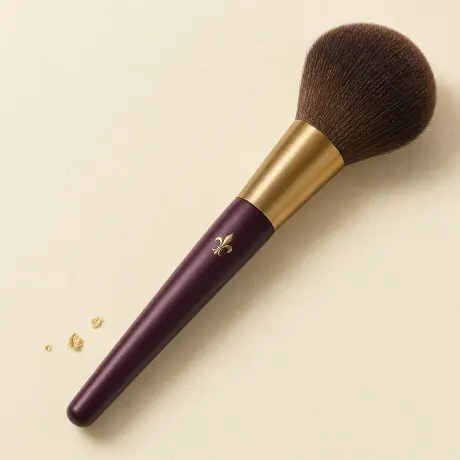
Powder brush
A large, loosely packed, fluffy brush that lays down a veil of powder rather than pushing it in.
Read the guide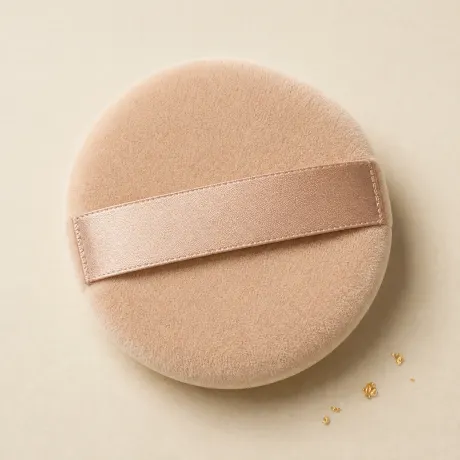
Velour powder puff
A plush round puff that presses powder in and rolls it off, setting without disturbing the base.
Read the guide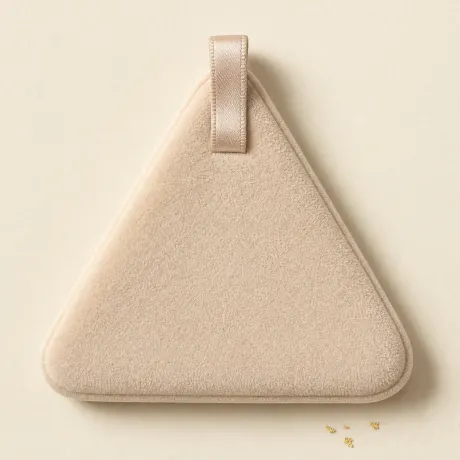
Triangle powder puff
A folded velour puff with a sharp point that reaches under the eye and around the nose.
Read the guide
Swansdown puff
A powder puff of soft down on a short handle — the dressing-table puff of the nineteenth and early twentieth centuries.
Read the guide
Other kinds of setting & finishing
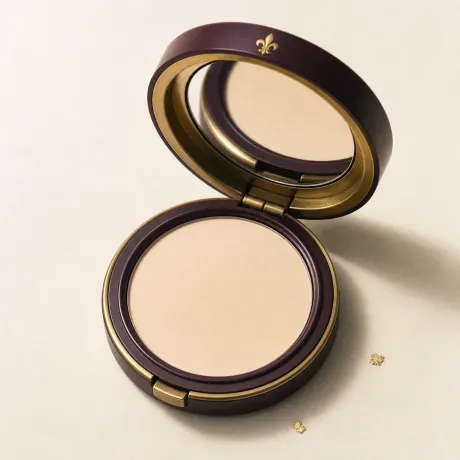
Pressed powder
Setting powder pressed into a compact, for touching up away from the mirror.
Read the guide
Blotting papers
Thin, absorbent sheets that lift oil from the skin without disturbing the makeup over it.
Read the guide
Setting spray
A fine mist that melts powder into skin and fixes the finished face for longer wear.
Read the guide