Swansdown puff
A puff of soft down on a pad or a short handle, for dusting loose powder over the face, throat and body: the dressing-table puff before velour. What it was, how to use and keep one — and why the real thing is now so hard to buy.
A swansdown puff is a powder puff of soft down feathers gathered onto a pad or a short handle, used to dust loose powder lightly over the face, throat and body rather than to press it in.

A swansdown puff is a powder puff of down, the fine, soft underfeathers of a bird, gathered onto a small pad of satin or silk and often mounted on a short handle. It holds loose powder lightly in the fluff rather than working it into a pile, so it dusts rather than presses: a thin veil over the face, the throat and the shoulders, and after a bath over the body.
That is the difference from the puffs that replaced it. A velour puff is short, dense pile that presses powder into the skin and can lift it from a pressed cake; a down puff is too soft to do either. It belongs with loose powder, on the dressing table beside a box or a bowl, and there it is still a gentle way to dust powder over a large area without disturbing the makeup underneath.
Down, marabou and imitations
Down. Real down is almost weightless and slightly uneven, and it stirs at a breath. The name has always been loose: the historian James Bennett notes that the “swan’s down” puff was “actually made from gooseflesh”.[1] Marabou, a fluffy feather trimming, was put to the same use.
Imitations. Most fluffy puffs on sale now are plush, synthetic fibre on a fabric back, or velour. They are sturdier and can be washed, and they dust powder well enough, but a listing that says “swansdown” without saying “down” is describing a look, not a material. Lambswool puffs, large and handmade, are the other old alternative for body powder. If real down matters to you, buy only from a maker that names the material and the bird.
How to use one
Use a down puff only with loose powder. Tip a little into the lid of the box, touch the puff to it, and tap the handle once on the rim so the excess falls back: an overloaded down puff leaves clouds on clothes and patches on skin. Then dust, with light, quick presses and sweeps over the face, the throat and the collarbone, and never rub.
For the body after a bath, pat the skin completely dry first, since powder on damp skin turns to paste in the folds. Keep the down puff away from pressed powder, which needs a firmer puff to lift anything from the cake, and away from foundation that is still wet, which clogs the down and leaves it stiff.
If you cannot find one
For the same light, dusting finish with loose powder, three tools are easy to buy. A large, loose powder brush comes closest to down on the face: it lays a veil without pressing, and it can be washed and dried in a day. A big plush puff sold for body powder does the down puff’s other job after a bath, and lives happily in a lidded box. A handmade lambswool puff sits between the two, softer than velour and sturdier than down. None of them is quite as light as down, and each is far easier to keep clean, which matters for a tool that goes back into the powder every time it is used.
Keeping one
Down cannot be scrubbed like velour. Shake the puff out over the basin after use, and let it air in the open before it goes back in its box. If it must be washed, swish it gently in lukewarm water with a drop of mild shampoo, rinse, press the water out in a towel without wringing, and let it dry completely, fluffing the down with the fingers as it dries. Store it in a lidded box, away from dust and from moths. Replace it when the down mats, thins or begins to shed, and keep it to yourself.
Where it came from
The best record of the swansdown puff is the objects themselves, and they show a luxury on its way to becoming ordinary. In about 1910 an opera bag made in France by Lemiere carried a white swansdown puff in a small buttoned purse of its own, beside a leather-backed mirror, opera glasses and a folding fan.[2] By the 1920s the puff had a handle. The Victoria and Albert Museum holds a sugar-pink swansdown puff backed with satin, on a two-part handle of coral-coloured plastic, catalogued as a baby’s powder puff and boxed in card covered with silvered paper,[3] and a British one of about 1928, white swansdown on a straw-stuffed pad of pale blue satin with a bone knob, in a black plastic box marked “British Make”.[4] The same decade dressed the idea up: a red marabou puff on gathered satin, its handle a laughing Pierrot in celluloid.[5]
At the top of the market it lasted into the 1930s. A gold vanity case made by Mappin & Webb in about 1935, its push-button set with sapphires, still held a puff of silk and swansdown in one compartment, beside a lipstick and a brow pencil.[6] Everyday compacts carried firmer puffs by then, since down could hardly lift powder from a pressed cake,[7] and down stayed where powder was loose: on the dressing table and in the nursery.
That is roughly where it remains. We could find no makeup house selling a puff of real down in the United States today, and the swansdown puff survives more as a shape and a word than as a material.
The techniques
- Sweep
- Long, light strokes that deposit a veil of product.
- Press
- Press product onto the skin without dragging, so it stays where it is put.
Sources
- [1, 7]Compressed Face Powders Cosmetics and Skin.View source (opens in a new tab) Accessed 2026-09-22.
- [2]Handbag with opera glasses, fan, mirror, note card and powder puff, Lemiere, France, about 1910 (museum no. T.219 to F-1965) Victoria and Albert Museum.View source (opens in a new tab) Accessed 2026-09-26.
- [3]Baby's powder puff and box, probably English, 1920s (museum no. MISC.182-1984) Victoria and Albert Museum.View source (opens in a new tab) Accessed 2026-09-26.
- [4]Powder puff and box, British, about 1928 (museum no. MISC.32-1985) Victoria and Albert Museum.View source (opens in a new tab) Accessed 2026-09-26.
- [5]Powder puff and box, Britain, 1920s (museum no. T.1656:1 to 3-2017) Victoria and Albert Museum.View source (opens in a new tab) Accessed 2026-09-26.
- [6]Vanity case, Mappin & Webb, Sheffield, about 1935 (museum no. M.140 to D-1984) Victoria and Albert Museum.View source (opens in a new tab) Accessed 2026-09-26.
What it is used with
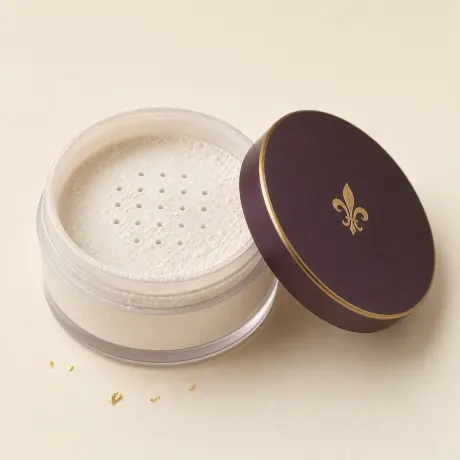
Other kinds of powder puffs
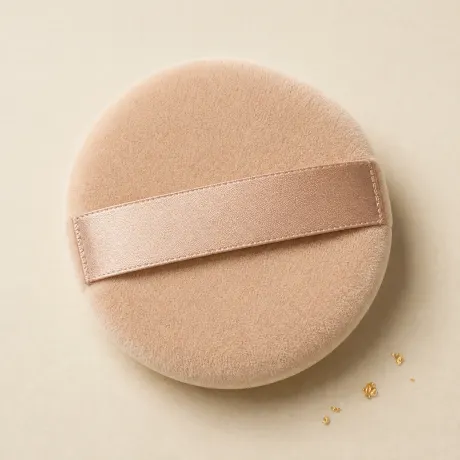
Velour powder puff
A plush round puff that presses powder in and rolls it off, setting without disturbing the base.
Read the guide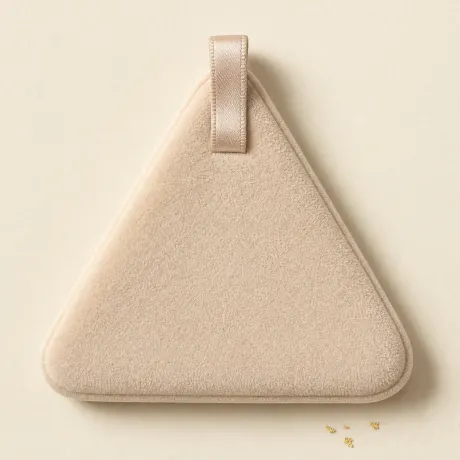
Triangle powder puff
A folded velour puff with a sharp point that reaches under the eye and around the nose.
Read the guide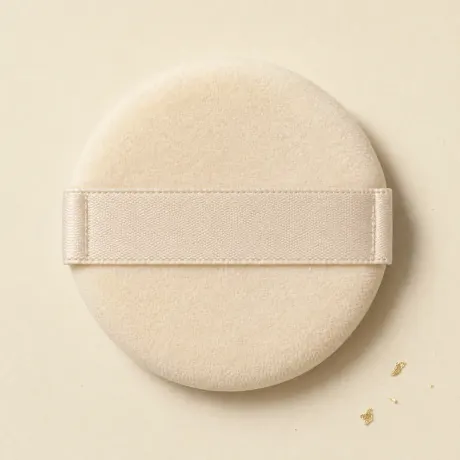
Cushion puff
A springy, flat puff that picks up cushion foundation and taps it on in a thin, even layer.
Read the guide