Cushion puff
The flat, springy puff that taps liquid foundation on in thin layers, from a cushion compact or from the back of the hand. How to choose one, use it off the compact, wash and replace it — and how the puff that came with the cushion became a product of its own.
A cushion puff is a flat, springy puff of dense, fine-pored foam, often with a soft cover and a fabric strap, used dry to pick up liquid or cushion foundation and tap it onto the skin in thin, even layers.

Our picks
Chosen across the foams and shapes cushion puffs now come in — Rubycell and plush, round, oval and teardrop — from Korean makeup and skincare houses and from American drugstore brands. These are the puffs we could confirm as sold by their makers; each opens on Amazon or at the house’s own shop.
As an Amazon Associate I earn from qualifying purchases. Affiliate links — we may earn a commission at no extra cost to you. How this works
Soft shellMid-range TIRTIR
Soft Shell Cushion Puff
Spare puffs from a Korean cushion maker, sold in packs so the one in the compact can be washed.
- Plush
- Packs of two or five
TeardropDrugstore Morphe
Cloud Cushion Seamless Puff
A double-layered teardrop with a precision tip, used dry with liquids, creams and powders.
- Double-layered
- Teardrop
- Use dry
Air puffMid-range Espoir
Be Velvet Air Puff
Round air puffs in a pack of seven, made to fit other brands’ cushions as well as the maker’s own.
- Round
- Fits most cushions
- Wet or dry
Pillow puffDrugstore e.l.f. Cosmetics
Pillow Puff Foundation Sponge
An inexpensive flat puff for liquid foundation, tapped on rather than blended.
- Bouncy foam
- Low absorption
- Tap to apply
Artist’s puffMid-range JUNG SAEM MOOL
Cushion Foundation Puff, The Round Shape
A pair of round puffs from the makeup brand of the Korean artist Jung Saem-mool, sized for a compact.
- Round
- Rubicelle
- Two to a pack
Oval RubycellDrugstore THE TOOL LAB
Long-lasting Tension Puff, Glow Type
An oval puff whose narrow end reaches the nose, sold as absorbing less foundation.
- Oval
- Rubycell
- Less absorption claim
Big puffMid-range Cell Fusion C
Multi-Use Base Puff
A large flat puff with a tapered tip, for foundation, BB cream and cushion alike.
- Rubycell
- Flat side and tip
- Wet or dry
A cushion puff is the small, flat puff that lives in the lid of a cushion compact: a springy pad of dense, fine-pored foam, often under a soft, velvety cover, with a fabric strap across the back for the fingers. It is used dry. Pressed onto the foundation-soaked sponge of a cushion, or onto liquid dotted on the back of the hand, it picks up a thin film and lays it on the skin in taps, building coverage in layers rather than blending it out.
Its neighbours do other jobs. A velour powder puff is fabric over a soft filling, made for dry powder. A blending sponge is used damp and bounced, and holds more of what it touches. A cushion puff is firmer and flatter, takes up little and gives it back on contact, which is why it suits runny formulas. Most are round, to fit a compact; oval and teardrop ones reach the nose and the inner corners of the eyes more easily.
Foam and shape
Makers sell cushion puffs on their foam. Several Korean houses use “Rubycell” or “Rubicelle” for a fine, micro-porous foam: The Tool Lab calls its Tension Puff pure Rubycell and says it absorbs less foundation, and Espoir, Cell Fusion C and Jung Saem Mool all sell their puffs on it. Others are sold on their build. Morphe’s is double-layered, e.l.f. sells a bouncy “pillow” of dense foam, and TIRTIR sells its plush puff as adapting to the contours of the face.
Shape follows the job. A round puff fits the compact and covers the cheeks and forehead; an oval or a teardrop has a narrow end for the sides of the nose and under the eyes; a large, flat puff covers the face fastest. If the puff is to live in a compact, check its size. Jung Saem Mool gives its round puffs as 2.1 inches, about 5 cm, across, and Espoir sells its own as fitting other brands’ cushions of a similar size.
Puff or sponge
Both lay down liquid foundation, and they leave different results. A damp blending sponge sheers a formula out, keeps some of it in the foam and leaves a softer, more diffused layer. A cushion puff, used dry, tends to put down more of what it picks up, in a thin, even film that builds with each round of taps. Choose the puff for a light base you top up during the day, for runny cushion and serum foundations, and for travel, since it needs no water. Choose a sponge for thicker creams, and for a sheer, blended finish over the whole face.
Using one without a cushion
A cushion puff works with any liquid foundation, not only a cushion. Dot a little foundation on the back of the hand, press the flat of the puff into it once, and stamp it onto the face in short, light taps, from the centre outward; the number of taps, not the pressure, builds the layer. Tap until no edge shows before going back for more.
If the result looks streaky, the puff is overloaded: press it on a clean tissue and carry on. For concealer, fold the puff and use the fold. Keep a second puff for cream blush or bronzer, because a puff that has carried colour tints the next foundation it touches. Some makers sell their puffs for powder too, used dry, but a puff kept for liquid is best kept for liquid.
Washing and replacing
A cushion puff goes between the face and the foundation many times a day, so wash it at least weekly, and more often if you touch up. Work a gentle soap into the foam, squeeze and rinse until the water runs clear, then press out the water in a towel and leave the puff to dry flat, out of the compact, with its strap up. A damp puff shut inside a closed compact cannot dry.
Replace it when the foam hardens, cracks or loses its spring, or when the cover pills or thins. That is why spares are sold in packs: TIRTIR sells its puffs in twos and fives, Espoir in sevens. Cell Fusion C sells its single puff as washable and reusable, keeping its bounce wash after wash. With a spare, one puff can dry while the other works, and nobody else’s puff should ever go into your compact.
Where it came from
The cushion puff arrived with the cushion. When Amorepacific put its IOPE Air Cushion on sale in 2008, it was a sunscreen: a polyurethane foam sponge soaked with liquid sunscreen, sealed in a compact with a puff, so that its users could carry it, touch up anywhere, and not have to wash their hands after applying their makeup.[1] The puff was part of the design from the start: the sponge held the liquid, and the puff kept the fingers out of it.
The format sold, and the puffs with it. By November 2016 Amorepacific said that more than 100 million cushion compacts had been sold, by then in their fourth generation, with a three-dimensional, hive-shaped sponge.[1] Each came with a puff that went between the face and the sponge many times a day, and a puff wears with every use. Spare puffs are now sold on their own, by Korean makeup and skincare houses and by American drugstore brands, for any liquid foundation, compact or not.
The techniques
- Pat
- Tap lightly with a fingertip or damp sponge so product melts in rather than moves.
- Press
- Press product onto the skin without dragging, so it stays where it is put.
Sources
- [1]AmorePacific changing women's makeup habits The Korea Times, 2016.View source (opens in a new tab) Accessed 2026-09-25.
What it is used with

Other kinds of powder puffs
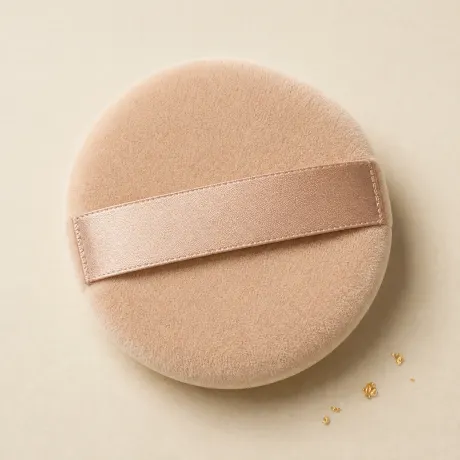
Velour powder puff
A plush round puff that presses powder in and rolls it off, setting without disturbing the base.
Read the guide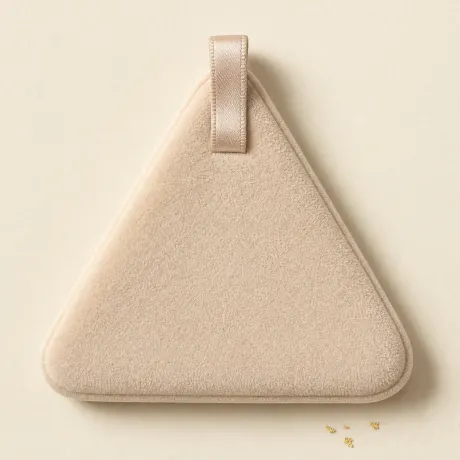
Triangle powder puff
A folded velour puff with a sharp point that reaches under the eye and around the nose.
Read the guide
Swansdown puff
A powder puff of soft down on a short handle — the dressing-table puff of the nineteenth and early twentieth centuries.
Read the guide