Baked blush
Blush made wet and dried slowly on a porous dish, which leaves it domed, marbled and luminous. What baking does, how to use one dry or damp — and the older trade in dried rouge cakes.
Baked blush is made from a wet, creamy paste of powders and pigment that is shaped on a porous base, often terracotta, and dried slowly in an oven, giving a domed, marbled cake with a luminous, usually shimmering finish.

Our picks
Chosen to cover the finishes, from sheer and satin to shimmering, and budgets from drugstore to prestige. Each opens where its maker sells it — on Amazon, or at the house’s own shop for those that do not sell there — and you choose your shade on that page.
As an Amazon Associate I earn from qualifying purchases. Affiliate links — we may earn a commission at no extra cost to you. How this works
SheerPrestige MAC Cosmetics
Mineralize Blush
A sheer, luminous baked powder that builds lightly, layer after layer, without heavy coverage.
- Baked
- Sheer
- Luminous
Terracotta-bakedDrugstore Milani
Baked Blush
Sold by Milani as a cream dough slow-baked on Italian terracotta into a marbled powder, in a wide range of shades.
- Baked on terracotta
- Made in Italy
Blush and glowMid-range Laura Geller
Baked Blush-n-Brighten
Blush and brightener marbled in one cake, which the company says is baked on terracotta tiles in Italy for 24 hours.
- Marbleized
- Baked for 24 hours
LuminousDrugstore COVERGIRL
TruBlend Skin Enhancer Baked Luminous Blush
An inexpensive baked blush with lighter swirls through the colour, for a soft glow.
- Luminous
- Light swirls
Talc-freeMid-range Kosas
Blush is Life
A talc-free baked powder, two tones swirled in each shade, for a finish closer to skin than to shimmer.
- Talc-free
- Two tones swirled
Baked blush is not pressed. A pressed powder is dry powder squeezed into a pan; a baked one starts as a creamy paste of powders, pigment and water, which is laid on a porous base, pressed into shape through a cloth, and dried in an oven while the water escapes through the base. That is where the dome comes from, and why the base is often terracotta: it lets the vapour out.[1] Some formulas begin not as a simple paste but as an emulsion of oil and water, thickened with a mineral.[2]
The wet method also holds together what a press cannot. Powders heavy with pearl, the particles that give shimmer, break apart when they are compressed, and baked compositions were developed to get round that.[2] So baked blushes lean luminous, often carry two or three colours swirled together, and have a harder, smoother surface than pressed ones, which gives up its colour slowly and makes a sheer layer easy. The same process makes baked highlighters and bronzers; a baked blush is the one with the most colour in it.
Dry or damp
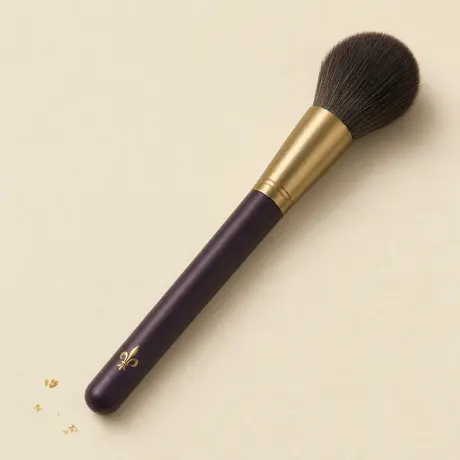
Used dry, a baked blush gives a sheer, buildable glow. Swirl a round, fluffy brush lightly over the whole dome, so it picks up every tone in the marbling, tap off the excess and sweep it onto the cheekbone, building in layers. The hard surface gives up less colour on each pass than a pressed powder does, which is the point: it is difficult to overdo.
Used damp, with a brush or sponge that has been misted and squeezed almost dry, the same cake gives stronger colour and more shine; baked cakes are commonly used with a wetted applicator.[3] Use water sparingly and let the surface dry before closing the compact. A cake that is soaked again and again can form a hard, glazed crust that no longer gives up colour; rubbing it gently with a clean, dry tissue usually brings it back.
Shimmer and skin
Most baked blushes have some shimmer, and shimmer shows texture. On smooth skin that is no problem; where pores or fine lines are a concern, keep the colour on the top of the cheekbone, where light would fall anyway, rather than on the apple, and use a light hand. Satin and near-matte baked blushes exist for anyone who wants the marbled colour without the shine.
Because the colours are swirled, a baked blush reads warmer or cooler depending on which part of the dome the brush takes most from. Turning the brush across the whole surface keeps the result the same from one day to the next, and keeps the dome wearing down evenly.
Looking after it
A baked cake has weak points of its own. The dome stands above the rim of the pan, so it takes knocks that a flat pressed powder does not; keep the compact closed and lying flat in a bag. The dome also changes with use, wearing into a shallow dip where the brush meets it most. The shape is awkward even for its makers: Chromavis’s patent notes that the classic dome lets powder and water escape from the pan when it is used with a wet applicator.[4]
Keep the brush clean, because oil carried back from the skin is what turns the surface of any powder hard and shiny. Close the compact only once a dampened surface has dried, and keep it out of a steamy bathroom, so that the cake stays as dry as it was when it left the oven. Kept that way, a baked blush lasts a long time: a little colour comes off with each pass, and a dome holds a great many passes.
Where it came from
Drying a wet colour into a cake is an old way of making rouge. In 1863 Pradal and Malepeyre described dried rouge cakes bound with oil and gum, and Bourjois began making rouge pots in 1879 by a method the firm claims to have invented: pigments and powders mixed with water and a little perfume, moulded into disks, dried, polished by hand and glued into their containers. A photograph of 1927 shows a drying cabinet for rouges at the Bourjois factory at Pantin.[5] Those cakes were dried, not baked: the trade’s instructions for wet-moulded compact powder, a method also used for rouge, were to dry the blocks at normal temperature in a current of air, because too much heat would split them.[6] Rouges still made this laborious way in the early twentieth century were often advertised as hand made, and they gave way to cakes made in mechanical presses.[7]
The modern baked cake answers a different problem. A patent application filed by Amorepacific in 2006 explains that pressed make-up breaks apart once pearl passes about forty per cent, and that baked eye shadows and compact foundations were developed to overcome it; its own example was dried at 60 to 80°C for twelve to eighteen hours.[8] A patent from the Italian manufacturer Chromavis, filed in 2009, describes the known process for baked eye shadow, blusher and bronzing powder: a creamy paste set on a permeable base, pressed into a dome by a concave die, and dried in an oven while the water escapes through the base. Its own invention names terracotta as the preferred base.[9] Several makers now advertise their terracotta tiles as Italian craft. In the patents, terracotta is a practical choice: it lets the water out.
The techniques
- Sweep
- Long, light strokes that deposit a veil of product.
Sources
- [1, 3, 4, 9]EP 2 218 350 B1 — Baked make-up product of preferably flat form European Patent Office, 2014.View source (opens in a new tab) Accessed 2026-09-25.
- [2, 8]WO 2007/119916 A1 — Plate for baked type make-up cosmetic compositions World Intellectual Property Organization, 2007.View source (opens in a new tab) Accessed 2026-09-25.
- [5]Bourjois Cosmetics and Skin, 2023.View source (opens in a new tab) Accessed 2026-09-25.
- [6]Compressed Face Powders Cosmetics and Skin.View source (opens in a new tab) Accessed 2026-09-22.
- [7]Rouge Cosmetics and Skin, 2010.View source (opens in a new tab) Accessed 2026-09-25.
What to apply it with
Other kinds of blush
Powder blush
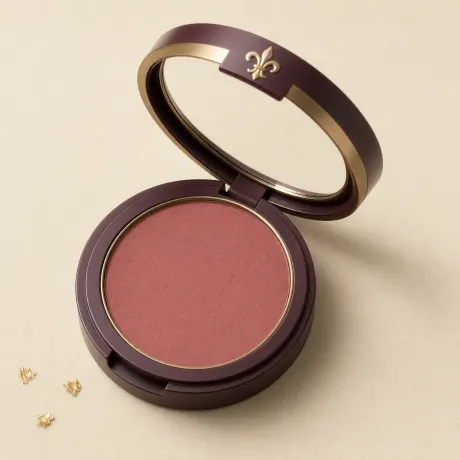
Pressed colour for the cheeks, the most common form of blush.
Read the guide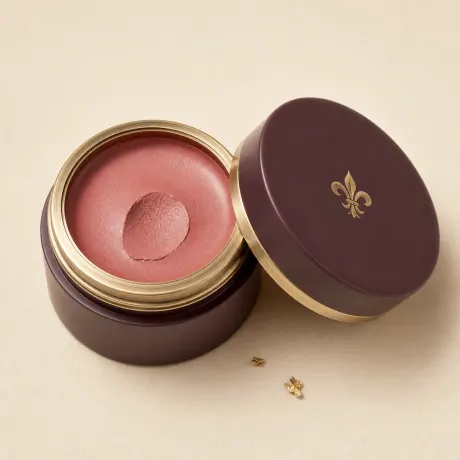
Cream blush
An emollient colour that melts into skin, often worn on the lips as well.
Read the guide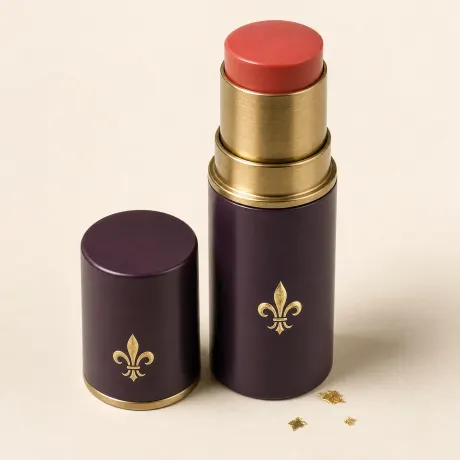
Blush stick
Cream blush in a twist-up stick, applied straight to the cheek.
Read the guide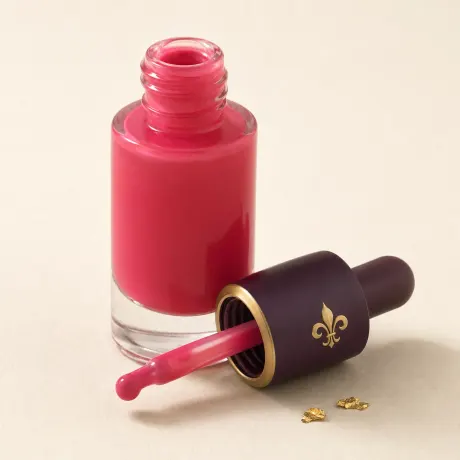
Liquid blush
Highly pigmented fluid colour for a flush that looks like it comes from under the skin.
Read the guide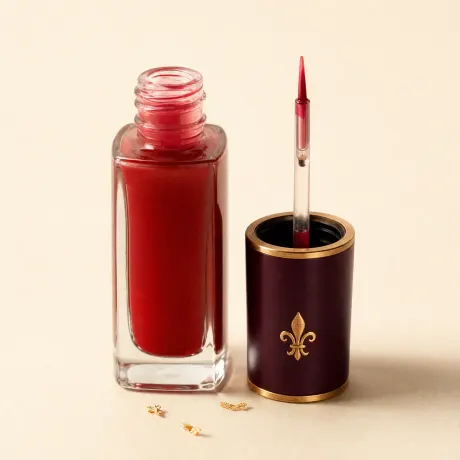
Cheek and lip tint
A water-thin stain that dyes rather than coats, and lasts through the day.
Read the guide