Angled liner brush
A thin, stiff brush cut on a sharp slant, for pressing gel or powder along the lashes and stamping the flick of a wing. How to choose one, how to line with it — and the orange stick that came before it.
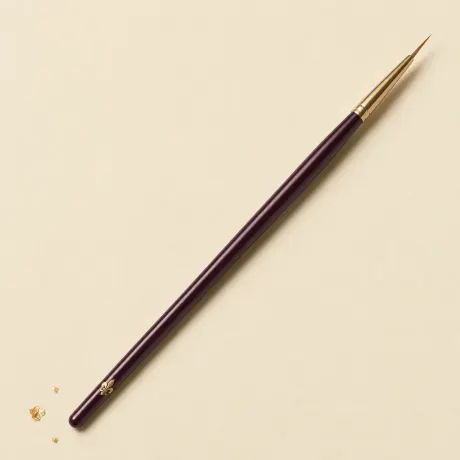
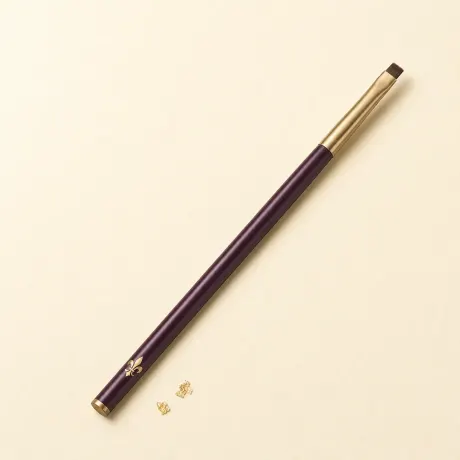
An angled liner brush is a small eyeliner brush of thin, flat, firm fibres cut on a sharp slant, used to press gel, cream or damp powder along the lash line and to draw the flick of a wing.

Our picks
Chosen across the sizes and firmness of the angled liner, from small, sharply angled wing brushes to wider ones that fill brows as well, in synthetic fibre and synthetic sable, from drugstore to prestige, one brush from each house. Each opens at the maker’s own shop.
Affiliate links — we may earn a commission at no extra cost to you. How this works
Ultra-flat anglePrestige MAC Cosmetics
263 Synthetic Small Angle Brush
An ultra-flat angled liner of firm fibres for thin lines of any eye colour along the lashes, or for brow strokes.
- Ultra-flat, angled
- Firm synthetic
- Liner or brows
Stamp and wingDrugstore Morphe
M363 Angled Eyeliner Brush
Stamp colour along the lashes with the slant, then wing it out to any length.
- Angled tip
- Powder, cream or liquid
Winged linerMid-range Sigma Beauty
E06 Winged Liner Brush
A small, sharply angled head made for a clean, fine line and a cat-eye wing.
- Small, sharply angled
- Gel or liquid
PrecisionPrestige Hourglass
Nº 10 Angled Liner Brush
An angled liner for lining and defining the eyes with precision and control.
- Angled
- Precision and control
Short bristlesDrugstore wet n wild
Angled Liner Brush
An inexpensive small brush of short, angled bristles for lining and defining.
- Short, angled bristles
Tapered pointMid-range Bdellium Tools
Golden Triangle 762 Small Angle
An angled, tapered point that follows the lash line in powder, liquid or cream, and fills brows.
- Angled, tapered point
- Vegan synthetic
- Brows too
Fine silhouettePrestige By Terry
Tool-Expert Eyeliner Brush
A fine, angled silhouette whose tapered tip hugs the lash line, for cream, gel or powder at any thickness.
- Fine, angled
- Tapered tip
- Vegan synthetic
Budget angleDrugstore L.A. Girl
Angled Liner Brush
An inexpensive angled liner made for easier lining and control.
- Angled
- Soft synthetic
Gel linerMid-range Jones Road
The Precision Eyeliner Brush
Firm, angled bristles made for the house’s gel liner, for a light line or a bolder one built up in coats.
- Firm, angled bristles
- Gel liner
Crisp or smudgedPrestige Trish McEvoy
Brush 50 Liner
A firm, angled liner for anything from a crisp line to a softly smudged one.
- Firm, angled
- Gel, cream or powder
Slender slantDrugstore KIKO Milano
Eyes 62 Slanted Eyeliner Brush
An inexpensive slender slant for clean, precise lines around the eye.
- Slender, slanted
- Synthetic
Cream or cakeMid-range Graftobian
OMNIA® Angle Liner Brush
An angle liner from a professional make-up house, for winged lines in cream or cake liner and for the brows.
- Angled
- Cream or cake liner
- Brows too
Slanted edgePrestige Clinique
Eye Definer Brush
A slim, firm, slanted edge for lining both lash lines and drawing cat-eye wings, in powder or cream.
- Slanted edge
- Firm bristles
- Wings and brows
Bevelled tipDrugstore essence
eyeliner brush
An inexpensive brush with a small, bevelled tip for precise gel lines.
- Small, bevelled tip
- Gel liner
Wet or dryMid-range Make-up Designory
#210 Angle Liner Brush
A fine, sharp angle from a makeup school’s own line, for eyeshadow used wet or dry as liner.
- Fine, sharp angle
- Wet or dry
- Synthetic
Thin and firmDrugstore Crown Brush
Pro Precision Angle Liner C541
A thin, firm angled head from a professional brush maker, for precise lining and for the brows.
- Thin, firm, angled
- Liquid, powder or cream
Synthetic sableMid-range Smith Cosmetics
205 Angled Liner Brush
An angled liner of soft synthetic sable, for anything from a graphic wing to tightlining.
- Angled
- Synthetic sable
- Gel, cream or powder
Vegan angleDrugstore Palladio
Angle Liner Brush
An inexpensive vegan angled liner for gel liner, shadow and brow pomade.
- Angled
- Soft, firm synthetic
- Vegan
Winged lineMid-range BK Beauty
208 Precision Angled
A precise angle for a winged line in shadow or gel, or for extending a kohl pencil line.
- Precise angle
- Shadow or gel
- Brows too
Thin or thickDrugstore Ulta Beauty Collection
Angled Eye Liner Brush 174
An angle from Ulta’s own line that draws a thin line or a thick one, in gel, cream or powder.
- Angled
- Synthetic
- Gel, cream or powder
An angled liner is a tiny, thin wedge of firm fibres, cut on a sharp slant and set in a pinched ferrule on a long handle. It is pressed more than drawn. Laid against the roots of the lashes, the long edge prints a short, even line; moved along in overlapping presses, it builds a line of any length without the wobble of a single long stroke. The point of the slant draws the flick of a wing, and turned onto its edge the brush draws a line finer than its own width.
That makes it a forgiving liner brush to learn with. A fine, pointed liner brush draws the thinnest line and the sharpest wing but follows every tremor of the hand; a flat definer presses colour into the roots of the lashes without drawing an edge at all. The angled liner sits between them, and because the same slant fills sparse brows with short strokes, many makers sell it for both.
Choosing one
Firmness comes first. Gel and cream liners need a stiff brush that does not splay under pressure: press a good angled liner against the back of your hand and its fibres stay in a thin plane, with a straight edge. Most are synthetic, which suits gels and creams because the fibres do not soak them up; Smith Cosmetics makes its 205 of soft synthetic sable, which it says balances flexibility with control.
Then size and angle. A very small, sharply angled head, like Sigma’s E06, is made for the wing and a thin line; brushes sold for liner and brows alike, like MAC’s ultra-flat 263S or Clinique’s Eye Definer, lay a line quickly and fill brows as well. The steeper the slant, the finer the point; a firmer, slightly wider angle suits the short strokes of a brow. Look at the length of the fibres too: short fibres give control close to the lashes, and a brush that bends too far drags liner across the lid instead of printing it.
Read the description as well as the name. Some brushes sold as angled have a pointed head on a bent ferrule rather than a cut tip; those are fine liners, and they draw rather than press. An angled liner is one whose bristles are cut on the slant.
How to line with it
Load the brush lightly. Press both sides of the slant into a gel pot, or dampen the brush and press it into a powder shadow for a softer, matte line, then wipe the excess off on the back of your hand: too much product is what makes a pressed line blotchy. Looking down into a mirror, set the long edge against the upper lash line at the outer corner and press, then lift and press again a little further in, overlapping each print. Two or three passes make a thicker line; a thin one needs only one.
For a wing, look straight ahead, set the point at the outer corner and draw the slant up towards the tail of the brow in one short stroke, then join the top of the flick back to the line on the lid. Taking both eyes to the same stage before finishing either keeps them even. To tightline, press the edge up into the roots of the upper lashes from below while looking down.
Two habits spoil most pressed lines. One is starting too thick at the inner corner: begin thin at the inner third and let the line grow towards the outer corner, where it can carry more weight. The other is pressing too hard, which fans the fibres and blurs the edge. If the brush splays, lighten the pressure or wipe off some product, rather than going over the line again.
Clean the brush after every use with gel, because dried gel stiffens the fibres and opens the edge. Wipe it on a tissue, wash it with a mild cleanser, reshape the edge between your fingers and dry it lying flat.
Where it came from
The line along the lashes was drawn for a long time with whatever came to hand. The actor Cavendish Morton, setting out his own method in 1909, darkened the lashes “by drawing a thin line along the edges of the lids. This I do with an orange stick dipped in melted paint.” For Hamlet the line was “carried a little way out at the outer corner of the eyes”.[1] A manicurist’s stick of orangewood, stage paint and a short extension at the corner: the parts of a winged line, without a brush.
By the 1960s the colour itself was being sold to be used either way. Among the eye make-up the British firm Eylure launched in the middle of the decade was Shadoliner, a “cake eye make-up that doubles as shadow or liner”,[2] the kind of product that asks for a brush able to press powder into a line as easily as it spreads it.
When the first brush cut on a slant for eyeliner went on sale is not recorded in anything read for this page, and no claim to a first is made here. What the angled liner keeps from Morton’s orange stick is the method: colour laid along the edge of the lid in short, controlled touches, with the outer corner carried a little further out.
The techniques
- Draw
- A single controlled line, built from short strokes where the hand needs it.
- Wing
- Extend the liner past the outer corner in a flick that follows the lower lash line upward.
- Tightline
- Press liner into the roots of the upper lashes from beneath, so the lash line looks denser with no visible line.
Sources
- [1]The Art of Theatrical Make-up Adam and Charles Black, London; Project Gutenberg eBook #56617, 1909.View source (opens in a new tab) Accessed 2026-09-26.
- [2]Eylure Cosmetics and Skin, 2019.View source (opens in a new tab) Accessed 2026-09-25.