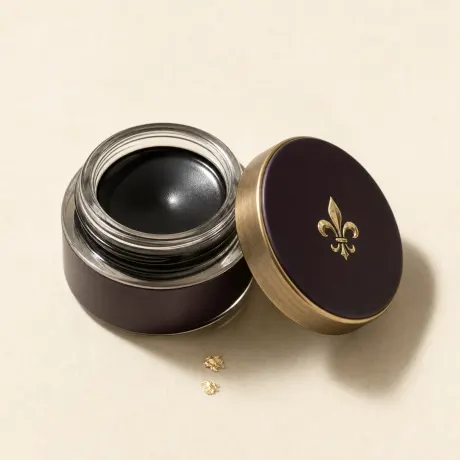
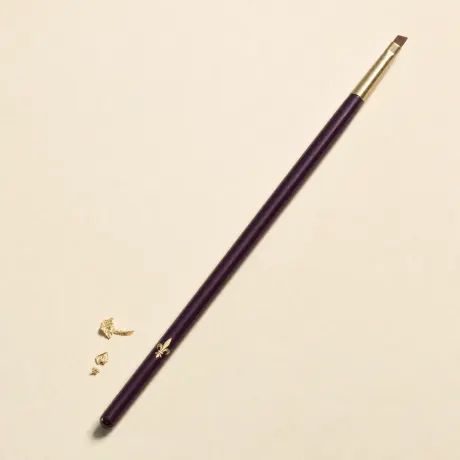
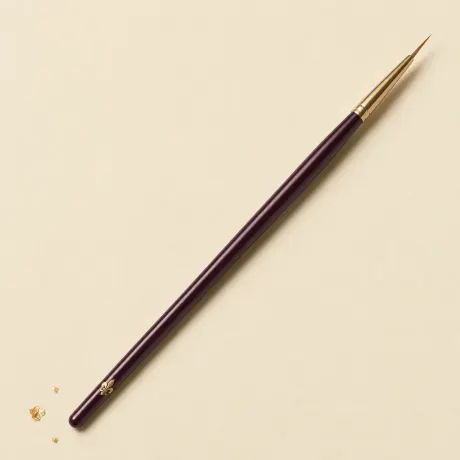
Flat definer brush
A tiny, square-cut brush that pushes colour into the roots of the lashes instead of drawing a line above them. How to choose one, how to tightline with it — and the kohl rod that did the same job first.
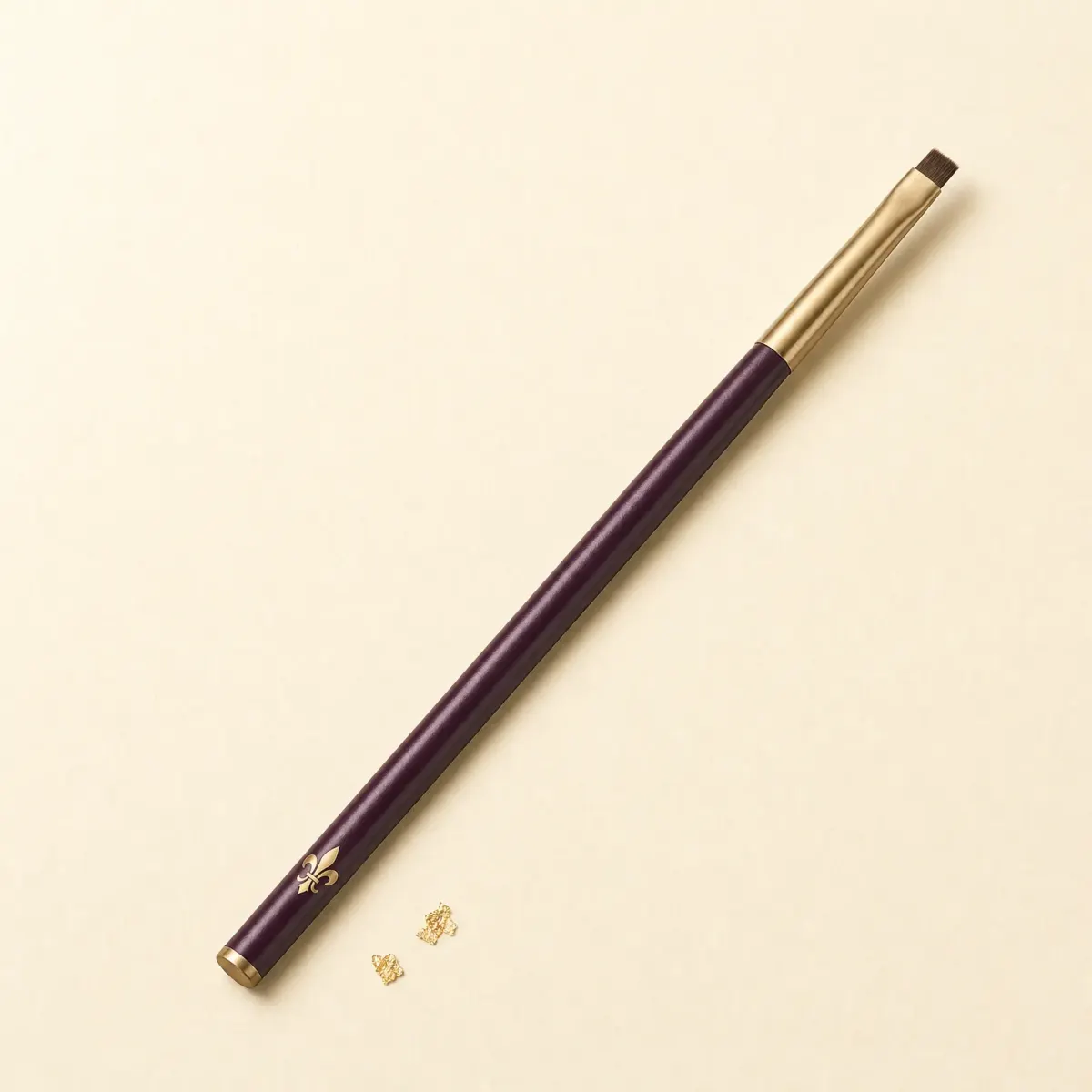
A flat definer brush is a small, flat, very dense eyeliner brush cut straight across, used to press gel, cream or powder into the roots of the lashes and along the upper waterline rather than to draw a line.
Our picks
Every house found selling a single flat, square-cut liner brush whose page could be verified and bought from, one brush each, in synthetic fibre and horse hair, among them a brush from Kumano. It is a professional’s brush, and few drugstore houses make one. Each opens at the maker’s own shop; one Australian house ships from its own shop abroad.
Affiliate links — we may earn a commission at no extra cost to you. How this works
Flat definerPrestige MAC Cosmetics
212 Synthetic Flat Definer Brush
A firmly bristled flat head that lays colour along the lashes in one stroke, and doubles as a brow brush.
- Flat, firm
- Powder, liquid or cream
- Brows too
Square and flatMid-range Anastasia Beverly Hills
A1 Pro Brush – Flat Definer Brush
A flat, square head of firm, thinly packed fibres, sized for the lash line and for tightlining.
- Flat, square
- Firm synthetic
- Tightlining
Square-toppedPrestige Trish McEvoy
Brush 11 Precise Lining
A square, flat-topped head with a razor-thin edge, pressed and wiggled across the base of the lashes.
- Square, flat-topped
- Razor-thin edge
- Synthetic
Firm flatMid-range Bdellium Tools
Golden Triangle 714 Flat Eye Definer
A firm, flat definer for precise lines and full-colour definition.
- Firm, flat
- Vegan synthetic
Straight edgeDrugstore KIKO Milano
Eyes 61 Graphic Eyeliner Brush
An inexpensive rigid, straight-edged brush for precise, graphic lines.
- Horizontal edge
- Rigid fibres
- Cream or powder
Thin flat linePrestige Laura Mercier
Flat Eye Liner Brush
Firm bristles that narrow to a thin, flat line, for exact placement along the lashes.
- Thin, flat
- Firm synthetic
Push, don’t dragMid-range Rae Morris
Jishaku #17 Square Lash Liner Brush
A square liner that pushes product into the lash line instead of dragging it, based, its maker says, on Japanese tradition.
- Square
- Pushed into the lash line
ChiselledMid-range Graftobian
OMNIA® Flat Liner Brush
Chiselled synthetic bristles from a professional make-up house, for liner or shadow in any formula.
- Chiselled bristles
- Vegan fibres
- Liquid, cream or powder
Horse hairPrestige Hakuhodo
J521BkSL Eyeliner Flat
From the Kumano maker Hakuhodo: a flat head of horse hair for extremely thin lines on the eyes and brows.
- Flat
- Horse hair
- Extremely thin lines
Ultra-flatMid-range Cinema Secrets
S16 Flat Smudge Liner Brush
A firm, ultra-flat edge for stamping colour at the lash roots, or softening a cream liner into smoke.
- Ultra-flat, firm
- Stamp at the roots
A flat definer is a liner brush that does not really draw. Its head is a tiny, very dense block of short fibres, cut square across and pinched flat in its ferrule, and it is used by pressing: set against the lash line and pushed or wiggled into the roots, it fills the gaps between the lashes with colour. The result looks like thicker lashes rather than a line, which is why it is also the brush for tightlining, colour pressed into the upper waterline from below.
Its neighbours are both liners. An angled liner is cut on a slant and prints a line with its edge; a fine liner draws with a point. The flat definer’s square edge can draw a crisp line too, turned on its side, but its real work is at the roots, where a pointed or angled brush tends to leave a line floating above the lashes. Rae Morris sells hers on exactly that promise: push the product into the lash line, with no need to drag the brush.
Choosing one
Density and length come first. The denser and shorter the head, the more colour it pushes into the roots and the less it spreads. A very short head, like Hakuhodo’s J521, whose hair its maker gives as 2.3 millimetres long, is sold for extremely thin lines; a firm flat head like MAC’s 212S lays colour along the lash line in a single stroke and doubles as a brow brush. The edge should be straight and firm: press it on the back of your hand, and it should leave a crisp stamp rather than a smear.
Fibre follows the formula. Synthetic fibre suits gel and cream liner, and anything used near the waterline, because it does not absorb product and washes clean; most flat definers are synthetic, several sold as vegan. Hair grips powder and presses it softly: Hakuhodo makes its J521 of horse hair. A slightly longer, more flexible head spreads colour a little as it presses, which suits a softer look; a very short, stiff one leaves the crispest edge and is the better tightliner.
For tightlining, choose a head no wider than the gap you are filling, since a brush that is too wide lands on the lid as well. Anastasia Beverly Hills sizes its A1 for the job, with thinly packed fibres, and Trish McEvoy gives its Brush 11 a razor-thin edge to reach the base of the lashes.
Pressing and tightlining
For definition along the upper lashes, dip the flat edge into gel or a dark powder shadow, tap off the excess, and press it into the lash roots from above, working from the outer corner inward in small wiggles rather than strokes. Build intensity with a second press where the lashes are sparse. Used dry with powder, the brush gives a soft line; dampened first, a sharper one.
To tightline, tilt your head back slightly, look down into a hand mirror and lift the upper lid gently at the outer corner. Press the loaded edge upward into the waterline beneath the lashes in short touches; there is no need to cover the whole rim. Use a product its maker says is suitable for the waterline, and stop if your eyes water or sting.
Below the eye, use less. Press only the outer half of the lower lash line, in a softer colour than above, because a dark line pressed right round the eye closes it up. For a gentler finish anywhere, press a matte shadow a shade lighter than the liner over the pressed line: it softens the edge without losing the definition at the roots.
Hygiene matters more with this brush than with any other, because it touches the rim of the eye. Wash it after each use with gel or cream, never share it, and replace it when the edge will no longer hold its shape.
Where it came from
The oldest tool for colour at the roots of the lashes is not a brush but a rod. The Metropolitan Museum of Art holds a kohl tube of faience and gold from Egypt’s Eighteenth Dynasty, about 1550–1300 BCE, catalogued with its applicator, a hematite stick 4.5 centimetres long.[1] Edward Lane, writing about the Egypt of 1833–35, found the same kind of tool in common use: kohl “applied with a small probe, of wood, ivory, or silver, tapering towards the end, but blunt”, moistened, dipped in the powder “and drawn along the edges of the eyelids”. The probe, he noted, “is called ‘mirwed’”.[2]
The historian James Bennett describes how such a rod works on the waterline: passed through the base of the lashes with the eyes closed, it leaves powder on the wet inner rim of the lid, “creating a smooth, even line”. The French house Dorin gave its customers the same instruction for El Mesdjem, a kohl it sold in the late nineteenth century: lay the coated wand between the lids, close the eye on it and slide it out.[3]
The flat definer does that work from outside the eye, with a shape borrowed from the painter’s box: square-ended and short-bristled, what the Getty’s art vocabulary calls a bright.[4] It presses colour into the same roots that the rod once coated from within.
The techniques
- Tightline
- Press liner into the roots of the upper lashes from beneath, so the lash line looks denser with no visible line.
- Press
- Press product onto the skin without dragging, so it stays where it is put.
Sources
- [1]Kohl Tube and Applicator, accession number 30.8.150 Department of Egyptian Art, The Metropolitan Museum of Art.View source (opens in a new tab) Accessed 2026-09-22.
- [2]An Account of the Manners and Customs of the Modern Egyptians, written in Egypt during the years 1833-1835 Ward, Lock and Co., London (reprint of the third edition of 1842); Project Gutenberg eBook #70796, 1890.View source (opens in a new tab) Accessed 2026-09-25.
- [3]Kohl Cosmetics and Skin, 2012.View source (opens in a new tab) Accessed 2026-09-25.
- [4]brights (brushes), Art & Architecture Thesaurus J. Paul Getty Trust.View source (opens in a new tab) Accessed 2026-09-26.