Wedge sponges
Small, dense triangles of foam, sold by the bag and used dry for coverage or damp for a sheerer layer, with an edge for tidying lines. Latex or latex-free, how to use them, when to throw them away — and how the rubber sponge came into the makeup kit.
Wedge sponges are small, dense triangles of fine-pored foam, latex or latex-free, used dry or barely damp to press foundation on with their flat faces and to tidy lines with their edges and points.
Our picks
Chosen across the forms a wedge now takes — the classic bagged wedge, jumbo and professional packs, a Korean latex round cut into six and a Japanese triangular pad — and across latex and latex-free foams. Wedges are a plain, mostly unbranded product, and these are the ones we could confirm as sold by their makers; each opens on Amazon or at the house’s own shop.
As an Amazon Associate I earn from qualifying purchases. Affiliate links — we may earn a commission at no extra cost to you. How this works
Japanese padPrestige Koh Gen Do
Makeup Sponge for Liquid/Cream Foundation
A flat, dense triangle shaped to fit the palm, sold by its Japanese maker for pressing liquid and cream foundation into the skin.
- Triangular
- Latex-free
- Dense
Jumbo wedgesDrugstore Swisspers
Premium Pro Cosmetic Wedges, Jumbo
Larger than most wedges, for pressing foundation over the whole face with a broad flat side.
- Latex-free
- Jumbo size
- Precision edges
Latex roundMid-range Piccasso
Latex Round Makeup Sponges
A round of latex foam cut into six wedges by a Korean tool maker, for anyone who wants latex rather than latex-free foam.
- Hydrophilic latex
- Six wedges
- Damp or dry
Professional bagDrugstore ForPro
Beauty Wedges
A professional supplier’s bag of a hundred, for anyone who uses a fresh wedge for every face.
- Latex-free
- Bag of a hundred
TheatricalMid-range Mehron
Non-Latex Triangular Foam Wedge
A theatrical makeup house’s non-latex wedge, for stage and cream makeup as well as foundation.
- Non-latex
- Cream and liquid
CharcoalDrugstore Daiso
Makeup Sponge, Charcoal, Wedge Shape
Grey charcoal wedges from a Japanese chain, twenty-two to a pack, sold as reusable until the surface wears.
- Wedge shape
- With charcoal
- Twenty-two
Made without latexDrugstore Ulta Beauty Collection
Beauty Wedges
A store’s own bag of latex-free wedges, sold for use dry for full coverage or damp for a sheerer layer.
- Made without latex
- Dry or damp
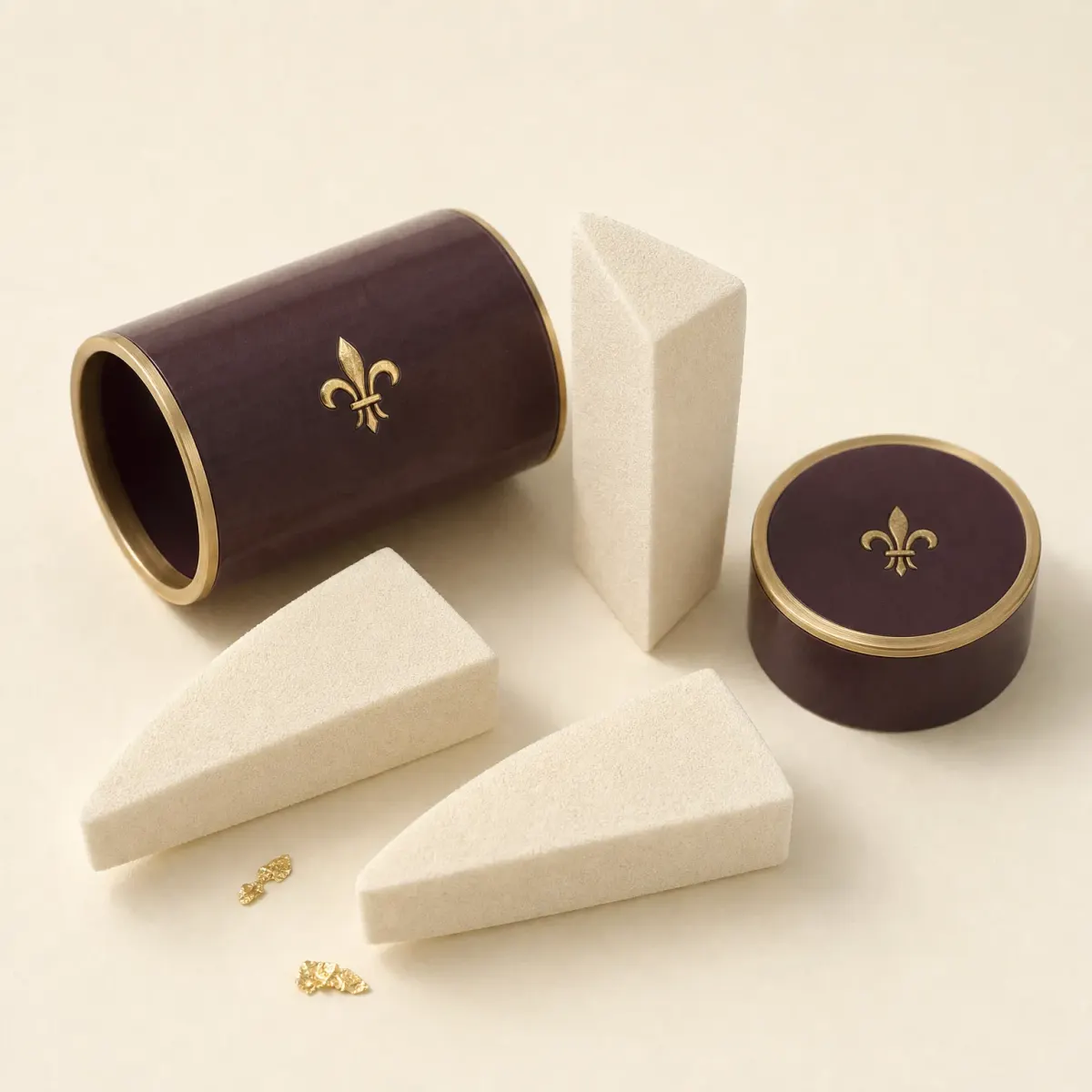
A wedge is the plainest tool in the kit: a triangle of dense, fine-pored foam, usually cut from a round or a block and sold by the bag. Its two flat faces press foundation or cream onto the skin, its point reaches the inner corner of the eye and the sides of the nose, and its long edges do the jobs no other tool does as well: cleaning up under a winged liner, sharpening a lip line, softening the edge of contour.
Beside a blending sponge it is firmer and denser, with smaller pores, and it swells little when wet, so it lays down more of what it picks up. Used dry it gives fuller coverage; used damp, a sheerer layer. And it is cheap enough to treat as disposable: one wedge, one face.
Sizes and shapes
The standard wedge is about the length of a finger, cut from a block, with two sharp corners and a point. Jumbo wedges give a broader flat face for foundation over the whole face; small ones are easier around the eyes and for detail. Some are sold as a round cut into six, which leaves each wedge with one curved side to roll over the cheek, and a few are single flat pads cut to a rounded triangle, such as Koh Gen Do’s, made to be held in the palm and pressed rather than dabbed.
Most are white or cream, which shows exactly when one is spent. Charcoal-grey and coloured wedges hide their stains, so judge those by feel: a wedge that has gone stiff or rough at the edge is finished.
Latex or latex-free
Wedges come in two families. Latex wedges are cut from latex foam: Piccasso sells its round of six as hydrophilic latex that turns soft and bouncy when damp. Latex-free wedges are the rest, and most bags on sale now are labelled that way. Swisspers, ForPro and Ulta sell theirs as latex-free, and Mehron sells its non-latex wedge as suited to all skin types, sensitive skin included.
The difference matters to anyone allergic to latex: the FDA puts allergy to natural rubber latex at roughly 1 to 6 per cent of the general population.[1] If you are allergic, or unsure, buy a bag that says latex-free, and stop using any sponge that makes the skin itch, redden or swell.
How to use them
For coverage, use the wedge dry. Dot foundation on the back of the hand, pick it up on a flat face and press it onto the skin, then stipple and roll outward; a dry wedge drags if you wipe it. For a sheerer layer, dampen it and squeeze it out hard in a towel. The latex round is sold for both: dry for a matte finish, damp for a dewy one.
Then use the edges. Run the long edge along the lower lash line to lift fallen shadow, sweep it outward under a winged liner to sharpen the flick, press it along the outline of the lips after lipstick, and soften the hard edge of cream contour with the flat. Keep one corner for each product, foundation on one and concealer on another, and cut a big wedge in half with scissors when you want a fresh, sharp edge.
When to throw them away
A wedge’s fine pores are hard to rinse clean, and used sponges are not clean things. A UK study that cultured donated makeup found the sponges the most contaminated items tested, most of them never cleaned.[2] Some makers sell their wedges as reusable: Swisspers calls its jumbo wedges washable, and Daiso says its wedges may be reused but should be replaced once the surface is damaged.
Treat that as the limit, not the plan. Wash a reusable wedge straight after use in mild soap and warm water, squeeze it out in a towel and let it dry in the open air. Throw it away when it is stained through, crumbling at the edges or has sat damp in a bag, and never use one wedge on two faces.
Where it came from
Make-up that had to be applied wet brought the sponge to the dressing table. Marinello’s Phantom Powder cakes of 1914 were packed with one,[3] and in 1926 Dubarry sold a powder cream, Peach Bloom, to be applied with a moistened rubber sponge that turned it into a liquid powder on the face; its box was oxidised aluminium, so the water would not rust it.[4] A Max Factor lecture of 1940 said its Pan-Cake was applied “by using a moistened sponge or cotton”.[3]
The wedge’s edge had its advocates early. Harriet Hubbard Ayer, which sold packets of foam-rubber sponges, told readers in 1953 that “a sponge’s corner easily dots on and evenly spreads shadow” and that a pencilled brow could be softened with a sponge’s edge, the jobs a wedge is still bought for. The idea did not catch on at the time; brushes and puffs were easier to use and fitted inside compacts.[5]
When the bagged triangle became the standard cheap sponge is not recorded in any source we found, and we have not guessed. By the time Rea Ann Silva’s reusable egg arrived in the early 2000s, the museum that holds her prototypes notes, sponges were typically used a few times and thrown away.[6] The bag of wedges is that older habit, and the edge is still the reason to keep one in the kit.
The techniques
- Press
- Press product onto the skin without dragging, so it stays where it is put.
- Pat
- Tap lightly with a fingertip or damp sponge so product melts in rather than moves.
Sources
- [1]Latex in Cosmetics US Food and Drug Administration, 2024.View source (opens in a new tab) Accessed 2026-09-26.
- [2]Microbiological study of used cosmetic products: highlighting possible impact on consumer health Journal of Applied Microbiology 128 (2): 598–605, 2020.View source (opens in a new tab) Accessed 2026-09-26.
- [3]Pan-Cake Make-up Cosmetics and Skin, 2026.View source (opens in a new tab) Accessed 2026-09-22.
- [4]Dubarry Cosmetics and Skin, 2026.View source (opens in a new tab) Accessed 2026-09-26.
- [5]Harriet Hubbard Ayer (post 1947) Cosmetics and Skin, 2022.View source (opens in a new tab) Accessed 2026-09-26.
- [6]Rea Ann Silva: The woman behind Beautyblender National Museum of American History, Smithsonian Institution, 2020.View source (opens in a new tab) Accessed 2026-09-26.