Pressed highlighter
Light-reflecting powder pressed into a pan and brushed onto the high points of the face. What gives it its shine, how to choose a finish and a shade, where to put it — and how shine found its way into a powder.
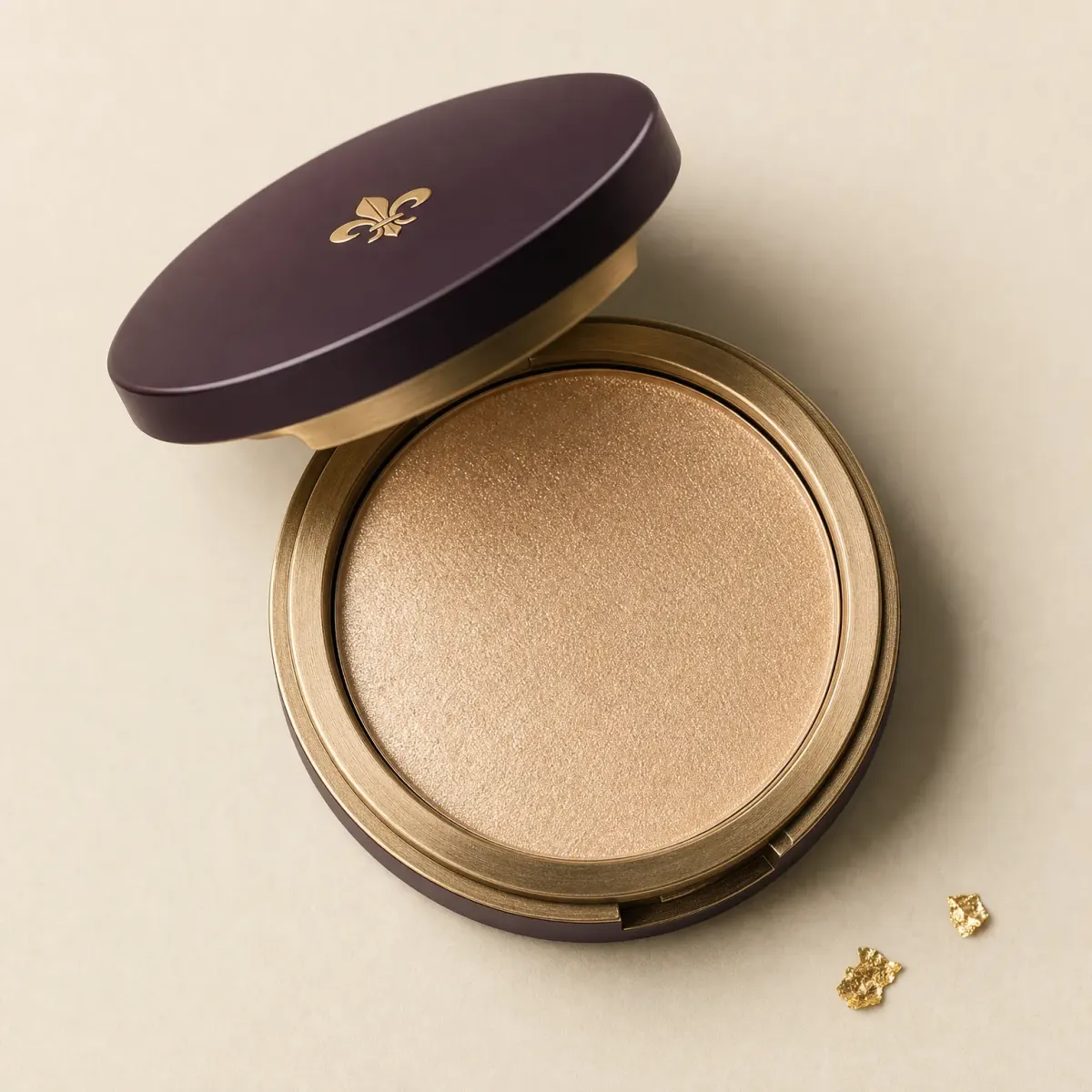
Pressed highlighter is a light-reflecting powder, made mostly of fine coated mineral flakes bound into a pan, that is brushed onto the high points of the face so that they catch the light.
Our picks
Chosen to cover the finishes, from a soft sheen to marbled, prismatic and metallic, and every budget from drugstore to prestige, with houses from Paris, Tokyo and Milan beside the American ones. Each opens where its maker sells it — on Amazon, or at the house’s own shop for those that do not sell there — and you choose your shade on that page.
As an Amazon Associate I earn from qualifying purchases. Affiliate links — we may earn a commission at no extra cost to you. How this works
Hydrating glowPrestige Dior
Dior Forever Glow Luminizer
A long-wearing powder with hyaluronic acid, sold in three finishes, for a glow that reads as skin rather than dust.
- Hyaluronic acid
- Long wear
- Three finishes
Micro-shimmerDrugstore e.l.f. Cosmetics
Halo Glow Silky Powder Highlighter
Fine micro-shimmer rather than glitter, at a drugstore price, sold as resisting caking.
- Micro-shimmer
- Cake-resistant
- Vegan
Pearl sheenPrestige NARS
Light Reflecting Luminizing Powder
A pearl powder that NARS sells for anywhere you want to reflect light, from the cheekbones to the brow bones.
- Radiant sheen
- Claims 10-hour wear
Glass-likeMid-range Rare Beauty
Positive Light Silky Touch Highlighter
A powder sold as giving a glass-like sheen, for anyone who wants glow without visible sparkle.
- Glass-like sheen
- Non-comedogenic
Opal shimmerPrestige Clé de Peau Beauté
The Luminizing Face Enhancer
The Japanese house’s highlighter, made with opal powder for a sheen that changes with the angle of the light.
- Opal powder
- Claims 12-hour wear
Low costDrugstore wet n wild
MegaGlo Highlighting Powder
The inexpensive place to start: a pearly pressed powder that is easy to control.
- Shimmer glow
- Natural pink
PrismaticPrestige MAC Cosmetics
Extra Dimension Skinfinish Highlighter
A liquid-powder hybrid with prismatic reflections, for a highlight that is meant to be seen.
- Liquid-powder
- Prismatic
- Claims 10-hour wear
Soft focusMid-range Makeup by Mario
Soft Glow Highlighter
Soft, lit-from-within light from a makeup artist’s brand, in five shades from Opal to Bronze.
- Creamy powder
- Five shades
Creamy powderPrestige YSL Beauty
Hyper Luminize Highlighter
A powder with the slip of a cream, for skin that finds most highlighters dry.
- Ultra-creamy
- Non-comedogenic
- Niacinamide
High impactDrugstore NYX Professional Makeup
Buttermelt Highlighter
A high-impact drugstore powder, sold on a claim of twelve hours’ wear.
- High impact
- Claims 12-hour wear
High intensityPrestige Pat McGrath Labs
Skin Fetish: Divine Glow Highlighter
The makeup artist Pat McGrath’s pressed highlight, made for intensity rather than subtlety.
- High-intensity
- Four shades
Talc-freeMid-range Haus Labs
Bio-Radiant Gel-Powder Highlighter
A talc-free gel-powder that melts onto skin, in ten soft-focus shades from Moonstone to Chocolate Opal.
- Talc-free
- Gel-powder
- Ten shades
Gel-powderPrestige Bobbi Brown
Highlighting Powder
A pearl-infused gel-powder from a house built on natural-looking makeup, for the cheeks and the eyes.
- Gel-powder hybrid
- Pearl-infused
Butter formulaDrugstore Physicians Formula
Murumuru Butter Highlighter
A butter-based pressed highlighter from a drugstore house, linked in its pale Pearl shade.
- Murumuru butter
- Dermatologist approved
StrobingPrestige Hourglass
Ambient Strobe Lighting Powder
Sold as a strobing powder, light used to sculpt, with a refined finish that suits a sparing hand.
- Strobing powder
- Natural highlight
Golden pearlMid-range Benefit Cosmetics
Cookie Powder Highlighter
One golden-pearl shade, a straightforward first highlighter.
- Golden pearl
- Single shade
MarbledPrestige Givenchy Beauty
Prisme Libre Highlighter Powder
Several tones marbled in one pan, sold as long-lasting and hydrating.
- Marbled
- Long-lasting
- Hydrating
Long wearDrugstore L'Oréal Paris
Infallible Up to 24HR Highlighter
A long-wear powder sold on a claim of twenty-four hours, for days when the highlight has to last.
- Claims 24-hour wear
- Longwear powder
Natural glowPrestige Lancôme
Teint Idole Ultra Wear C.E. Skin Transforming Highlighter
A vitamin-infused powder in five shades designed with the makeup artist Lisa Eldridge, for a natural rather than metallic glow.
- Vitamin-infused
- Five shades
Italian houseDrugstore KIKO Milano
Glow Fusion Intense Powder Highlighter
The Milan house’s pearl-rich powder, for a dewy rather than frosted highlight.
- Reflective pearls
- Dewy effect
VeganMid-range Jouer Cosmetics
Powder Highlighter
A vegan pressed highlighter from a smaller house, in shades named for stones: Citrine, Topaz, Rose Quartz.
- Vegan
- Gluten-free
- Paraben-free
Warm goldDrugstore ColourPop
Pressed Powder Highlighter
A buttery, highly reflective pressed powder, linked here in Boombox, a warm peachy gold.
- Buttery-soft
- Highly reflective
Pressed highlighter is a powder made to do the opposite of what face powder was invented for. A setting powder scatters light to hide shine; a highlighter sends it back. The shine comes from effect pigments: thin, flat platelets, most often mica coated with titanium dioxide or iron oxide, which reflect and refract light much as the layers of a pearl do. Synthetic mica, glass flakes and bismuth oxychloride play the same part in some formulas.[1] The platelets are mixed with a slippery base powder and a little oil or binder, and pressed into a pan.
The size of the platelets decides the finish. Fine ones give a soft sheen; larger ones catch the light as visible sparkle.[1] That is most of the difference between a highlighter that looks like skin in daylight and one that looks like makeup. Its neighbours differ in form more than in purpose: a baked highlighter is made wet and dried, and can hold more shimmer; a loose one has no binder at all; a cream or liquid one melts into the skin instead of resting on it. Pressed powder is the easiest of them to control, because it goes on last, over a finished base, and builds in thin layers.
Finish and shade
Finish runs from luminous or satin, a sheen with no visible particles, through shimmer, which glints as the face moves, to metallic or foiled powders that look almost wet. The softer the finish, the more forgiving it is. Open pores, fine lines and dry patches all show more under sparkle, because each particle sits on the surface and marks it; on smooth skin, or for evenings and photographs, the stronger finishes read well from a distance.
Choose the shade by the depth of your skin first. Pearl, champagne and pale pink suit fair skin; gold, peach and soft bronze a middle range; deep gold, copper, bronze and rose-gold dark skin, on which pale, silvery highlighters can sit as a grey or chalky film. Undertone comes second: a pinker highlight flatters cool skin, a golden one warm. A highlighter should look like light falling on skin, so test a stripe on the cheekbone and look at it by a window, not a swatch on the back of the hand.
How to apply it
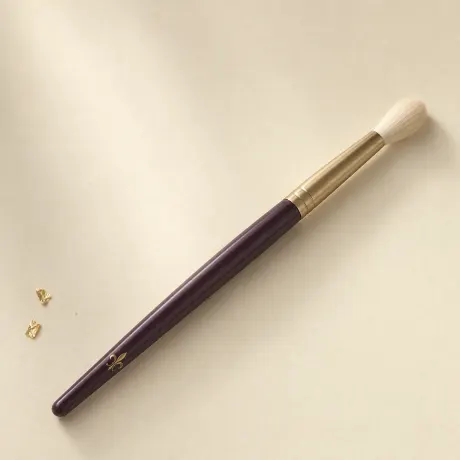
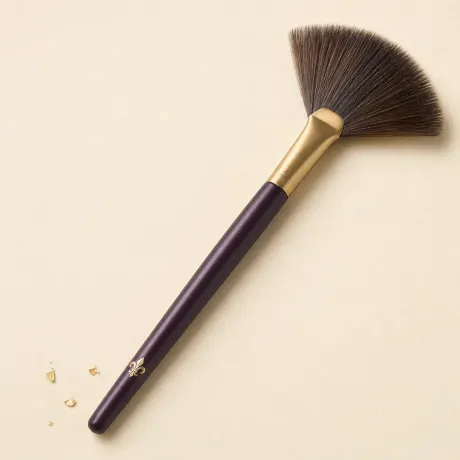
Highlight goes where light would fall on the face anyway: the top of the cheekbone, the bridge of the nose, the centre of the cupid’s bow, the brow bone and, lightly, the inner corner of the eye. Load a small tapered brush or a fan brush, tap off the excess, and sweep or press a narrow band along the top of the cheekbone, from about the outer edge of the iris towards the temple. Keep it above the blush rather than on it; on the apple of the cheek, shine finds every pore. A fan brush gives the lightest, most diffuse result, a tapered brush a narrower one, and a fingertip, pressing the powder in, the most intense of the three.
Apply it over a base that has been set, so it glides rather than grabs, and build slowly: two light passes look like skin, one heavy pass looks like powder. A damp brush gives a stronger, more metallic result, and the same powder pressed over a cream highlighter is more intense than either alone. Where skin is oily, keep the shine to the upper cheekbone and away from the nose and forehead, which will make their own by the afternoon.
Where it came from
Highlighting began as a matter of light and dark, not shine. In the mid-1930s Perc Westmore, head of make-up at Warner Brothers–First National, devised what he called corrective make-up on the rule cameramen used when lighting a face: light brings a feature forward and shade makes it recede. A broad nose was thinned by painting its ridge with a lighter greasepaint than the base and its sides with a darker one — “highlighting places that are undesirably recessed or concave, shadowing unpleasant protuberances”, as he put it in 1935.[2] Shine itself was the enemy. Under the brighter lights that Technicolor needed, the slight sheen of greasepaint picked up colour from the scenery, and Max Factor’s Pan-Cake, first used on a feature in 1937, was made to overcome it.[3]
Putting a pearly sheen into a powder took chemistry. Bismuth oxychloride, made in the laboratory from the 1930s with larger, more lustrous crystals, could be used dry, and so allowed pearlescent effects in face powders; titanium dioxide coated on mica, described in 1942, became widely available in the 1960s.[4] In 1959 Richard Hudnut was selling a Cloudsilk Pearled Face Powder.[4] In 1966 Max Factor launched Geminesse, a department-store line promising “beauty illusions of highlights, contour and shadow”, with a trio of highlights and shadows and five “light-reflective” pressed powders.[5]
Half a century after Geminesse, highlighter had become a product category in its own right. The NPD Group, which measures prestige beauty sales in the United States, reported that makeup’s growth in 2017 came partly from “other face products such as bronzers, highlighters, and glow products”.[6] A pressed highlighter holds both halves of that history: the light the film studios painted on, and the pearl that took so long to get into a compact.
The techniques
- Strobe
- Highlight the high points alone, with no shading to set them against.
- Sweep
- Long, light strokes that deposit a veil of product.
Sources
- [1, 4]Pearl Essence Cosmetics and Skin, 2009.View source (opens in a new tab) Accessed 2026-09-22.
- [2]The Ideal Face Cosmetics and Skin, 2018.View source (opens in a new tab) Accessed 2026-09-26.
- [3]Pan-Cake Make-up Cosmetics and Skin.View source (opens in a new tab) Accessed 2026-09-22.
- [5]Max Factor (post 1960) Cosmetics and Skin, 2013.View source (opens in a new tab) Accessed 2026-09-25.
- [6]U.S. Prestige Beauty Industry Sales Rise 6 Percent in 2017, Reports The NPD Group PRWeb, 31 January 2018, 2018.View source (opens in a new tab) Accessed 2026-09-26.
What to apply it with
Other kinds of highlighter

Baked highlighter
Highlighter baked into a domed cake, giving a wet-looking, metallic shine.
Read the guide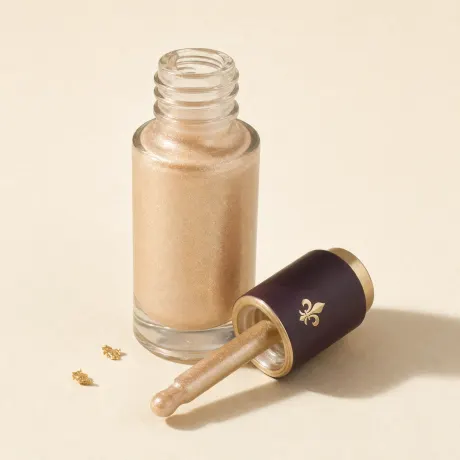
Liquid highlighter
A pearlescent fluid for an all-over glow or a precise high shine.
Read the guide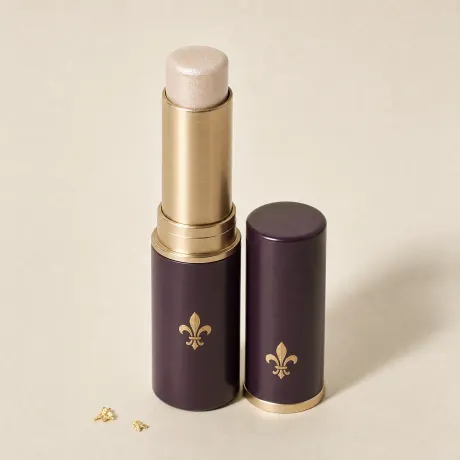
Cream highlighter stick
A translucent balm with a sheen, for a highlight that looks wet rather than glittery.
Read the guide
Loose highlighter
Pure shimmer pigment, the most intense form of highlight.
Read the guide