Loose highlighter
Shimmer with nothing to hold it together: the most intense highlighter there is, and the messiest. What it is made of, how to wear it without fallout, and the long history of pearl powder.
Loose highlighter is unbound shimmer powder — light-reflecting pigment, usually coated mica, with little or no base — pressed or swept onto the high points of the face for the strongest highlight a powder can give.

Our picks
Loose highlighter is a small category, and these are the ones we could find sold by their makers as highlighters for the face, from a pearled bronze for deep skin to white gold. Each opens at the house’s own shop, where you choose your shade.
Affiliate links — we may earn a commission at no extra cost to you. How this works
Deep skinMid-range Juvia's Place
The Nubian Loose Highlighter
A pearled bronze made for deep skin, where pale loose highlighters turn grey.
- Finely milled pearls
- Pearled bronze
- Vegan
Body glowDrugstore Rude Cosmetics
Moon Halo Face & Body Shimmer
A loose shimmer for the face and body that can be stirred into lotion for a glow all over.
- Face and body
- Mixes into lotion
Ultra-fineMid-range Ofra Cosmetics
Shimmer Loose Powder
An ultra-fine loose powder that builds from a sheen to a strong glow.
- Ultra-fine
- Made with minerals
- Face, body, hair
With applicatorDrugstore Profusion Cosmetics
Petal Power Loose Shimmer Highlighter
A white-gold loose shimmer sold with its own sponge applicator.
- Sponge applicator
- Face and body
Warm copperMid-range Juvia's Place
The Royalty Loose Highlighter
A copper-peach shimmer with gold reflects, sold as suiting every skin tone.
- Light copper
- All skin tones
Loose highlighter is shimmer with nothing holding it together. A pressed highlighter mixes its reflective platelets with a base powder and a binder and compacts them into a pan; a loose one leaves most of that out, so what comes out of the jar is close to pure pigment. That makes it the most intense highlighter there is, and the most versatile: a trace gives a sheen, a pressed-on layer gives near-metallic light, and a pinch stirred into moisturiser or foundation turns it into a liquid.
It is also the messiest. Loose shimmer travels: onto the cheek below, into the brows, across the counter. Its neighbours are easy to tell apart by what they are for. A loose setting powder blurs and takes shine away rather than adding it; cosmetic glitter uses larger particles that sparkle rather than glow; and loose eye pigments are close relations, some of them sold for the face as well.
Wearing it without fallout
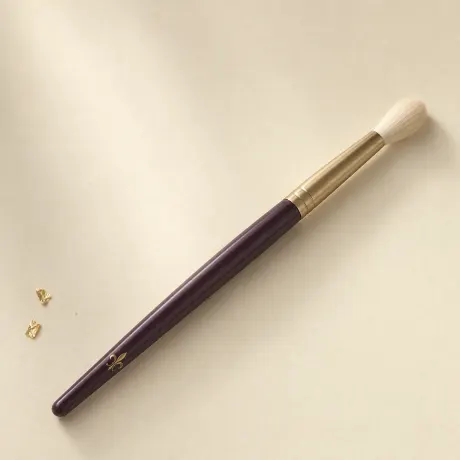
Never work straight from the jar. Tip a little into the lid, pick up a trace with a small, dense brush or a fingertip, tap off the excess and press it onto the top of the cheekbone rather than sweeping it. Pressing lays the platelets flat, which is where their shine comes from, and leaves less to fall. A thin layer of cream highlighter, balm or moisturiser underneath gives the powder something to grip, and a barely damp brush makes it more intense still.
Apply it before the concealer under the eyes and any final powder, so that fallout can be lifted away without disturbing them; a piece of tape pressed lightly on the skin picks up stray shimmer more cleanly than a brush. For a glow all over, mix a very small amount into a drop of moisturiser or foundation on the back of the hand. Close the jar after every use. A sifter stops the powder pouring out, but not drifting.
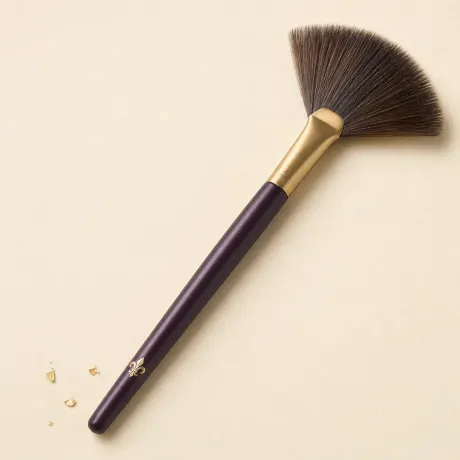
Around the eyes, keep it to the brow bone and the inner corner, and away from the lash line, where loose particles can drift into the eye. On the collarbones and shoulders, a larger, softer brush spreads a sheer veil that catches the light as you move.
Choosing one
Loose highlighters vary more than pressed ones, because nothing in the jar softens the pigment. Fine, pearly powders give a sheen that can be worn by day; coarser ones sparkle, and are better kept for the evening or the body. Duochromes, which shift colour as the angle of the light changes, are for effect rather than every day. Choose the depth of shade for your skin, pearl and champagne if it is fair and deep gold, copper or bronze if it is dark, because white or silver shimmer on deep skin reads as grey.
What it is made of
Most loose highlighters are built on mica, a mineral that splits into thin, flat sheets. Coated with titanium dioxide or iron oxides it gives pearly and metallic effects, and the size of the platelets decides the finish: small ones give a sheen, larger ones glitter.[1] Synthetic mica and glass flakes are used alongside it or in its place. In the United States, mica and bismuth oxychloride, another pearlescent white, are both listed as colour additives permitted in cosmetics generally, the eye area included.[2][3]
Natural mica has to be mined, and the trade has been investigated. The first inquiries by the Dutch organisations Terre des Hommes and SOMO, in 2015, estimated that up to 22,000 children were involved in mica mining in the Indian states of Jharkhand and Bihar.[4] Some makers now say they use synthetic mica, or mica from sources they audit. Those are the makers’ own claims; the place to check them is the ingredient list and what each maker publishes about its supply.
Where it came from
Powdered pearl is one of the oldest cosmetic whites. James Bennett, whose Cosmetics and Skin traces the trade literature, suggests the practice may have begun in China; ground pearl was sold by European apothecaries, and a book of 1825 describes Chinese boxes of colours holding a white powder “prepared from real pearl” for giving “an alabaster colour to some parts of the face and neck”.[5] What pearl gave was whiteness, not glow. A writer of 1826 warned that the cheaper imitations, made from mother-of-pearl or oyster shells, were never ground as fine, and so “leave a shining appearance on the face, which shows the art that has been used on the very first view”.[5] Shine was the giveaway.
The usual substitute was bismuth: bismuth oxychloride, which has a pearly sheen, and bismuth subnitrate, sold under names such as pearl white and blanc de perles. They had a notorious flaw. Some turned grey in the sulphurous air of rooms heated by coal and lit by gas, and an American advice book of 1870 describes women obliged to retire with their faces “of a dirty ash color”.[5] The Science Museum holds a Pears’ Blanc de Perle of about 1890, a face whitener made with bismuth oxychloride and sold for everyday and theatrical wear.[6]
In the twentieth century the aim turned round: chemists set out to copy the lustre of pearl rather than its whiteness.[5] Titanium dioxide coated on mica, described in 1942 and widely available from the 1960s, gave them a pigment whose colour could be set by its coating.[7] A jar of loose highlighter is the result — the shine that once gave the art away, sold for its own sake.
The techniques
- Press
- Press product onto the skin without dragging, so it stays where it is put.
- Sweep
- Long, light strokes that deposit a veil of product.
Sources
- [1, 7]Pearl Essence Cosmetics and Skin, 2009.View source (opens in a new tab) Accessed 2026-09-22.
- [2]21 CFR 73.2496 - Mica Code of Federal Regulations, title 21, part 73, subpart C, 2026.View source (opens in a new tab) Accessed 2026-09-22.
- [3]21 CFR 73.2162 - Bismuth oxychloride Code of Federal Regulations, title 21, part 73, subpart C, 2026.View source (opens in a new tab) Accessed 2026-09-22.
- [4]Global Mica Mining and the Impact on Children's Rights Terre des Hommes Netherlands, 2018.View source (opens in a new tab) Accessed 2026-09-22.
- [5]Pearl Powders Cosmetics and Skin, 2009.View source (opens in a new tab) Accessed 2026-09-22.
- [6]Pears' Blanc de Perle Science Museum Group Collection, 1890.View source (opens in a new tab) Accessed 2026-09-22.
What to apply it with
Other kinds of highlighter
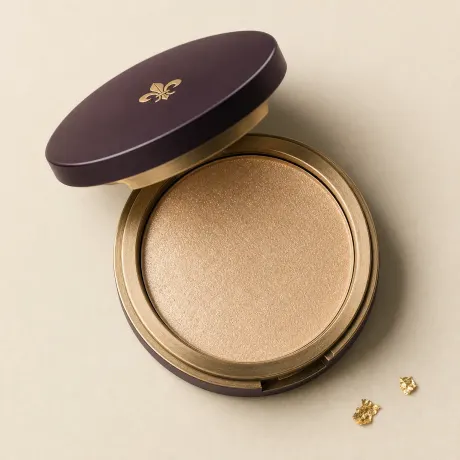
Pressed highlighter
A light-reflecting powder for the high points of the face.
Read the guide
Baked highlighter
Highlighter baked into a domed cake, giving a wet-looking, metallic shine.
Read the guide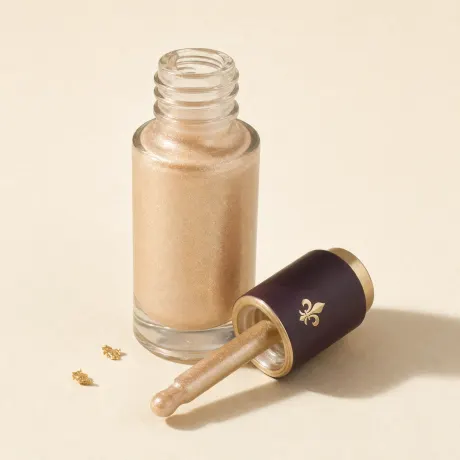
Liquid highlighter
A pearlescent fluid for an all-over glow or a precise high shine.
Read the guide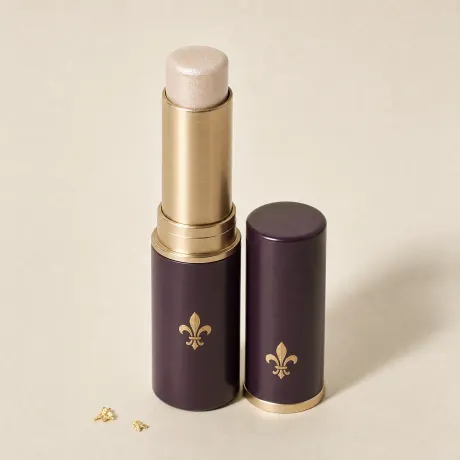
Cream highlighter stick
A translucent balm with a sheen, for a highlight that looks wet rather than glittery.
Read the guide