Baked highlighter
Highlighter made wet, shaped into a dome and dried slowly, so it can hold more shimmer than a pressed powder. What baking does, how to use one dry or wet, and how little the record says about where it began.
Baked highlighter is a light-reflecting powder made from a wet paste of pearl pigments and powders, shaped on a porous base and dried slowly in an oven, giving a hard, domed, often marbled cake with a metallic or luminous finish.

Our picks
Baked highlighter is a small category, and most of it sits at the drugstore end: these are the genuine ones we could link from their makers, from a sheer, glitter-free glow to a glittering cake. Each opens where its maker sells it — on Amazon, or at the house’s own shop — and you choose your shade on that page.
As an Amazon Associate I earn from qualifying purchases. Affiliate links — we may earn a commission at no extra cost to you. How this works
Sheer polishPrestige MAC Cosmetics
Mineralize Skinfinish
A domed, slow-baked powder for the cheekbones as highlight, or all over as a sheer polish.
- Slow-baked
- Domed
- Radiant finish
Terracotta-bakedDrugstore Milani
Baked Highlighter
A drugstore baked cake that Milani sells as never glittery, in four shades.
- Baked on terracotta
- Never glittery
SwirledMid-range Laura Geller
Baked Gelato Swirl Illuminator
Swirled tones baked into one cake, so the glow shifts a little with where the brush lands.
- Baked
- Swirled tones
Glitter finishDrugstore KIKO Milano
Glitter Baked Highlighter
For sparkle rather than sheen: a baked cake with a glitter finish.
- Glitter finish
- Reflective pearls
Universal shadeMid-range Juvia's Place
Heroine Glow II Highlighter
One universal shade of rose and gold pearls, from a house known for colour for deeper skin.
- Universal shade
- Rose and gold pearls
Low costDrugstore essence
pure nude highlighter
An inexpensive, lightly marbled baked powder for a subtle shimmer.
- Marbled
- Vegan
Glitter-freeMid-range Laura Geller
Baked Natural Glow Highlighter
A low, glitter-free glow that the company makes for mature skin, where shimmer can read as texture.
- Baked 24 hours
- Glitter-free
Wet or dryDrugstore L.A. Colors
Strobing Powder
A baked strobing powder in ten shades, sold for use dry for a soft finish or wet for intensity.
- Wet or dry
- Ten shades
High shimmerDrugstore J.Cat Beauty
You Glow Girl Baked Highlighter
A high-shimmer baked cake that doubles as an eyeshadow.
- High shimmer
- Face or eyes
Soft focusDrugstore Rude Cosmetics
Baked Highlighter
A drugstore baked powder sold as blurring as well as glowing.
- Soft-focus
- Microfine shimmer
Talc-freeDrugstore Profusion Cosmetics
Matcha Glow Illuminating Baked Highlighter
A talc-free baked highlighter in recyclable packaging, at a drugstore price.
- Talc-free
- Paraben-free
A baked highlighter is shimmer that has been dried rather than compressed. The pigments and powders are mixed with water into a creamy paste, shaped on a porous base and dried in an oven for many hours, and the cake that comes out is harder, smoother and denser with shine than a press could make it. The dome, and the marbling of two or three tones that many of them carry, are the marks of that wet process.[1]
The reason to bake a highlighter is pearl. The platelets that make shimmer push one another apart under a press, so a powder heavy with them stays soft and crumbly however hard it is squeezed. An application filed by the Korean company Amorepacific in 2006 puts the limit for ordinary pressed make-up at 40 per cent pearl, beyond which it separates or breaks, and says baked compositions were developed to get past it.[2] That is why baked highlighters sit at the metallic, wet-looking end of the range. Baked blush and bronzer are made the same way; the highlighter is the one with the least colour and the most light, and against a pressed highlighter it trades some subtlety for intensity.
Dry for a sheen, wet for foil
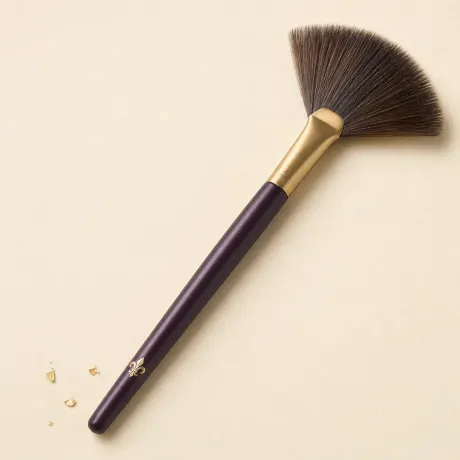
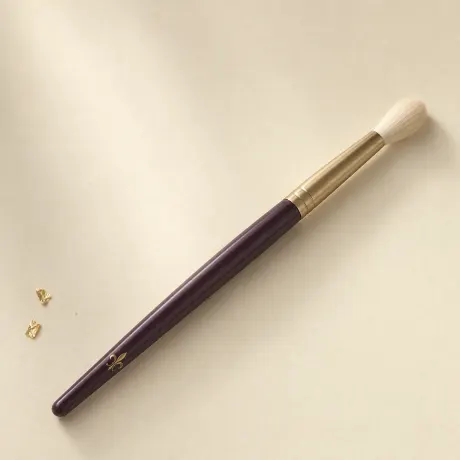
Used dry, a baked highlighter gives a translucent sheen. Swirl a fan brush or a small tapered brush lightly across the dome, tap it once and sweep it along the top of the cheekbone. Because the surface is hard, each pass picks up only a little, so the shine builds without a hard edge. This is the everyday way to wear it, and the kindest to texture.
Used wet, the same cake gives a dense, foil-like shine. Mist a brush or a sponge, squeeze it until it is barely damp, press it onto the cake and tap the colour onto the very top of the cheekbone or under the arch of the brow, where that intensity looks deliberate. A wet highlight sets as it dries, so soften its edge straight away, and over a cream or liquid base press rather than sweep, so the hard cake does not drag the foundation beneath it. Use as little water as you can, and leave the compact open until the surface is dry again: a cake that is soaked over and over can seal itself under a hard, glassy layer that no longer picks up.
Choosing one
Look first at the marbling. A single-tone cake gives the same result wherever the brush lands; a swirled one reads warmer or cooler depending on which part of the dome the brush takes most from, so sweep across the whole surface to keep the result, and the wear, even. Then at the finish: most baked highlighters are metallic or strongly luminous, and a few are sheer glow powders for daytime. The stronger the finish, the more it shows texture, so on open pores or fine lines keep it high on the bone and use it dry.
The shade follows the rule for any highlighter: pearl and champagne on fair skin, gold and peach in the middle range, and bronze, copper and deep gold on dark skin, where a pale baked cake can turn grey and metallic. Read the name as well as the colour. Many houses sell a baked blush beside a baked highlighter in the same kind of compact, and a shimmering blush on the cheekbone reads as colour, not light.
Keeping the dome
The dome stands proud of the pan, which makes it the first thing to break when a compact is dropped: keep it closed and flat in a bag. It also sheds. Chromavis, an Italian cosmetics manufacturer, notes in a patent that a dry brush drawn across a domed cake pushes powder down its sides and into the case.[3] Tap the brush rather than dragging it, and wipe out the case from time to time. Keep the brush clean as well: oil carried back from the skin is what turns the top of a powder hard and shiny, and a gentle rub with a clean, dry tissue brings it back.
Where it came from
The baked highlighter’s history is short and thinly documented. Its makers tend to tell it as a craft story, and several say their cakes are baked on terracotta in Italy, which describes how they are made rather than when the method began. The patents are firmer ground. A European patent granted to Chromavis, filed in 2009, sets out the known process for baked eye shadow, blusher, bronzing powder and face powder — a creamy paste pressed into a dome by a concave die and dried in an oven at atmospheric pressure — and proposes a concave terracotta base instead, dried at 30 to 80°C for eight to twenty-four hours.[4] It does not name highlighter, and neither it nor Amorepacific’s earlier application says when baked make-up was first made, or by whom.[5]
What the Amorepacific application does explain is why the method suits shine. In a pressed powder, it says, a firm cake is difficult to obtain because of “the repulsive force between pearl and pearl”; a baked composition overcomes it with a powder dissolved in water, and its own example was dried at 60 to 80°C for twelve to eighteen hours.[5] A highlighter, which is mostly pearl, needs that more than most powders. The domed, marbled cake in the compact is less an old tradition than an engineering answer to a powder that would not hold together.
The techniques
- Strobe
- Highlight the high points alone, with no shading to set them against.
- Sweep
- Long, light strokes that deposit a veil of product.
Sources
- [1, 3, 4]EP 2 218 350 B1 — Baked make-up product of preferably flat form European Patent Office, 2014.View source (opens in a new tab) Accessed 2026-09-25.
- [2, 5]WO 2007/119916 A1 — Plate for baked type make-up cosmetic compositions World Intellectual Property Organization, 2007.View source (opens in a new tab) Accessed 2026-09-25.
What to apply it with
Other kinds of highlighter
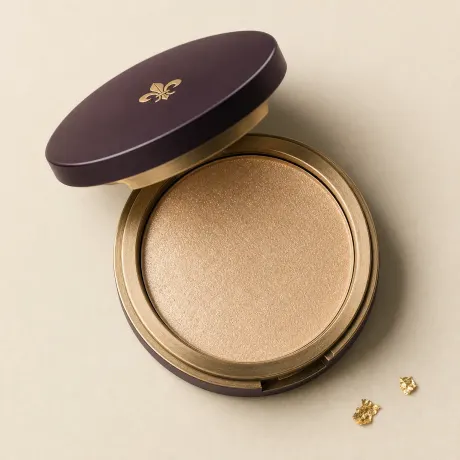
Pressed highlighter
A light-reflecting powder for the high points of the face.
Read the guide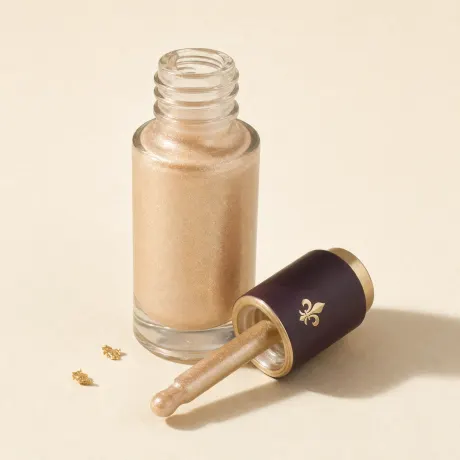
Liquid highlighter
A pearlescent fluid for an all-over glow or a precise high shine.
Read the guide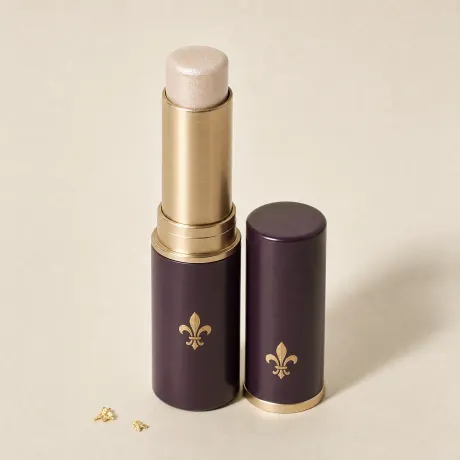
Cream highlighter stick
A translucent balm with a sheen, for a highlight that looks wet rather than glittery.
Read the guide
Loose highlighter
Pure shimmer pigment, the most intense form of highlight.
Read the guide