Sponge-tip applicator
The small foam tip on a stick, often at both ends, that presses eyeshadow onto the lid and smudges it along the lashes. What it does better than a brush, how to choose, use and clean one — and how foam took over from the little finger.
A sponge-tip applicator is a small stick with a tip of soft foam, usually at both ends, used to press and pack eyeshadow onto the eyelid and to smudge it along the lash line.
Our picks
Chosen across the sponge-tip applicators makers sell on their own — double-ended packs and single tips on a handle, small and large — from drugstore houses in the US, Japan and Italy to a replacement applicator from Clé de Peau Beauté. Prestige houses put a sponge tip inside their compacts but rarely sell one alone. Each opens where its maker sells it: on Amazon, or at the house’s own shop.
As an Amazon Associate I earn from qualifying purchases. Affiliate links — we may earn a commission at no extra cost to you. How this works
Sponge and brushPrestige Clé de Peau Beauté
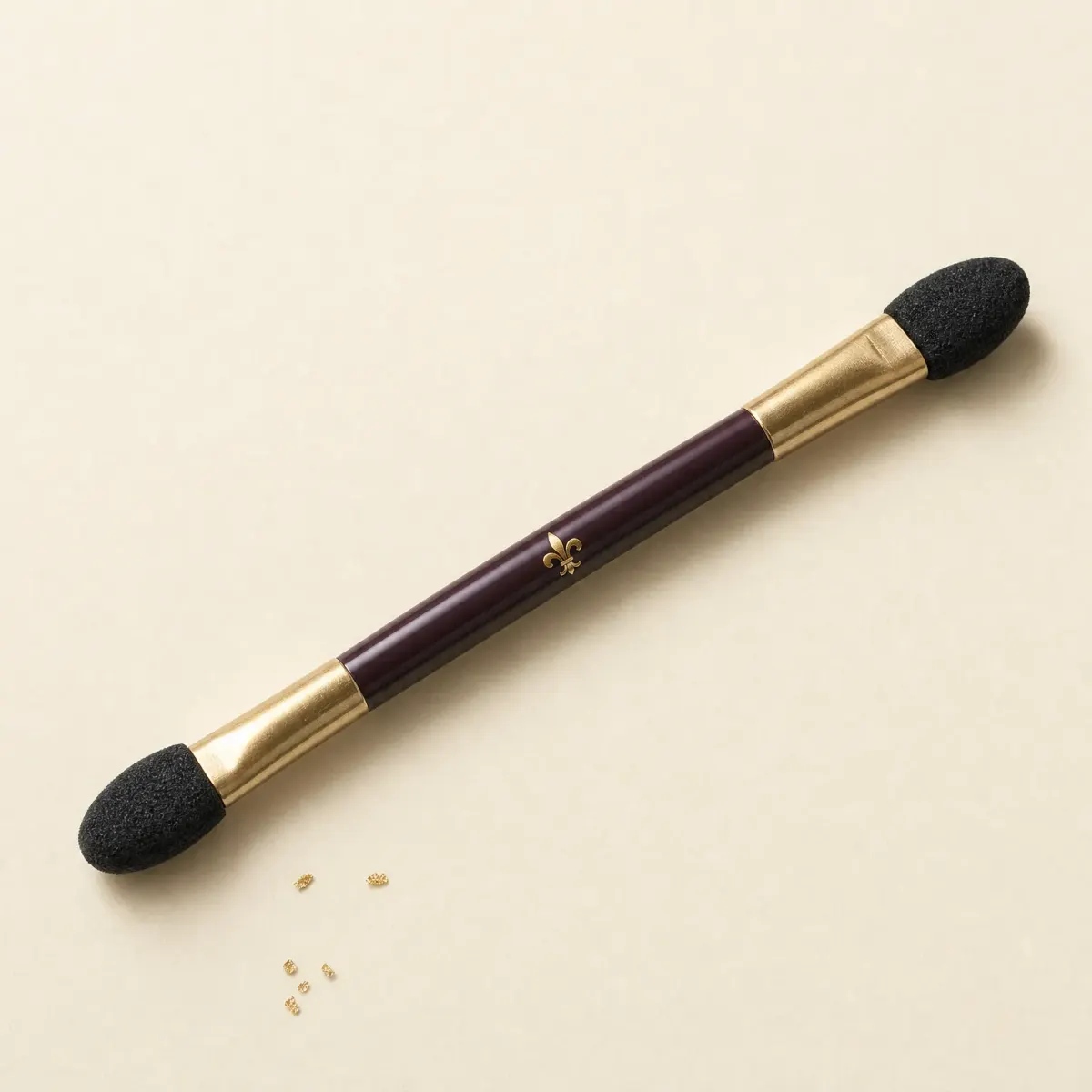
Eye Color Quad Replacement Applicator (Sponge Tip and Brush)
A luxury house’s spare applicator for its quad: a sponge tip for pressing on primer, and a brush for the powder over it.
- Sponge tip
- Brush tip
- For primer and powder
Flat and pointedDrugstore Ulta Beauty Collection
Dual Tipped Foam Applicators
A store’s own foam applicators with a flat end for laying colour down and a finer tip for lining.
- Flat side
- Foam tip
- Twelve to a pack
Maxi tipsDrugstore KIKO Milano
Maxi Eyeshadow Applicators
Larger tips than most, which cover a lid in a few presses, three to a pouch from a Milanese house.
- Double tip
- Larger size
- With pouch
On a handleMid-range Bdellium Tools
Pink Bambu Series 740 Sponge Applicator
A single foam tip on a proper brush handle, made to be washed and kept rather than thrown away.
- Rubycell foam
- Single tip
- Brush handle
Drugstore classicDrugstore COVERGIRL
Makeup Masters Eye Shadow Applicators
The familiar drugstore applicator in a pack of three, for spares when the tips that come with compacts wear out.
- Sponge tips
- Three to a pack
Japanese tipsDrugstore Daiso
Double Eye Shadow Tip Set
Inexpensive double-ended tips from a Japanese chain, enough for a clean one each time.
- Double-ended
- Ten tips
Wet or dryDrugstore AOA Studio
AOA Dual-Ended Sponge Eyeshadow Applicators
Mini double-sided tips sold for glitter and loose pigment as well as pressed shadow, damp for stronger colour.
- Ten minis
- Double-sided
- Wet or dry
Twelve-packDrugstore CALA
Eyeshadow Applicators (Double-Tip)
A plain twelve-pack of double-tipped applicators from a tool maker, one end for a light shade and one for a dark.
- Double-tip
- Twelve to a pack
A sponge-tip applicator is a stick a few centimetres long with a small oval of foam at one or both ends: the doe-foot shape that comes tucked into eyeshadow compacts, sold on its own in packs or on a handle. Foam behaves differently from a brush. It does not spread and diffuse colour but presses it, so shadow goes on denser and with less fallout, and shimmer and metallic shades look more like foil. Used damp, it lays down more still.
That makes it the tool for putting colour down rather than softening it. A fluffy brush blends an edge and a smudge brush softens a line; the sponge tip packs a lid with colour in a few presses and smudges pencil or powder along the lower lashes. Most people who use one keep a clean brush beside it for the last blend.
Choosing one
Ends. Double-ended applicators give one tip for a light shade and one for a dark, so the two never muddy each other. Single tips on a brush handle, like Bdellium’s, are made to be washed and kept. Size. A small, narrow tip reaches the lash line and the inner corner; a larger one, like KIKO’s maxi applicators, covers the lid in fewer presses. Some packs pair a flat side for picking up colour with a finer tip for lining.
Foam. Denser foam packs colour more firmly and holds its shape for longer; softer foam is gentler on a delicate lid and lays down less at a time. Kept or thrown away. Packs of ten or twelve cost little enough to treat as disposable, which suits anyone who wants a clean tip every time; a single applicator on a handle has to be washed after each use. Whichever you choose, one that frays, tears or hardens is finished.
How to use it
Touch the tip to the shadow and knock off the excess on the rim of the pan. Press it onto the lid and roll it slightly rather than sweeping, working up from the lash line, and press again to build colour. For shimmer and metallic shades, dampen the tip first with a little water or setting spray; AOA sells its applicators for use wet, for stronger colour, or dry, for softer. To smudge the lower lash line, run the narrow edge of the tip along it, over pencil or powder.
Use one end per colour, and finish by blending the upper edge of the shade with a clean brush: foam leaves a firmer edge than bristles. The same tip that packs a lid also presses loose glitter onto a primed lid, with less of it scattering down the cheek than a brush would leave.
Sponge tip, brush or finger
Reach for the sponge tip when the aim is intensity: packing a shimmer or a deep shade onto the lid, pressing on glitter, smudging along the lower lashes. Reach for a brush when the aim is blending, softening the crease and diffusing an edge, where foam leaves too firm a line. The finger, the oldest of the three, still suits a cream shadow, whose texture its warmth helps to spread, and a quick wash of colour across the lid. Clé de Peau’s replacement applicator puts a sponge at one end and a brush at the other, which covers the first two in one tool.
Keeping it clean
An applicator goes from the eye back into the pan every time it is used, so it carries whatever it picks up. The FDA’s advice for eye cosmetics is not to share them, to make sure that anything used around the eye is clean, and to try makeup at a store only with single-use applicators.[1] Testers show why. In a study published in 1981, researchers who sampled the eyeshadow testers of 15 brands on display in shops found 67 per cent of 1,345 samples contaminated with microorganisms.[2]
Wash a reusable applicator in warm, soapy water after use, press it dry in a tissue and let it dry completely before it goes back in its pouch or compact. Throw a disposable one away after the day, and never pass one between two people. The tip that comes with a compact wears out long before the shadow does: replace it rather than working with a split one.
Where it came from
Before foam, the usual applicator was a finger. Pastes were the commonest form of eyeshadow before the Second World War, and they went on with the little finger. Pressed powder shadows became more common after the war and the most popular form in the 1960s, and they were sold in tablets with a foam-tipped applicator or a brush.[3]
The foam had to be made to behave. In 1967 Bruno D. Aston of Hacienda Heights, California, first applied for a patent, granted in 1971, on an applicator of soft, open-celled urethane foam on a handle, “to serve the general purpose of a brush”. Its open cells, he wrote, drew product in by capillary action, and it kept definite boundaries under light pressure, making it “very easy for the user to control the area of application with precision”; his examples were face powder, dry rouge and nail polish.[4] In 1972 L’Oréal filed in France for a stick that came already loaded: a cardboard stick about 3 mm across, its end wrapped in a thin sheet of polyurethane foam soaked in eye shadow and dried.[5]
Who first tucked one into an eyeshadow compact is not recorded in any source we found. But the doe-foot tip is foam on a stick, and the case for it is still the one Aston made: a small, firm edge that puts colour where it is pressed.
The techniques
- Press
- Press product onto the skin without dragging, so it stays where it is put.
- Pack
- Pat colour onto the lid for full, dense payoff rather than sweeping it.
- Smudge
- Soften a drawn line into a haze while the product is still workable.
Sources
- [1]Eye Cosmetic Safety US Food and Drug Administration.View source (opens in a new tab) Accessed 2026-09-22.
- [2]Microbial flora of in-use, display eye shadow testers and bacterial challenges of unused eye shadows Applied and Environmental Microbiology 42 (2): 297–302, 1981.View source (opens in a new tab) Accessed 2026-09-26.
- [3]Eye Shadow Cosmetics and Skin, 2019.View source (opens in a new tab) Accessed 2026-09-26.
- [4]US Patent 3,577,582 - Method of making an applicator for cosmetics United States Patent Office, 1971.View source (opens in a new tab) Accessed 2026-09-26.
- [5]US Patent 3,863,654 - Cosmetic applicator United States Patent Office, 1975.View source (opens in a new tab) Accessed 2026-09-26.