Precision swabs
A cotton bud with a firm, pointed tip, for sharpening a wing, cutting back a lip line and lifting fallout. How to choose and use them, what to do about the waste — and how a baby-care product became a makeup tool.
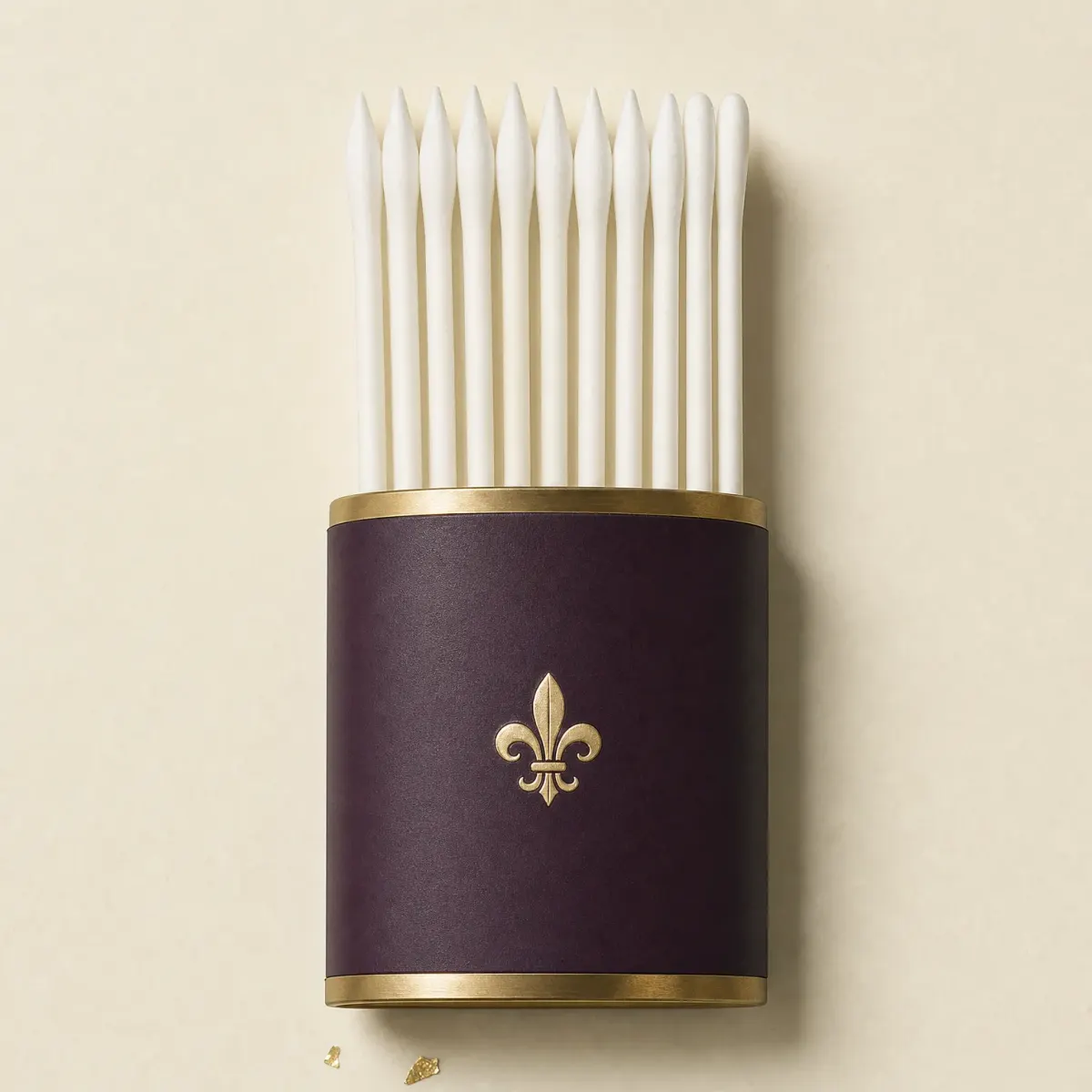
Precision swabs are cotton buds with a firmly wound, pointed tip at one or both ends, used dry or with a drop of remover to sharpen the edge of eyeliner or lipstick and to lift small mistakes without disturbing the makeup around them.
Our picks
Chosen across the swabs sold for makeup — pointed cotton buds, a flat-and-pointed pair, bamboo-stemmed ones, a washable swab and one pre-filled with remover — from drugstore brands to a small Danish maker. No prestige house sells a swab of its own that we could find. Each opens where its maker sells it: on Amazon, or at the house’s own shop.
As an Amazon Associate I earn from qualifying purchases. Affiliate links — we may earn a commission at no extra cost to you. How this works
Precision tipDrugstore Q-tips
Precision Tip Cotton Swabs
The familiar drugstore swab in its precision-tip version, the one box to keep beside the remover.
- Precision tip
- 170 count
One pointed tipMid-range Clean Skin Club
Clean Swabs
Swabs with a pointed end for liner and a plain one for everything else, on bamboo sticks rather than plastic.
- One pointed tip
- Organic cotton
- Bamboo sticks
Pointed tipsDrugstore Diane
Pointed Tip Cotton Swabs
A beauty-supply brand’s pointed swabs, sold for makeup and for tidying the edge of nail polish.
- Pointed tip
- 200 count
ReusableMid-range LastObject
LastSwab Beauty
A washable makeup swab in its own case, for anyone who would rather rinse one tip than throw away hundreds.
- Washable
- Travel case
Flat and pointedDrugstore Ulta Beauty Collection
75 ct. Dual Tipped Cotton Applicators
A store’s own cotton applicators with a flat end for picking up colour and a pointed one for lining.
- Flat end
- Pointed tip
- 75 count
Pre-filledMid-range Alleyoop
Tip Off Swabs
A swab that carries its own remover, released by snapping the stick, for fixing liner or mascara away from home.
- Pre-filled remover
- Snap to release
- 72 count
A precision swab is a cotton bud made for makeup: the cotton wound firmly to a point at one end, sometimes both, rather than fluffed into a soft round head. The point is the tool. Dipped in remover, it erases a millimetre of liner and leaves the rest; dry, it lifts a flake of mascara or a fleck of shadow from the cheek; pressed along a lip line, it sharpens the edge of a lipstick. A round cotton bud does the same jobs more clumsily, taking away more than it should and leaving fibres behind.
The kind now comes in several forms. Many packs pair a pointed tip with a round or flat one; some are wound on paper or bamboo rather than plastic; a reusable version replaces the cotton with a washable tip; and one comes pre-filled with remover, released by snapping the stick.
Choosing them
Tip. Look for cotton wound firmly to a point that keeps its shape when pressed; a loose, fluffy tip spreads remover wider than you want and sheds fibres into the lashes. A pointed end with a flat or round one at the other covers correcting and blending in one swab. Stick. A stiff stem gives control near the eye. Paper, bamboo and wood are firm and are replacing plastic.
Reusable or not. A washable swab, like LastObject’s, saves throwing away hundreds of cotton buds, but it must be washed after every use, and because its tip absorbs nothing it moves remover rather than soaking it up, so use it with a very little. Pre-filled. Swabs that carry their own remover, like Alleyoop’s, are sold as mess-free for a bag, and each is used once. Keep a box of plain pointed swabs at home as well: they are an inexpensive way to have a clean one for every job.
How to use them
A wing. Wet the pointed tip with remover and blot it on a tissue so that it is damp, not dripping. Lay it along the edge you want and draw it outward, towards the temple, in one stroke, turning to a clean part of the tip for the next. A bi-phase remover is the one for waterproof liner; micellar water is enough for most. A lip line. Use a damp tip to cut back lipstick that has strayed, then trace the new edge with a dot of concealer on a clean swab.
Fallout and smudges. Use the swab dry. Let flecks of shadow or mascara dry first, then roll the swab over them rather than rubbing. Softening. A dry pointed tip also smudges a pencil line along the lower lashes. Keep the swab on the skin: never on the eye itself.
Common mistakes
Too much remover. A dripping tip runs into the crease and takes the shadow with it; blot first, every time. Rubbing. Scrubbing at a line smears it into a grey haze; make one clean stroke, then turn to a fresh part of the tip. Correcting too soon. Wet liner smears under a swab, so let it set for a minute before cutting back the edge. An oily finish. An oil-based remover leaves a slick that new liner will not grip; press a dry swab over the spot, or touch it with a little micellar water, before you redraw. A used tip. A tip that has picked up black liner prints it wherever it touches next.
Clean habits
Use a fresh swab for each job and each eye, and never put a used one back into a product. The FDA’s advice for trying eye makeup at a store is to have it applied with single-use applicators, “such as clean cotton swabs”, and to make sure anything placed in the eye area is clean.[1] Wash a reusable swab with soap and water after every use and keep it in its case, and replace it when the tip splits.
Where it came from
The cotton bud was not made for makeup. In the account usually repeated, Leo Gerstenzang, a Polish immigrant to the United States, devised it in 1923 after watching his wife wind cotton onto toothpicks to clean their baby. It was sold first as Baby Gays, then as Q-tips Baby Gays, the Q standing for quality, and at last simply as Q-tips: white cotton on a wooden stick, changed in the 1950s to rigid paper after Gerstenzang bought a company that made it, and later to plastic.[2] It is a tidy origin story, and it is reported rather than documented.
When makeup took up the swab, and when the pointed tip appeared, is not recorded in any source we found, and no maker we found dates its own. What can be dated is the swab’s newest turns. England banned the supply of plastic-stemmed cotton buds on 1 October 2020, when it was estimated that 1.8 billion of them were used there every year and many makers had already moved away from plastic.[3] LastObject, a Copenhagen company, says it launched its washable LastSwab on Kickstarter in 2019, with more than 20,000 backers.[4]
The makeup swab is the baby-care bud turned eraser: a point of cotton small enough to take back a millimetre of line and leave the rest of the face alone.
The techniques
- Draw
- A single controlled line, built from short strokes where the hand needs it.
Sources
- [1]Eye Cosmetic Safety US Food and Drug Administration.View source (opens in a new tab) Accessed 2026-09-22.
- [2]Design Moment: Q-tip, 1923 The Irish Times, 2019.View source (opens in a new tab) Accessed 2026-09-26.
- [3]Start of ban on plastic straws, stirrers and cotton buds GOV.UK, 2020.View source (opens in a new tab) Accessed 2026-09-26.
- [4]LastSwab LastObject, 2026.View source (opens in a new tab) Accessed 2026-09-26.
