Sindoor
The red-orange powder that many married Hindu women draw along the parting of the hair. What it means and to whom, what is in it now and why health agencies warn about it, how to wear it more safely, and what the record says of its past.
Sindoor is a red or orange-red powder, now also sold as a liquid, that many married Hindu women wear along the parting of the hair as a sign of marriage, and that is also worn on the forehead and offered in worship.
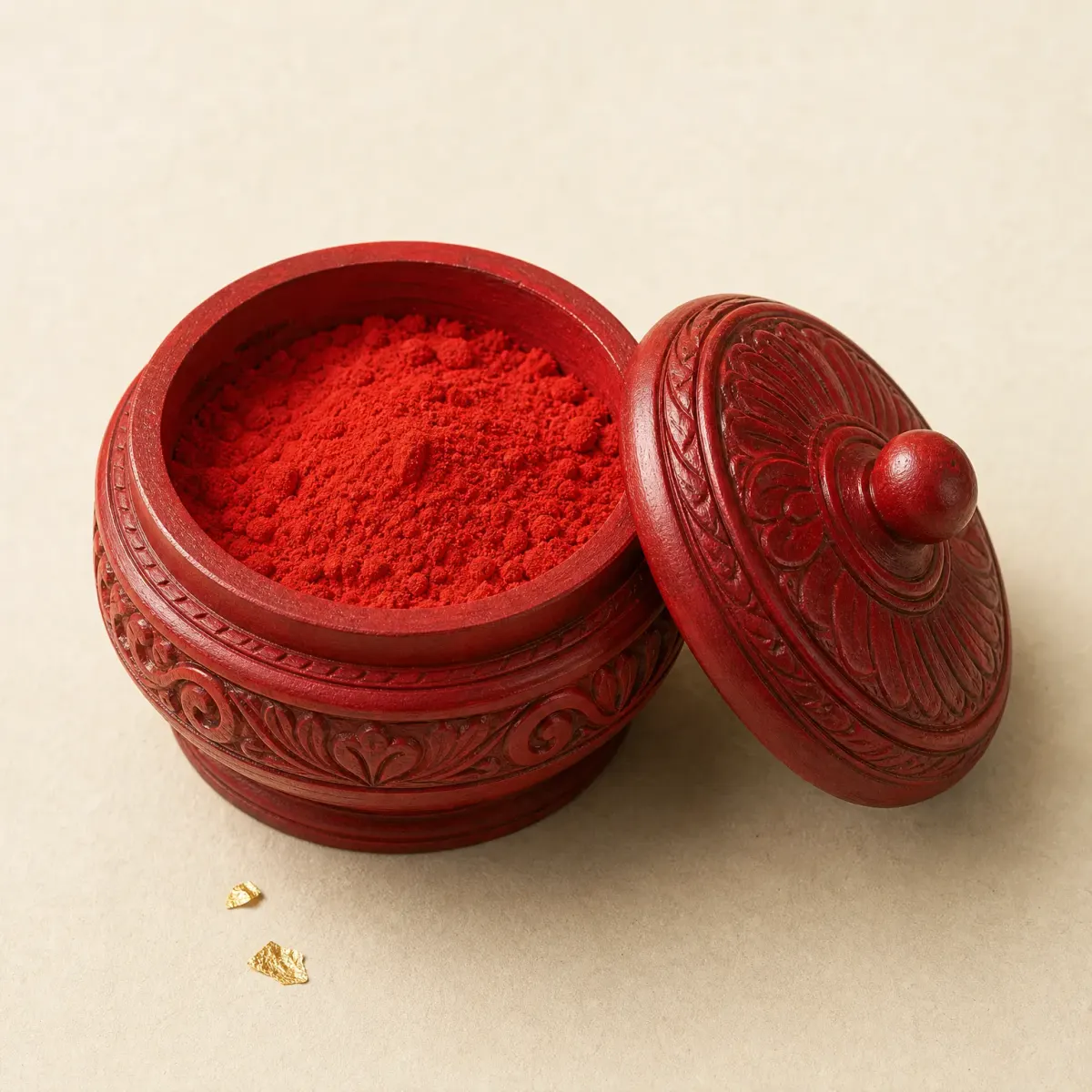
Sindoor is a red or orange-red powder worn along the parting of the hair. For many married Hindu women it is the sign of marriage: the public-health researchers who tested it in New Jersey describe it as worn to show that a woman is married and as a wish for her husband’s long life, and note that the same powder is pressed on as a dot between the brows and used to mark men and children in worship.[1] Some Sikh women wear it in the parting too.[2]
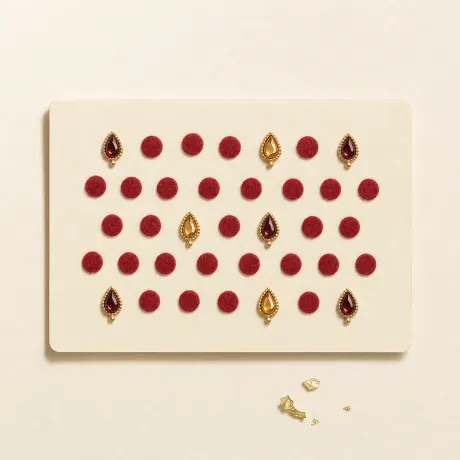
Its nearest neighbour is kumkum, the red powder pressed onto the forehead, and the names overlap: dermatologists writing about both note that kumkum, sold as powder or liquid, is also worn in the parting as sindoor.[3] A bindi is the mark between the brows, painted or stuck on. Sindoor, then, is defined by where it goes rather than by what it is made of, and what it is made of is the reason for most of this page.
What it is made of
The name has never fixed the recipe. Moti Chandra, surveying the Sanskrit sources in 1940, rendered sindura as red lead in one passage and as vermilion, the red of mercury, in others; the ambiguity is in the word.[4] Dermatologists have since reported sindoor that contains mercury,[5] and New Jersey’s health department warns that makers often add red lead to give the powder its colour.[6]
Testing bears the warnings out. In December 2007 the US Food and Drug Administration told consumers not to use a brand of sindoor sold through Indian grocery shops in seventeen states, after two people in Illinois were poisoned by cooking with it; its label implied it was food, and “other uses of the product, including as a cosmetic, can also be dangerous”, the agency said.[7] Of 95 samples bought in New Jersey shops in 2014 and 2015, 83 per cent contained lead, and the most contaminated samples from New Jersey and from India each held more than 300,000 micrograms of lead per gram, over 30 per cent of their weight.[8] A clinic at Children’s Hospital Boston found three sindoor products that were more than 47 per cent lead.[9] None of this means that every box is contaminated. It means that a box cannot be judged by its colour.
Choosing and wearing it
If you wear sindoor, the label is the first safeguard. American rules allow only listed colour additives in cosmetics, and no lead compound and no mercury sulphide is among them;[10] a cosmetic with more than a trace of mercury is adulterated in law.[11] A cosmetic sold at retail must list its ingredients,[12] so a loose powder, or a box with no ingredient list, is one to leave on the shelf. Keep sindoor away from children and out of the kitchen, never use it to colour food, and wash your hands after putting it on: New York City’s health department warns that lead from these powders reaches the body from fingers that have touched them.[13]
To wear it, part the hair cleanly and draw the powder or liquid along the parting from the hairline back, with a fingertip, the end of a comb or the sponge tip of a liquid sindoor, then tap away the excess: powder that sweat carries down onto the forehead spreads a reaction beyond the mark.[14] A few wearers develop itching, or a brown or slate-grey stain at the parting or on the forehead; stop using anything that causes either. If you or a child has used sindoor like the brands New York City has named in its warnings, ask a doctor for a blood lead test.[15]
Where it came from
Sindoor’s tie to marriage is old, but the texts give it more than one meaning. Chandra cites from the Markandeya Purana an injunction that a wife who wishes her husband a long life must not go without turmeric, saffron, sindura and collyrium, and in the same survey quotes dancers whose faces were marked with “a row of vermilion spots”.[16] Writing for Mint, Tanushree Bhowmik points to a hymn to the goddess Lalita that ties sindoor to power, and reports the Indologist Nrisingha Prasad Bhaduri’s finding that no Vedic or Puranic text treats sindoor daan, the giving of sindoor at a wedding, as what confirms a marriage.[17]
Nor has it ever been only a married woman’s red. In the Kathmandu Valley the image being worshipped is adorned with sindur each day, and the V&A holds an eighteenth-century Nepalese brass box for it, cast as a stupa, a shape that suggests Buddhist use.[18] In Bengal, on the last day of Durga Puja, married women put sindoor in the goddess’s parting and then on one another. A newspaper campaign in 2017 urged that widows, transgender people and single mothers be included, and in most city pandals this sindoor khela now takes in women and men whatever their marital status, though a married woman’s parting is still filled only by another married woman or her husband.[17] Cinema has used the rite as shorthand: the V&A glosses the title of a poster printed in Madras for the 1980 film Maang Bharo Sajana as “keep my parting filled”, meaning “keep me married”.[19] The line in the parting has held; what it is made of, and who may share in it, keep changing.
The techniques
- Along the parting
- Draw a line of colour along the parting of the hair from the forehead back.
- Dot
- A single placed mark — between the brows, on the forehead or the chin.
Sources
- [1, 8]Lead Content of Sindoor, a Hindu Religious Powder and Cosmetic: New Jersey and India, 2014–2015 American Journal of Public Health 107(10): 1630–1632, 2017.View source (opens in a new tab) Accessed 2026-09-26.
- [2]About Lead in Foods, Cosmetics, and Medicines Centers for Disease Control and Prevention, 2025.View source (opens in a new tab) Accessed 2026-09-26.
- [3, 5, 14]Dermatoses Due to Indian Cultural Practices Indian Journal of Dermatology 60(1): 3–12, 2015.View source (opens in a new tab) Accessed 2026-09-26.
- [4, 16]Cosmetics and Coiffure in Ancient India Journal of the Indian Society of Oriental Art 8, 62-145, 1940.View source (opens in a new tab) Accessed 2026-09-22.
- [6]Sindoor Fact Sheet New Jersey Department of Health, 2015.View source (opens in a new tab) Accessed 2026-09-26.
- [7]FDA Warns Consumers Not to Use Swad Brand Sindoor: Product Contains High Levels of Lead FDA News, 15 December 2007 (archived by the Internet Archive), 2007.View source (opens in a new tab) Accessed 2026-09-26.
- [9]Pediatric Lead Exposure From Imported Indian Spices and Cultural Powders Pediatrics 125(4): e828–e835, 2010.View source (opens in a new tab) Accessed 2026-09-26.
- [10]Color Additives Permitted for Use in Cosmetics, 21 CFR Parts 73 and 74View source (opens in a new tab) Accessed 2026-09-22.
- [11]Use of mercury compounds in cosmetics, 21 CFR 700.13View source (opens in a new tab) Accessed 2026-09-22.
- [12]Temporary Tattoos, Henna/Mehndi, and "Black Henna": Fact Sheet United States Food and Drug Administration, 2024.View source (opens in a new tab) Accessed 2026-09-26.
- [13]Hazardous Products: Cosmetics and Religious Powders NYC Health, 2026.View source (opens in a new tab) Accessed 2026-09-26.
- [15]Health Warning: Do Not Use (sindoor products found to contain high levels of lead) NYC Health (warning sign in English, Hindi and Bengali), 2019.View source (opens in a new tab) Accessed 2026-09-26.
- [17]‘Sindoor Khela’: This ritual centred around women has found a place in Indian pop culture Mint (Mint Lounge), 2 October 2025, 2025.View source (opens in a new tab) Accessed 2026-09-26.
- [18]Container in the form of a stupa, cast brass, Nepal, 18th century (museum no. IS.9:1,2-2009) Victoria and Albert Museum, London.View source (opens in a new tab) Accessed 2026-09-26.
- [19]Indian film poster, Maang Bharo Sajana (1980), Madras (museum no. IS.140-1988) Victoria and Albert Museum, London.View source (opens in a new tab) Accessed 2026-09-26.