Kumkum
The red powder pressed onto the forehead in worship and as a sign of marriage. What it is made of, what American rules allow, how to wear it, and the history of a name that once meant saffron.
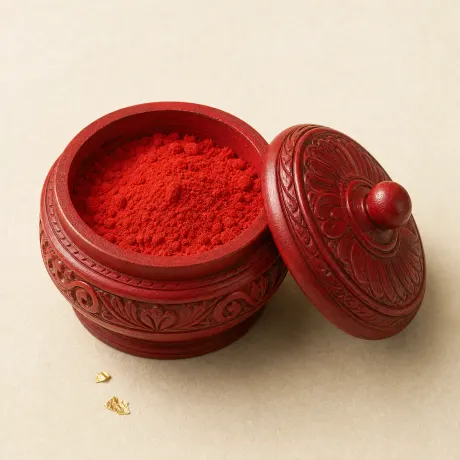
Kumkum is a red powder, traditionally turmeric reddened with slaked lime and now usually coloured with synthetic dyes, pressed onto the forehead as a dot or a line in Hindu worship and as a mark of marriage.
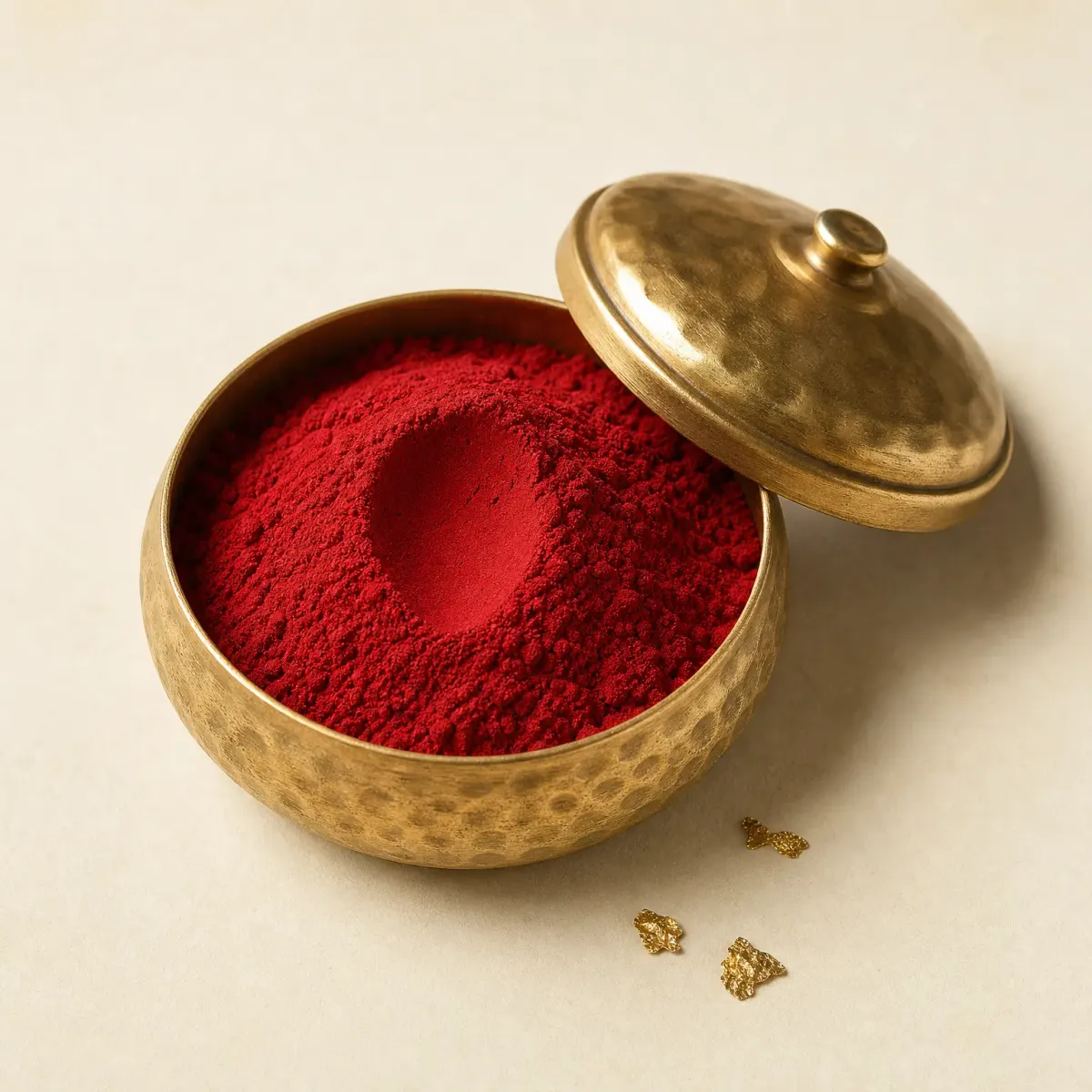
Kumkum is a red powder pressed onto the forehead with a fingertip, as a dot or a short upward line between or just above the brows. Its traditional form is turmeric reddened with slaked lime, sometimes with camphor, a mixture that dental pathologists have even tested as a stain for tissue slides.[1] Many Hindu women wear it, and it marks men as well as women in worship: priests routinely put red powder on the foreheads of worshippers as they enter a temple.[2]
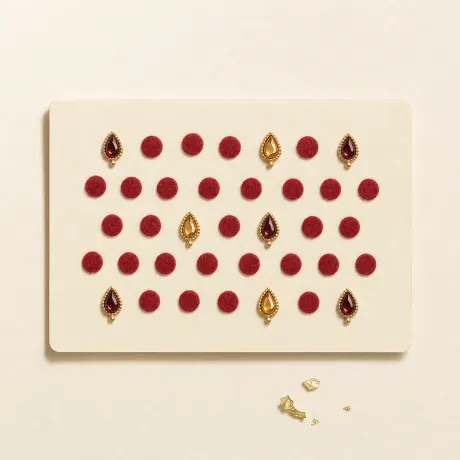
The names around it overlap. Kumkum is always a powder or paste and can go anywhere on the face or body, whereas a bindi is worn only between the brows and may be a sticker; kumkum worn in the hair parting, to show that a woman is married, is sindoor.[3] What matters to the wearer is less the name than the powder, which has changed more than the practice has.
What it is made of
Commercial kumkum is a different product from the turmeric and lime. Dermatologists in India find it hard to learn from makers what is in their kumkum; the ingredients identified so far include the dyes Sudan I, Brilliant Lake Red R and erythrosine, other azo and coal-tar colours, cananga oil and fragrance, groundnut oil, gum, preservatives and chalk,[4] and a study of the traditional powder describes corn starch, chalk and azo dyes as the usual commercial base.[5] Several of these are recognised allergens. In a series of 46 people with kumkum dermatitis, the forehead was affected in 31 and the hair parting in six, and three in four had pigmented contact dermatitis,[6] a brown or slate-grey staining that can appear with no visible rash at all.[4]
Lead has been found too. New York City’s health department lists kumkum beside sindoor as a traditional powder that may contain high levels of lead,[7] and in 2021 posted a warning, in English, Hindi, Bengali and Nepali, against a roli kumkum powder from India that it had found to contain lead.[8] American rules add a problem even for the traditional recipe. Every colour used on the skin must be listed for that use, and turmeric is listed for colouring food[9] but not among the colours permitted in cosmetics,[10] so a kumkum coloured with turmeric, however pure, uses a colour the rules do not provide for on the forehead.
Choosing and wearing it
Start with the label. A kumkum sold under American rules should list every ingredient, colours included, and the colours permitted in cosmetics there include iron oxides, carmine and a few synthetic reds identified by their FDA names, such as D&C Red No. 7.[11] A label that gives a colour only by its colour-index number does not show that a certified colour was used, and the FDA’s import rules treat such a label as a reason to ask for proof.[12] Leave unlabelled loose powder alone, and keep any kumkum where children cannot reach it.[13]
Put it on with the tip of a finger: press a little onto the centre of the forehead for a dot, or draw it upward for a line. A thin film of oil or petroleum jelly beneath helps it hold, a way of wearing it that Britannica dates to the twentieth century.[14] Keep it off broken or irritated skin and away from the eyes, and remember that sweat carries powder down the face, so the skin around the mark can react as well as the skin beneath it.[15]
Stop at the first itch, redness or darkening. A dermatologist can patch-test the product and its likely allergens, which is how thimerosal and a mix of gallate preservatives were found to be the commonest culprits in the series of 46 patients.[16]
Where it came from
The word is older than the powder. In the Sanskrit sources Moti Chandra surveyed in 1940, kumkuma is saffron, the first of eleven names the lexicon Amarakosa gives it, and the injunction that a wife must not go without turmeric, saffron, sindura and collyrium lists turmeric and saffron as two separate things.[17] How a name for saffron came to belong to a powder of turmeric and lime is not recorded in the sources used here, and a confident story about it would be an invention.
The forehead mark itself is well attested. The same lexicon names four kinds, among them the tilaka, which Chandra read as a round mark in sandalwood, musk or red lead.[17] The words have gone on overlapping: the V&A’s record of a poster for the 1980 film Maang Bharo Sajana calls the red a man puts in a woman’s parting “kumkum”, in the rite by which she shows that she is married.[18] The chemistry changed with synthetic dyes, and the dermatology followed it. Reports of kumkum dermatitis were appearing in the medical journals by the 1980s;[19] in 1988 an analysis found the dye Sudan I in three of seven brands of red kumkum, at up to 8.7 milligrams per gram, and named it the probable cause of the brown staining,[20] and the series of 46 patients followed in 2007.[21] Through all of it the place has stayed the same: the centre of the forehead, marked at home, at a wedding and at the door of a temple.
The techniques
- Dot
- A single placed mark — between the brows, on the forehead or the chin.
Sources
- [1, 5]Natural stain (Kumkum) formulated by the extract of Curcuma aromatica and slaked lime in histostaining of oral tissues: An observational study Journal of Oral and Maxillofacial Pathology 25(1): 88–96, 2021.View source (opens in a new tab) Accessed 2026-09-26.
- [2, 14]Bindi Encyclopaedia Britannica, 2025.View source (opens in a new tab) Accessed 2026-09-26.
- [3, 4, 15, 19]Dermatoses Due to Indian Cultural Practices Indian Journal of Dermatology 60(1): 3–12, 2015.View source (opens in a new tab) Accessed 2026-09-26.
- [6, 16, 21]Kumkum-induced dermatitis: an analysis of 46 cases Clinical and Experimental Dermatology 32(4): 385–387, 2007.View source (opens in a new tab) Accessed 2026-09-26.
- [7, 13]Hazardous Products: Cosmetics and Religious Powders NYC Health, 2026.View source (opens in a new tab) Accessed 2026-09-26.
- [8]Health Warning: Do Not Use (religious powder found to contain lead) NYC Health (warning sign in English, Hindi, Bengali and Nepali), 2021.View source (opens in a new tab) Accessed 2026-09-26.
- [9]21 CFR 73.600: Turmeric Electronic Code of Federal Regulations, Title 21, Part 73, Subpart A (Foods), 2026.View source (opens in a new tab) Accessed 2026-09-26.
- [10, 11]Color Additives Permitted for Use in Cosmetics, 21 CFR Parts 73 and 74View source (opens in a new tab) Accessed 2026-09-22.
- [12]Import Alert 53-06: Detention Without Physical Examination of Cosmetics That Are Adulterated and/or Misbranded Due to Color Additive Violations U.S. Food and Drug Administration, Office of Regulatory Affairs, 2023.View source (opens in a new tab) Accessed 2026-09-22.
- [17]Cosmetics and Coiffure in Ancient India Journal of the Indian Society of Oriental Art 8, 62-145, 1940.View source (opens in a new tab) Accessed 2026-09-22.
- [18]Indian film poster, Maang Bharo Sajana (1980), Madras (museum no. IS.140-1988) Victoria and Albert Museum, London.View source (opens in a new tab) Accessed 2026-09-26.
- [20]Sudan I as a cause of pigmented contact dermatitis in "kumkum" (an Indian cosmetic) Annals of the Academy of Medicine, Singapore 17(4): 492–494, 1988.View source (opens in a new tab) Accessed 2026-09-26.