Bindi
The mark worn between the brows, painted for centuries and now as often a felt or jewelled sticker. What it means across South Asia’s religions and regions, how to choose and wear one, what its adhesive can do to the skin, and how it came to be worn far from home.
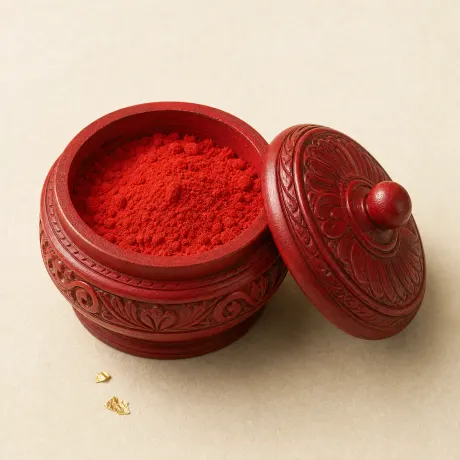
A bindi is a mark or ornament worn on the forehead between the brows, traditionally painted in kumkum or vermilion and now more often a self-adhesive disc of felt, velvet or plastic, plain or set with stones.

Our picks
Chosen to cover the kinds of bindi people wear: plain velvet dots for every day, books of many colours, crystal bindis for occasions and handmade statement sets. Four open on Amazon, sold by their makers; two open at The Bindi Project’s own shop, which ships from India. Whichever you choose, try a new bindi on a less visible patch of skin first, as the section on the adhesive explains.
As an Amazon Associate I earn from qualifying purchases. Affiliate links — we may earn a commission at no extra cost to you. How this works
Everyday maroonDrugstore VAMA
Maroon Velvet Round Bindis
The classic maroon velvet dot in a single colour and shape, from an Indian label selling through its own US account.
- Velvet
- Round
- Maroon
Handmade feltPrestige The Bindi Project
Chandre Crescent Bindi Set
Small handmade bindis on felt in the traditional red, maroon and black, sold as reusable.
- Felt base
- Red, maroon, black
- Reusable
Silver crystalMid-range KARIZMA
Gigi Silver Bindi
Silver-set crystal bindis in mixed shapes for weddings and festivals, sold on Amazon by the house itself.
- Crystal
- Silver
Bindi bookDrugstore VAMA
Premium Velvet Bindi Book
Nearly a thousand plain velvet dots in many colours and sizes, bound as a book, for matching the mark to the day’s clothes.
- 948 bindis
- Velvet
- Multicolour
Heritage textilePrestige The Bindi Project
Poulomi M — Threads of Legacy
Larger bindis hand-cut from scraps of ikat, jamdani and kalamkari cloth: a statement piece that carries other Indian crafts with it.
- Upcycled textile
- Hand-cut
- Reusable
Gold crystalMid-range Mercy London
Avantika Bindi
A mixed packet of gold-set crystal bindis from the London label behind KARIZMA, for occasions rather than every day.
- Crystal
- Gold
- Multipack
A bindi is a mark or ornament worn on the forehead between the brows. For most of its history it was painted, in vermilion or kumkum powder, and it still can be; since about the middle of the twentieth century it has also come as a sticker, and by the late 1980s the maroon felt disc had done more than anything else to replace the powder.[1] Sticker bindis are discs of felt, velvet or plastic, plain or set with stones, sold as disposable substitutes for the older liquid bindis.[2]
It overlaps with two neighbours without being either. Kumkum is a powder or paste that can go anywhere on the face or body, while a bindi is worn only between the brows and may be a sticker.[2] The tilak is a forehead mark that traditionally shows the wearer’s religious sect, three horizontal bands for followers of Shiva, for example, and is worn by men and women alike.[1]
What it means, and to whom
There is no single meaning. Hindu, Jain and Buddhist women wear bindis, and occasionally men do; some women wear one only for rituals; for others a daily bindi is a reminder to keep God in mind; and the mark is associated with the ajna, the chakra between the brows. A red bindi is, for many, a sign of marriage. In some communities a widow replaces it with a black one or a touch of white ash, or stops wearing one, and some women take it off while they mourn any relative. Since the sticker made it easy, bindis of every colour and shape have been worn by married and unmarried women and by girls, as ornament as much as observance.[3]
What it means also depends on where it is worn. In Bangladesh, where it is called a teep, a Dhaka college teacher’s complaint in April 2022 that a policeman had harassed her for wearing one brought women out to form human chains and put teeps on one another’s foreheads in protest; one statement recalled a minister of the 1960s who had insulted Bengali women for wearing it.[4]
Choosing and wearing one
Choose by occasion, and by what a colour says where you live. A red or maroon bindi reads as a sign of marriage in many communities, and black, in some, as a sign of widowhood, while for many wearers the bindi is as much a matter of fashion as of meaning.[5] A small plain dot is the everyday form; larger, jewelled and elongated shapes are for weddings and festivals; and a book of several hundred dots in many colours lets you match the mark to what you wear.
Put it on clean, dry skin with no moisturiser or foundation beneath, centred between the brows or just above them, and press for a few seconds so that the whole disc takes. To take it off, lift one edge slowly rather than pulling from the middle; a drop of oil loosens a stubborn one. A reusable bindi goes back on its card between wears.
The adhesive and the skin
The sticker brought a problem of its own. In 1990 dermatologists in India described 100 consecutive patients who had lost pigment where their bindis sat; the adhesive they analysed was 80 per cent para-tertiary-butylphenol.[6] A later review explains that such chemicals are toxic to the cells that make pigment, counts adhesive bindis as the cause of 104 of 864 cases of chemical leukoderma in one series, notes that itching and redness can come first, and puts the lag between first wear and pale patches at anything from weeks to years; stopping is the treatment, which the authors acknowledge is hard for women who wear a bindi at all times.[7]
Try a new bindi on a less visible patch of skin before you wear it on your face, as the Food and Drug Administration suggests for stick-on temporary tattoos.[8] Stop at the first itch, redness or pale spot and see a dermatologist, and wear a painted dot in the meantime.
Where it came from
The forehead mark is old; the sticker is not. The Sanskrit lexicon Amarakosa names four kinds of forehead mark, among them the tilaka, which Moti Chandra, writing in 1940, read as a round mark in sandalwood, musk or red lead, and the tamalapatra, which he thought might be a shape cut from a leaf and stuck on, as brides in Rajputana and around Mathura still wore them in his day.[9] Britannica takes the story on: powder over an ointment in the twentieth century, a tiny dot in fashion in the cities of the 1930s and 1940s, stick-on bindis from about mid-century, liquid kumkum in the 1980s, and then the maroon felt sticker.[10]
The sticker travelled, and so did the risk of wearing one. In August 1987 a newspaper in Jersey City, New Jersey, printed a letter from a group calling itself the Dotbusters, after the dot on the forehead; attacks on Indian residents followed, Navroze Mody was beaten into a coma in neighbouring Hoboken and died four days later, and one Indian doctor said she had given up her sari and her bindi.[11] A decade later Madonna and Gwen Stefani were wearing intricate bindis, and when Selena Gomez wore one on stage in 2013, Hindu leaders objected that she was treating a religious sign as an accessory, while others pointed out that she could wear it without fear for her safety, as some South Asian women in the West could not.[10] The same small mark has been a vow, an ornament and a target, depending on whose forehead it is on.
The techniques
- Dot
- A single placed mark — between the brows, on the forehead or the chin.
Sources
- [1, 3, 5, 10]Bindi Encyclopaedia Britannica, 2025.View source (opens in a new tab) Accessed 2026-09-26.
- [2, 7]Dermatoses Due to Indian Cultural Practices Indian Journal of Dermatology 60(1): 3–12, 2015.View source (opens in a new tab) Accessed 2026-09-26.
- [4]‘Does your training rule out respecting women?’ The Daily Star (Dhaka), updated 5 April 2022, 2022.View source (opens in a new tab) Accessed 2026-09-26.
- [6]Contact depigmentation from free para-tertiary-butylphenol in bindi adhesive Contact Dermatitis 22(2): 99–102, 1990.View source (opens in a new tab) Accessed 2026-09-26.
- [8]Temporary Tattoos, Henna/Mehndi, and "Black Henna": Fact Sheet United States Food and Drug Administration, 2024.View source (opens in a new tab) Accessed 2026-09-26.
- [9]Cosmetics and Coiffure in Ancient India Journal of the Indian Society of Oriental Art 8, 62-145, 1940.View source (opens in a new tab) Accessed 2026-09-22.
- [11]The "Dotbuster" Attacks: Hate Crime Against Asian Indians in Jersey City, New Jersey Middle States Geographer (1996), pp. 30–38, 1996.View source (opens in a new tab) Accessed 2026-09-26.