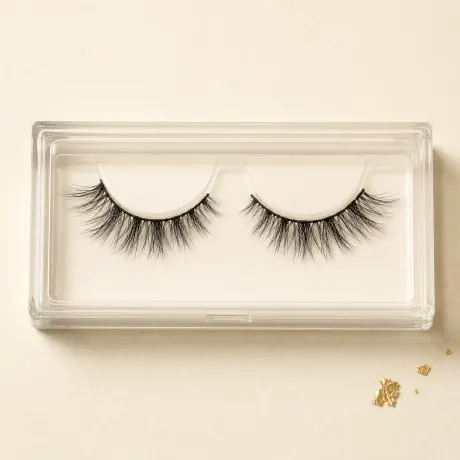
Lash adhesive
The glue that holds false lashes on: latex or latex-free, clear or black, for strips or for clusters. How to choose it and use it, what regulators say about it — and how it took over from the actor’s spirit gum.
Lash adhesive is a glue made to hold false eyelashes along the lash line, usually a latex or latex-free formula that goes on white or black, turns tacky in about half a minute and dries to a flexible film that peels away when the lashes come off.
Our picks
Chosen across the forms lash glue now takes — tube, brush, pen and cluster bond — and across latex-free and waterproof formulas, from drugstore glues to lash specialists’. Each opens where its maker sells it: on Amazon, or at the house’s own shop.
As an Amazon Associate I earn from qualifying purchases. Affiliate links — we may earn a commission at no extra cost to you. How this works
The classic tubeDrugstore DUO
Strip Eyelash Adhesive, Clear
A quick-drying, waterproof strip glue in a squeeze tube, clear once it sets along the band.
- Dries clear
- Waterproof
- Squeeze tube
Underlash bondPrestige Lashify
Whisper Light Classic Clear Lash Bond
A clear, flexible bond for underlash sections, layered on the natural lashes with a small wand.
- Dries clear
- Buildable
- Mascara-style wand
Cluster bondMid-range Lilac St.
Eternal Bond Lash Cluster Glue
A black bond for do-it-yourself clusters, sold as holding firmly while staying flexible.
- Black
- Quick-drying
- Brush tip
Everyday strip glueDrugstore KISS
Strip Lash Adhesive, Clear
An inexpensive latex-free strip glue with a brush in the cap, sold as holding for 24 hours.
- Latex-free
- Aloe
- Brush applicator
Latex-freePrestige Velour
Lash Adhesive White
A latex-free strip glue from a lash maker, for wearers who avoid latex.
- Latex-free
- White formula
Sensitive eyesMid-range House of Lashes
Latex-Free Eyelash Adhesive
A latex-free glue sold for sensitive eyes, from a house that makes strip lashes.
- Latex-free
- Sensitive eyes
Brush-on clearPrestige Battington
Battington Lash Glue
A plain brush-on glue that dries clear, from a house that makes handmade lashes.
- Brush-on
- Dries clear
Bond and sealDrugstore KISS
Falscara Bond & Seal, Clear
The bond and sealant made for KISS’s Falscara clusters, sold together for fixing them beneath the lashes.
- Bond and sealant
- Clear
- For underlash clusters
Clear, latex-freePrestige Lash Star Beauty
Visionary Lash Adhesive
A clear, latex-free glue from a lash specialist, made as the companion to its own lashes.
- Latex-free
- Dries clear
Brush-onDrugstore DUO
Brush-On Lash Adhesive, Clear
The same house’s glue with a fine brush in the cap, sold as latex-free and formaldehyde-free.
- Brush-on
- Latex-free claim
- Formaldehyde-free claim
Glue penPrestige Lilly Lashes
Power Liner Lash Glue, Clear
Lash glue in a felt-tip pen, drawn along the lash line like liner and dry in moments.
- Felt tip
- Latex-free
- Dries clear
Lash glue has one job and two ways to fail at it. It must hold a band of fibres to the edge of the eyelid for hours, through blinking, heat and the occasional rub, and then let go cleanly without taking natural lashes with it. Most strip-lash glues go on white or black, turn tacky as they begin to dry and set to a clear or black film that flexes with the lid. Some are made with natural rubber latex; many are now sold as latex-free.
They come in more forms than they used to: tubes with a fine nozzle, bottles with a brush in the cap, felt-tip pens that double as eyeliner, and the bonds and sealants sold with underlash cluster systems, which are made to hold for days rather than hours. None of these is the glue a salon uses for eyelash extensions, which fixes fibres to the natural lashes themselves and is a different product under different rules.
Choosing one
Clear or black. Glue that dries clear forgives a crooked band; black glue vanishes into a line of eyeliner and can stand in for one. Latex or latex-free. Natural rubber latex is a common allergen, so anyone with a latex allergy, or whose lids itch after wearing lashes, should choose a formula sold as latex-free and read its ingredients. Applicator. A brush lays a thin, even film along a band, a nozzle gives more control for small repairs, and a pen is quickest, making glue and liner a single step.
For underlash clusters, use the bond made for the system: those formulas are designed around their own sealant and remover, and an ordinary strip glue will not hold for days. Whatever you buy, look for an ingredient list. In the United States eyelash adhesives are regulated as cosmetics,[1] and cosmetics sold to consumers must list their ingredients.[2]
How to use it
Use less than seems necessary. Run a thin line along the band, or squeeze a little onto the back of the hand and draw the band through it, then wait about thirty seconds until it turns tacky: wet glue slides, and can run into the eye. Press the lashes on and hold them for a few seconds. Keep glue off the waterline and out of the natural lashes, and close the tube at once, since glue that has begun to set in the nozzle comes out in strings.
To remove, soften the glue with the remover the maker recommends, or with an oil-based cleanser, and peel from the outer corner. Pick the dried film off the band before storing the lashes. Stop using any glue that makes the lids itch, swell or redden, and see a doctor if the irritation persists.[3]
What regulators say
In the United States the FDA treats false eyelashes, extensions and their adhesives as cosmetics, which must meet the safety and labelling requirements for cosmetics, and tells wearers to check the ingredients before using them.[4] Its guidance on latex names eyelash adhesives among the products that typically contain natural rubber latex: between January 2015 and September 2017 it received 30 reports of allergic reactions involving such products, four of which appeared to be anaphylactic. Cosmetics need carry no latex warning, so it suggests that people concerned about a latex allergy may want to avoid eyelash adhesives even when latex is not listed.[5]
Europe draws the line elsewhere. The EU working group on cosmetic products, in a manual for national regulators that is not legally binding, takes the view that a glue whose only function is to attach false eyelashes has no cosmetic function and so is not a cosmetic, while a product whose main purpose is to change the look of the skin, such as a magnetic eyeliner, can be one; each is judged case by case.[6] Glue for salon extensions is held to tighter rules: Health Canada allows cyanoacrylate-based eyelash extension adhesives, the chemistry of instant glue, to be sold for professional use only, with cautionary statements on the label.[7] Formaldehyde is a further concern. A study published in 2022 found it released by 15 of 20 professional eyelash glues, none of which declared it, and by 4 of 17 consumer glues, two of them without declaring it.[8]
Where it came from
Early false lashes came with their own fixative. Charles Nessler’s strip lashes of about 1903 were sold with a small bottle of “skin fluid”, patented in America, and a salon fixed the first pair. By the 1930s the adhesive came in a phial or a tube, and a trade journal of 1934 gave the same instruction as a modern box: spread it lightly on the band and let it dry for a moment, until it is merely sticky.[9]
On stage and in film, hair was fixed with spirit gum. When the make-up artists Eric and David Aylott began selling Eylure lashes in 1947, they boxed them with a tube of their own adhesive, Lashfix, made of equal parts of latex and distilled water; unlike spirit gum, it stretched with the eyelid, so lashes were less likely to come away as it moved.[10] The fashion for false lashes in the 1960s brought its own problems, among them occasional allergic reactions to the glue and glue building up on lashes worn again and again, and in 1968 one women’s magazine was recommending surgical adhesive as “the cheapest and best”. DUO eyelash adhesive was on sale by 1971.[9] Latex is still common in lash glue: the FDA lists eyelash adhesives among the products that typically contain it.[11]
The techniques
- Glue and place
- Apply adhesive, wait until tacky, then set onto the lash line.
Sources
- [1, 3, 4]Eye Cosmetic Safety US Food and Drug Administration.View source (opens in a new tab) Accessed 2026-09-22.
- [2, 5, 11]Latex in Cosmetics US Food and Drug Administration, 2024.View source (opens in a new tab) Accessed 2026-09-26.
- [6]Manual on the scope of application of the Cosmetics Regulation (EC) No 1223/2009 (Art. 2(1)(a)), version 5.5 European Commission (CIRCABC), 2025.View source (opens in a new tab) Accessed 2026-09-26.
- [7]Compliance Verification Project 2023-2024: Cosmetic Regulations (cyanoacrylate-based eyelash extension adhesives) Government of Canada, 2024.View source (opens in a new tab) Accessed 2026-09-26.
- [8]Formaldehyde Release From Eyelash Glues: Analysis Using the Chromotropic Acid Method Dermatitis 33 (6): 442–446, 2022.View source (opens in a new tab) Accessed 2026-09-26.
- [9]False Eyelashes Cosmetics and Skin, 2018.View source (opens in a new tab) Accessed 2026-09-26.
- [10]Eylure Cosmetics and Skin, 2019.View source (opens in a new tab) Accessed 2026-09-25.