Felt-tip eyeliner
Liquid liner in a pen with a firm felt tip: the easiest way to draw a wing. How to choose one, how to build the wing in three strokes — and where the eyeliner pen came from.
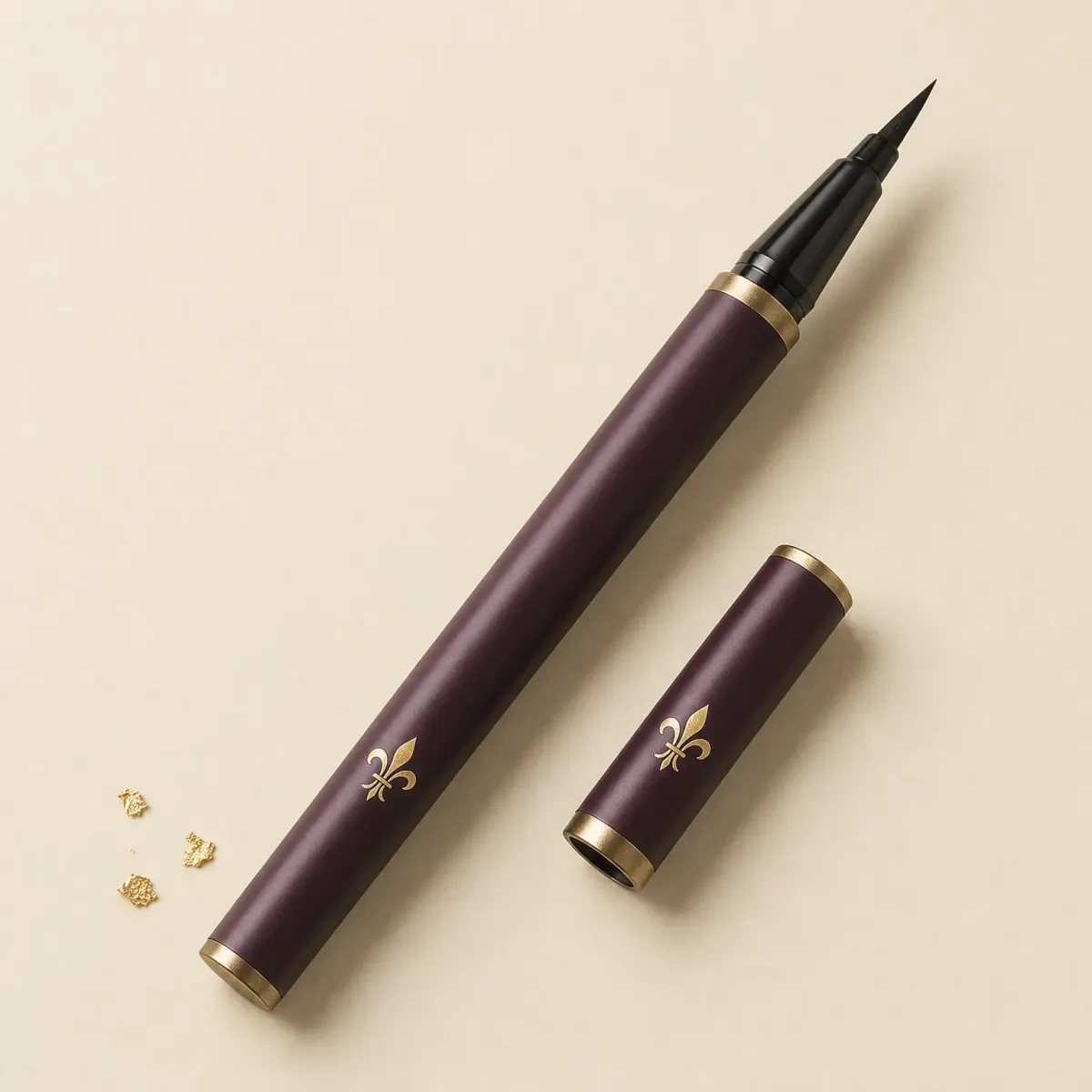
A felt-tip eyeliner is a liquid eyeliner in pen form, delivering ink through a firm, tapered tip of pressed fibres for a steady, precise line.
Our picks
Eighteen pens with a true felt or sponge nib, from drugstore to prestige, with a Korean pen among them; pens with a brush tip behave differently and are in the liquid eyeliner guide. Each opens where its maker sells it — on Amazon, at Sephora or at the house’s own shop — and you choose your shade on that page.
As an Amazon Associate I earn from qualifying purchases. Affiliate links — we may earn a commission at no extra cost to you. How this works
Fine and firmPrestige Tom Ford Beauty
Eye Defining Pen
A black pen with a fine, firm tip, for the crispest wing with the least effort.
- Fine, firm tip
- Liquid black
BudgetDrugstore e.l.f. Cosmetics
H2O Proof Eyeliner Pen
An inexpensive waterproof pen that draws thin or thick lines, and the easy way to try the format.
- Felt tip
- Waterproof
- Vegan
MatteMid-range Benefit Cosmetics
Roller Liner Waterproof Liquid Eyeliner
A precision felt tip and a true-matte finish, for a line that reads as soft black rather than lacquer.
- Felt tip
- Matte
- Waterproof
The flickPrestige Charlotte Tilbury
The Feline Flick Waterproof Liquid Eyeliner
A matte, quick-drying pen with a slightly softer, brush-like felt tip, built round the winged flick.
- Waterproof
- Matte
- Quick-drying
Thin to thickDrugstore Revlon
ColorStay Sharp Line Liquid Eyeliner
A drugstore felt tip that draws a fine line at its point and a bolder one on its side.
- Felt tip
- Waterproof
- Smudge-proof
Marker tipMid-range Stila
Stay All Day Waterproof Liquid Eye Liner
A waterproof pen whose tip its maker likens to a marker, for fine lines or bold strokes.
- Marker-like tip
- Waterproof
Luminous blackPrestige Lancôme
Idôle Liner
An ultra-precise felt tip that draws a one-stroke line in a black with a little light in it.
- Felt tip
- Waterproof
- 24-hour wear claim
Matte, long wearDrugstore Milani
Stay Put Matte Liquid Eyeliner
A tapered felt tip and a quick-drying matte formula made to last through heat and humidity.
- Matte
- Waterproof
- 17-hour wear claim
Super-fine tipMid-range Smashbox
Always On Liquid Liner
A super-fine felt tip for ultra-thin lines, in a formula sold as transfer-proof.
- Felt tip
- Waterproof
- 24-hour wear claim
Couture feltPrestige Givenchy Beauty
Liner Disturbia
Givenchy’s precision felt tip, for buildable lines in an intense black that sets fast.
- Felt tip
- Waterproof
- Transfer-proof
Sensitive eyesDrugstore Almay
Conditioning Liquid Liner
A waterproof felt-tip pen sold as hypoallergenic, for eyes that react to most liners.
- Felt tip
- Waterproof
- Hypoallergenic
Soft feltMid-range Anastasia Beverly Hills
Liquid Liner
A soft felt tip that goes from superfine lines to bold wings without skipping.
- Felt tip
- Quick-drying
Ultra-blackPrestige Hourglass
Voyeur Waterproof Liquid Liner
A flexible felt tip and a very black, waterproof formula, for a dramatic line that holds all day.
- Felt tip
- Waterproof
- Ultra-black
Korean penDrugstore CLIO
Superproof Pen Liquid Eyeliner
A Korean pen with a fine sponge tip and a fast-drying formula, for a sharp wing in one stroke.
- Sponge tip
- Waterproof
- Fast-drying
Fine-point markerMid-range Merle Norman
Pro Pen Eyeliner
A slim felt tip that works like a fine-point marker, from a house sold through its own studios.
- Felt tip
- Water-resistant
Liner and serumDrugstore Physicians Formula
Eye Booster 2-in-1 Lash Boosting Eyeliner + Serum
A felt-tip liner sold as an eyeliner and lash serum in one; judge it as a liner.
- Water-resistant
- Smudge-resistant
Ultra-fineDrugstore Palladio
Ultra Fine Tip Eyeliner Pen
An inexpensive marker-style pen with an ultra-fine tip, for thin lash-line definition.
- Felt tip
- Ultra-fine tip
Lowest costDrugstore essence
Superfine Eyeliner Pen Waterproof
The least expensive felt-tip pen here, with an extra-thin tip for precise lines.
- Felt tip
- Waterproof
A felt-tip eyeliner is liquid liner in the form of a marker: a slim pen whose barrel holds the ink and feeds it, through a reservoir or a wick, to a firm, tapered tip of pressed fibres. It draws like a pen on paper. The tip does not splay the way a brush does, so the line is steadier and the stroke easier to repeat, and there is no bottle to dip into and no brush to reload. That is why it is the easiest way to draw a wing.
The same firmness is its limit. A felt tip draws a narrower range of line than the brush of a dip liner, which can go from hair-fine to bold in one stroke, and a tip that has dried or frayed cannot be replaced. Beside a liquid liner it is easier and a little less exact; beside a gel pencil it is sharper and does not smudge at all. Some pens sold as liquid liners have a tiny brush in place of the felt; those behave more like a dip liner and take more control.
Choosing one
Feel the tip before anything else. A fine, stiff point draws the thinnest line and the crispest wing. A thicker or softer, more brush-like felt lays colour down faster and makes a bold line easier, at some cost in precision. Then the formula: most felt-tip liners now claim to be waterproof or smudge-proof, most dry matte, and most come in black, with a brown or two for a softer line.
Buy for how often you will use it. A pen that sits unused dries at the tip long before its ink is gone, and most cannot be refilled. Store it with the cap firmly on — several makers also ask for it to be kept tip-down, so the ink stays at the nib — and replace it when the line starts to skip or turn grey, rather than pressing harder, which frays the felt and spoils the point for good.
Felt tip or brush pen?
From the outside a felt-tip liner and a brush pen look alike, and the pack does not always say which is which. The difference shows in the stroke. A felt nib is a pressed pad of fibres: it holds its shape, draws a line of even width, and is the easiest to steady, which is why so many first liners use one. A brush pen has separate hairs that bend and spread under pressure, so it can swell a line from hair-fine to bold, but it punishes a shaky hand. Some makers split the difference with a flexible or “brush-like” felt that bends a little without splaying, and a few use a fine sponge.
If you have a steady hand and want the sharpest possible flick, a brush tip will give you more. If you want the same line every morning, with the least practice, a felt tip is the surer tool.
Drawing a wing
The pen turns the wing into a sequence rather than a single stroke. With the eye open and looking straight ahead, draw the flick first: a short line from the outer corner, following the angle of the lower lash line up towards the tail of the brow. Close the eye and draw a second line from the tip of the flick back down to the upper lash line, about a third of the way in, then fill the triangle. Finally line the rest of the lash line from the inner corner outward in short strokes, thickening it as it meets the wing.
Hold the pen almost flat to the lid for a thick line and upright for a thin one, and keep the pressure light: a felt tip draws best when it barely touches. On an oily lid, a little powder shadow pressed along the lash line first gives the felt a drier surface to grip. If one wing ends higher than the other, lengthen the lower one rather than cutting the higher one back, and tidy the edge with a pointed cotton bud and a little remover.
Where it came from
The eyeliner pen is a borrowing from the stationery shop, and its history is short and poorly recorded; no one can be named with confidence as having sold the first. The clearest early evidence is a patent. Revlon filed for a new eyeliner formula in 1986, and its patent, granted in 1991, states that “a wick-type nib pen which delivers a steady flow of coloring liquid has been available in Europe and Japan as a delivery system for eyeliner cosmetics”: a nib of porous urethane-nylon, fed from a cartridge of liquid liner.[1]
The same document explains why such pens were slow to reach the United States. The liquids that flowed well through a wick were coloured with water-soluble organic dyes that the FDA had not approved for use around the eye, while the pigments that were approved, such as iron oxides, are insoluble particles large enough to clog a fibre nib. Revlon’s answer was to grind approved pigments to five microns or less and keep them suspended with a film-forming polymer, polyvinylpyrrolidone, so that they would travel through the felt without blocking it.[1] Getting pigment rather than dye to flow through felt is the problem the format was built around, and every pen on the counter is an answer to it.
The techniques
- Draw
- A single controlled line, built from short strokes where the hand needs it.
- Wing
- Extend the liner past the outer corner in a flick that follows the lower lash line upward.
Sources
- [1]US Patent 5,013,543 — Cosmetic eyeliner formulation United States Patent Office, 1991.View source (opens in a new tab) Accessed 2026-09-25.
Other kinds of eyeliner
Kohl pencil
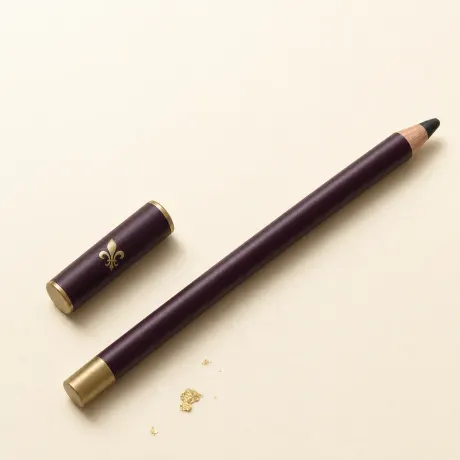
A soft, waxy pencil made to be smudged — the modern way to wear a kohl-rimmed eye.
Read the guide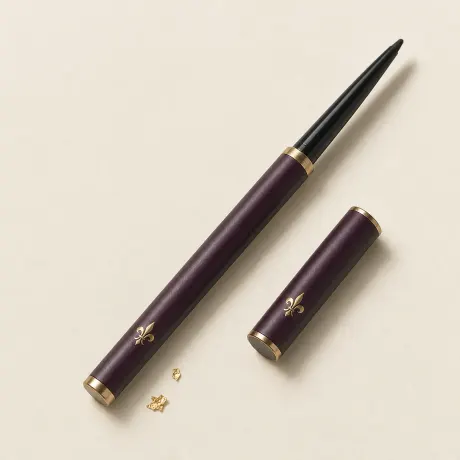
Gel eyeliner pencil
A retractable pencil with a creamy gel lead that glides, then sets waterproof.
Read the guide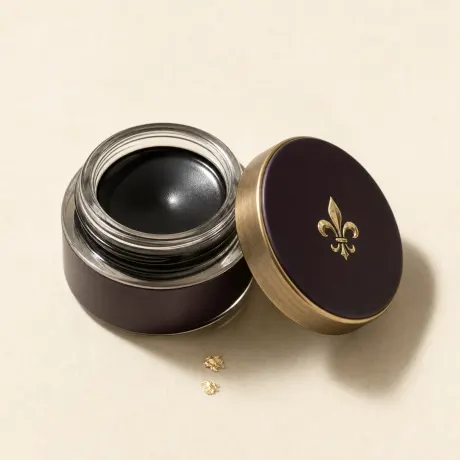
Gel eyeliner
A dense gel in a small pot, applied with a brush — sharp enough for a wing, soft enough to smudge.
Read the guide
Liquid eyeliner
Ink-like liner with a fine brush in the cap, for the sharpest possible line.
Read the guide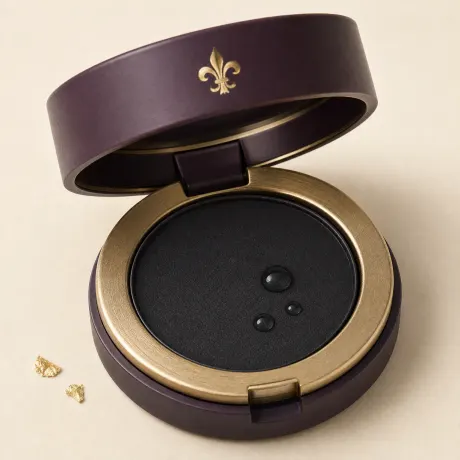
Cake eyeliner
A pressed cake of liner pigment activated with water, still the choice for graphic and stage work.
Read the guide