Face gems
Self-adhesive crystals, pearls and studs placed on the face as decoration, from the festival field to the television screen. How to choose them, put them on and take them off safely, and where the idea came from.
Face gems are small flat-backed crystals, rhinestones or pearls with adhesive on the back, pressed onto the skin around the eyes, brows and cheekbones as decoration and peeled off afterwards.
Our picks
Five sets from the three makers we found selling face gems to American readers from their own shops: Half Magic, ColourPop and the London label Mercy London, which ships abroad. No prestige makeup house sells them. Each opens at the maker’s own shop.
Affiliate links — we may earn a commission at no extra cost to you. How this works
Crystals and neonsMid-range Half Magic
Face Gems
Rhinestones from the brand of the makeup artist behind Euphoria’s jewelled looks, in iridescent, neon or champagne sets.
- Self-adhesive
- Three colourways
- Medical-grade adhesive claim
Mixed sizesDrugstore ColourPop
Crystal Face Jewels (Individual)
An inexpensive pack of rhinestones in mixed sizes and shapes, sold as coming off without residue.
- Self-adhesive
- Mixed shapes
- Reusable with lash glue
PearlsMid-range Half Magic
Face Pearls
Pearls rather than crystals, for a softer gleam on the cheekbone or along the brow.
- Self-adhesive
- Iridescent or metallic
Clear, with tweezersDrugstore Mercy London
Face Gems in Clear
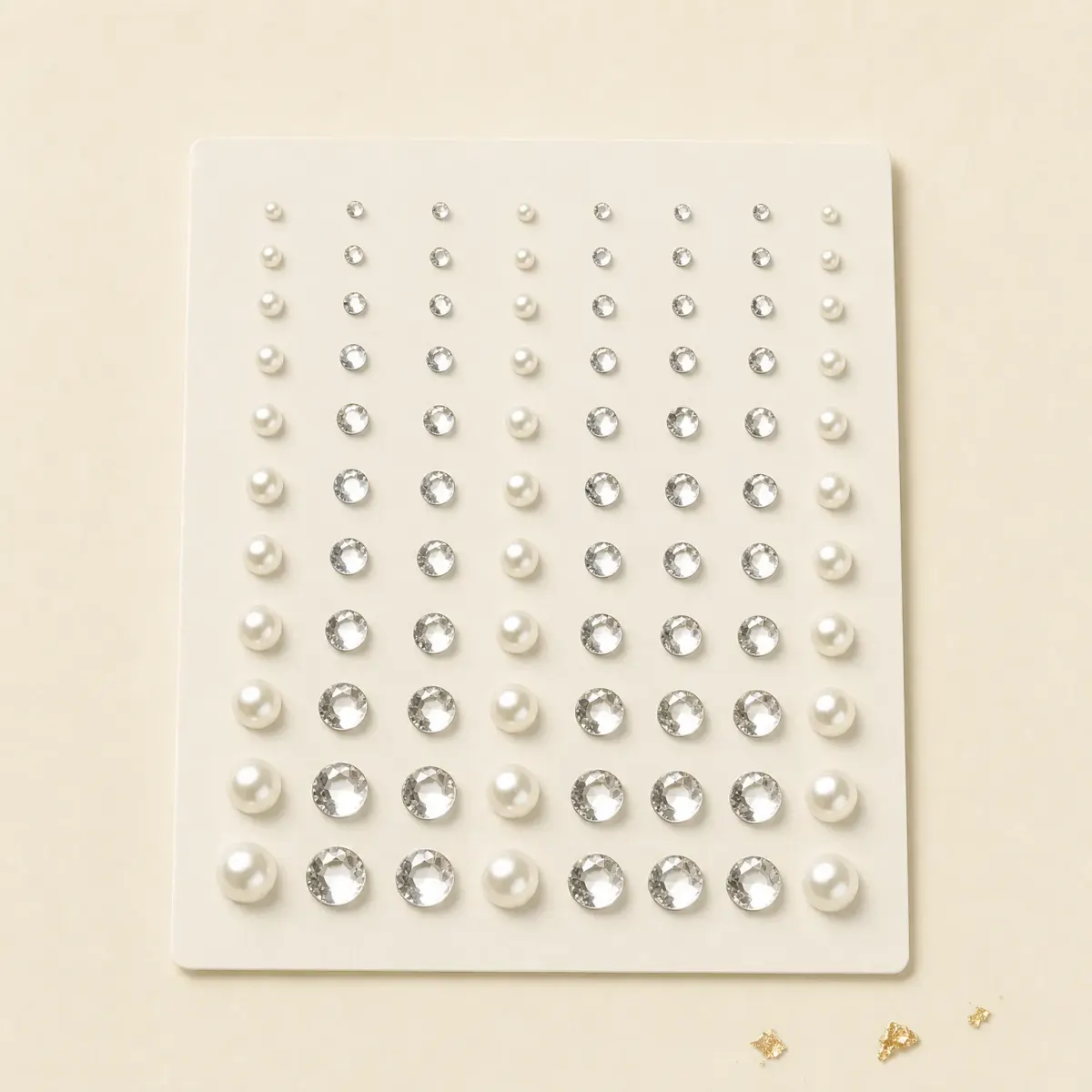
Four sheets of clear stones in graded sizes, with tweezers to place them: the simplest way to start.
- Four sheets
- Tweezers included
- Clear stones
Ready-made designDrugstore Mercy London
Cat Eye Crystal Jewels in Iridescent
A cat-eye design laid out in advance on its sheet, for a finished look without placing stones one by one.
- Pre-arranged design
- Iridescent
- Reusable with lash glue
Face gems are decoration you stick on: flat-backed rhinestones, crystals, pearls or metal studs, sold on a backing sheet with adhesive already on each one. They are lifted off with tweezers and pressed onto the skin at the outer corner of the eye, along the brow or across the cheekbone, as a single point of light or scattered in a line or a constellation, and they come off at the end of the night.
They sit between two neighbours. Glitter is loose colour, worked into a gel or pressed onto a base and spread; a gem is a single object placed exactly where it is wanted. A bindi, worn between the brows, carries religious and marital meanings for many of the Hindu, Jain and Buddhist women who wear it.[1] A face gem is decoration only, and it can go anywhere.
Choosing them
Most sets come ready to stick, with a range of sizes on each sheet, from pinpoints for tracing a line on the lid to larger stones for the cheekbone. Crystals and rhinestones catch the light hardest; pearls give a softer, rounder gleam; metal studs look sharper. Iridescent stones take on the colour of whatever they sit on, and clear ones are the easiest start.
Look at the adhesive before the stones. A maker that names it, or says it is made for skin, tells you more than one that does not, and cosmetics sold at retail in the United States must list their ingredients.[2] If you want to reuse gems, some makers suggest re-sticking them with lash glue, which the FDA treats as a cosmetic;[3] choose a latex-free one if you react to latex, because eyelash adhesives are among the products that typically contain it.[4] Never use nail glue or superglue on skin. Regulators have said little about face gems themselves: a manual for European regulators, which is not binding, puts a glue whose only job is to attach an article, such as false eyelashes or jewellery on teeth, outside cosmetics law.[5]
Where to put them
Start with one stone. A single crystal at the outer corner of the eye, just beyond the end of the lash line, catches the light every time the head turns; a few graduated stones along the brow bone or the top of the cheekbone read as a line of light rather than a scatter. A row of tiny stones on the lid, a little above the lashes, can stand in for eyeliner, and a small cluster below the outer corner reads as a tear. Keep the design on the bones of the face, where the skin moves least, and away from the creases at the corners of the eyes and mouth, which work stones loose.
Putting them on and taking them off
Apply gems to clean, dry skin or over makeup that has set, never over oil or a fresh layer of moisturiser, or they will slide. Lift each one with tweezers, place it, and press for a few seconds with a fingertip. Keep them off the waterline and the roots of the lashes and away from the eye itself: a stone that works loose near the eye can fall into it, and the FDA warns that even a slight scratch to the eye can lead to a serious infection.[6]
To take them off, soften the edge with an oil or an oil-based remover and lift slowly from one side; never pull a stone straight off or scrub, and put any you mean to reuse back on their sheet. Try a new set on a less conspicuous patch of skin first, as the FDA suggests for stick-on temporary tattoos,[7] and stop at the first itch, redness or pale spot. The warning comes from the bindi, the stick-on ornament worn most often and longest: dermatologists in India traced loss of pigment in 100 consecutive patients to a bindi adhesive that was 80 per cent para-tertiary-butylphenol.[8] An evening’s gems are a far smaller exposure, but the lesson holds.
Where it came from
Sticking something on the face to be looked at is not new. On 30 August 1660 Samuel Pepys recorded the first day he had seen his wife wear black patches since their marriage,[9] and by 1711 The Spectator could joke that ladies at the opera patched on opposite sides of the forehead according to their politics.[10] Patch boxes followed, some with a mirror in the lid,[11] and the patches in them hid blemishes as well as drawing the eye.[12]
The jewelled face has a closer cousin in the bindi. Stick-on bindis spread from about the middle of the twentieth century; Madonna and Gwen Stefani wore intricate ones in the late 1990s, and when Selena Gomez wore one on stage in 2013, Hindu leaders objected that a religious sign was being treated as an accessory.[13] Television then made gems mainstream on their own terms. The makeup of Euphoria, first shown in 2019, was full of rhinestones, neon and glitter, and in 2022 its head of makeup, Donni Davy, launched a brand, Half Magic, whose first range included Face Gems, tiny rhinestones moulded to her own design.[14] What began as a black patch is now a way of drawing on the face with light.
The techniques
- Dot
- A single placed mark — between the brows, on the forehead or the chin.
Sources
- [1, 13]Bindi Encyclopaedia Britannica, 2025.View source (opens in a new tab) Accessed 2026-09-26.
- [2, 7]Temporary Tattoos, Henna/Mehndi, and "Black Henna": Fact Sheet United States Food and Drug Administration, 2024.View source (opens in a new tab) Accessed 2026-09-26.
- [3, 6]Eye Cosmetic Safety US Food and Drug Administration.View source (opens in a new tab) Accessed 2026-09-22.
- [4]Latex in Cosmetics US Food and Drug Administration, 2024.View source (opens in a new tab) Accessed 2026-09-26.
- [5]Manual on the scope of application of the Cosmetics Regulation (EC) No 1223/2009 (Art. 2(1)(a)), version 5.5 European Commission (CIRCABC), 2025.View source (opens in a new tab) Accessed 2026-09-26.
- [8]Contact depigmentation from free para-tertiary-butylphenol in bindi adhesive Contact Dermatitis 22(2): 99–102, 1990.View source (opens in a new tab) Accessed 2026-09-26.
- [9]The Diary of Samuel Pepys, entries for 30 August, 20 October and 21 November 1660 Project Gutenberg eBook #4125 (Diary of Samuel Pepys, complete 1660), 1660.View source (opens in a new tab) Accessed 2026-09-25.
- [10]The Spectator, No. 81, Saturday 2 June 1711 Project Gutenberg eBook #12030 (The Spectator, volumes 1, 2 and 3), 1711.View source (opens in a new tab) Accessed 2026-09-25.
- [11]Patch box, Meissen porcelain factory, about 1750, museum number 939-1882View source (opens in a new tab) Accessed 2026-09-25.
- [12]Patch box, Josiah Wedgwood and Sons, Etruria, 1785-1790, museum number WE.4650-2014View source (opens in a new tab) Accessed 2026-09-25.
- [14]Euphoria Makeup Head Donni Davy’s Makeup Brand, Half Magic, Is Finally Here Allure, 13 May 2022, 2022.View source (opens in a new tab) Accessed 2026-09-26.