Huadian
A small ornament painted or pasted between the brows, shown on Tang faces and worn again today with Han-style dress. What the images show and the stories claim, how to wear one now, and why we link none.
Huadian are small ornaments painted or pasted on the forehead between and above the brows, shown widely in Tang-dynasty tomb painting and figurines and now also sold as printed stickers for historical Chinese dress.
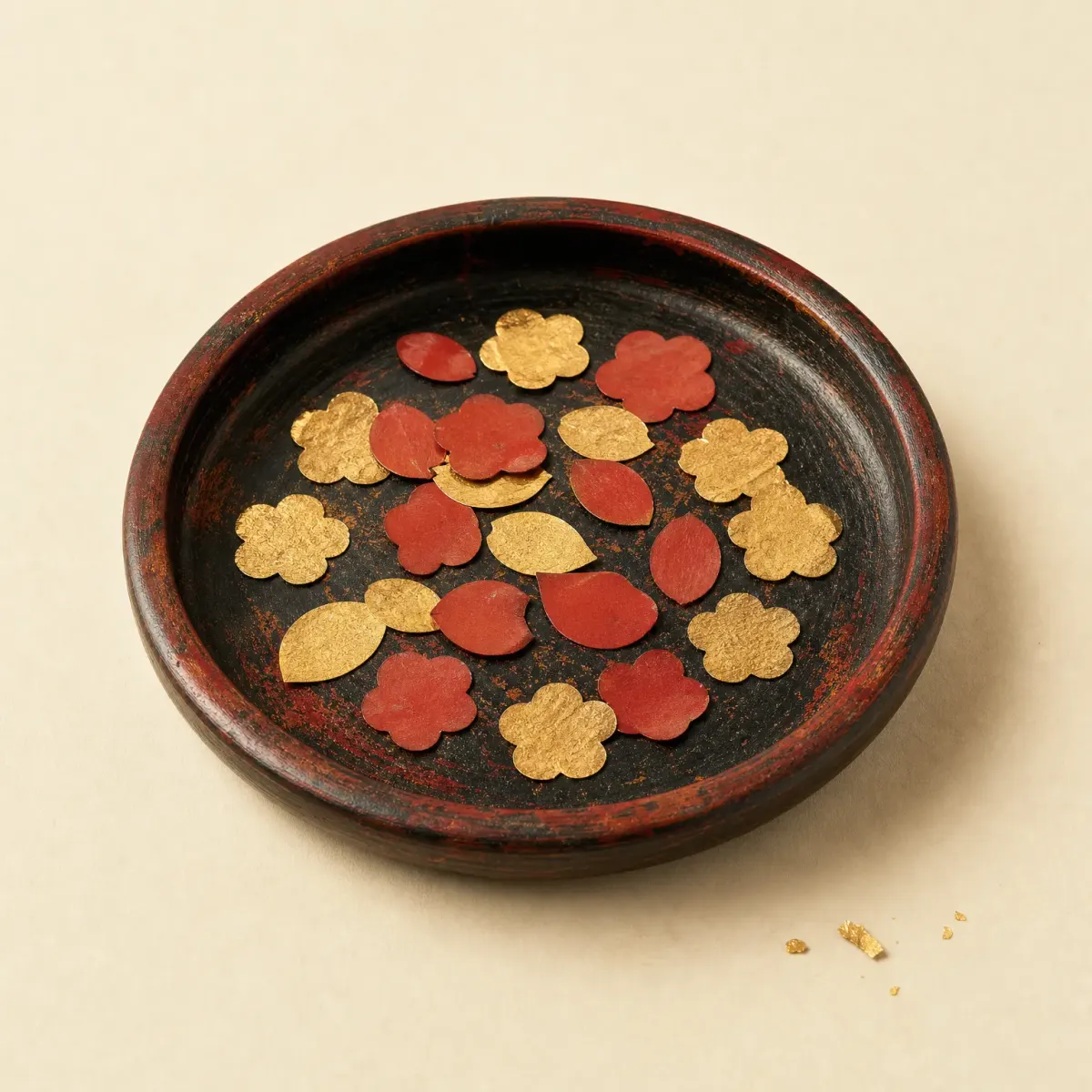
A huadian is an ornament between the brows: a small mark painted on the forehead, or a shape cut out and pasted there, most often a flower or a few petals. It is a cousin of the bindi and of the European patch, and like them it adds something to the face rather than evening it out.
It is best known from the Tang dynasty. Tang adornment survives unusually well, in excavated textiles, funerary figurines, tomb painting and poetry, well enough that scholars now read it as a fashion system, a matter of changing taste rather than fixed costume,[1] and the painted and modelled faces of the period often wear a mark between the brows. What those marks were made of is a harder question. A painting shows where an ornament sat and what shape it took; it cannot show whether it was pigment, gold, paper or something else, and the lists of materials that circulate come from literary compilations written long afterwards rather than from the objects.
The story and the evidence
The famous origin is a story. A plum blossom fell on the forehead of Princess Shouyang, daughter of the Liu Song emperor Wu, and left a five-petalled mark that took three days to wash off; her attendants copied it. The story reaches us through the Taiping yulan, an encyclopedia compiled between 977 and 983 that quotes an earlier work now lost, so its earliest surviving telling is some five hundred years younger than the events it describes.[2] It is good evidence that the story was told in the tenth century, and weak evidence for anything in the fifth. Stories of a single woman and a single accident tend to attach themselves to a fashion after the fact, and this one arrived late even by that standard.
The images are firmer. Tang funerary figures and tomb paintings were made to accompany the dead, so an ornament on their foreheads is part of a face someone meant to last.[3] Whether it meant anything beyond fashion, whether marital, protective or ritual, is not recorded in the sources used here, and a confident answer in either direction would be invention.
Wearing one now
The simplest huadian is painted. Take a lip colour or a cream eyeshadow on a fine liner brush and press five small petals around a dot, just above the line of the brows; or draw a single teardrop, or three fine strokes rising from the centre. Use a colour sold for the face or eyes rather than a craft paint, since only colours approved for cosmetics belong on skin,[4] and set it with a touch of translucent powder so that it does not smudge when the brows move. It comes off with the rest of your makeup.
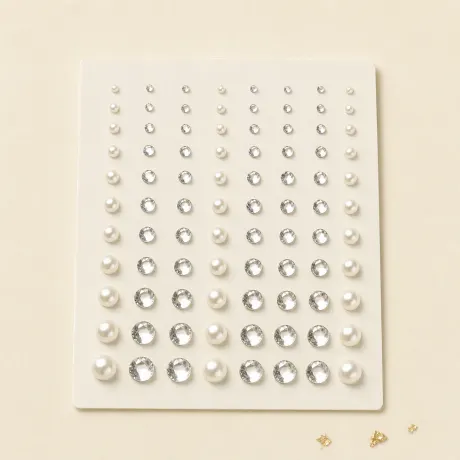
To wear a stuck-on ornament, start with clean, dry skin with no moisturiser or foundation beneath it, centre it between the brows or just above them with a mirror at eye level, and press for a few seconds so that the whole shape takes. A single flat-backed crystal or pearl, placed the same way, reads as a modern huadian, and face gems are sold with their adhesive already on.
Stick-on huadian, sold as printed stickers or water-transfer decals, are closer to the pasted ornaments of the stories, and they carry the risks of anything glued to the forehead. The FDA suggests trying a decal temporary tattoo on a less conspicuous patch of skin before putting it on the face.[5] The bindi, worn in the same place, gives a sharper warning: dermatologists in India have traced loss of pigment, sometimes appearing years after first wear, to chemicals in bindi adhesive, and in one series of 864 cases of chemical leukoderma, adhesive bindis caused 104.[6] Wear a stuck-on ornament for an occasion rather than every day, lift it off after softening the edge with oil, and stop at the first itch, redness or pale spot.
Where it came from
The history of the huadian is mostly a history of pictures. Chinese face whites survive as residues in sealed vessels and have been analysed in the laboratory, as with a face cream buried in a tomb some 2,700 years ago;[7] a painted petal or a scrap of cut paper does not survive that way, and no excavated huadian is cited in the sources used here. What remains is the painted and modelled face, in the figurines and tomb paintings that are the evidence for Tang adornment as a whole.[8] The origin story attached to it survives only in the form written down five centuries after the events it describes.[9]
It has come back with the clothes it was worn with. The hanfu movement, the revival of Han Chinese dress, began on the mainland, by one account, in 2003, when a power worker in Henan, Wang Letian, drew wide attention by wearing traditional clothing in public; in Britain, Chinese students were founding hanfu clubs by 2007.[10] Huadian are now sold by the sheet, printed with petals and flowers, to wear with it. What is revived is the image the tombs kept: a flower between the brows, chosen, as it was then, because it was the fashion.
The techniques
- Dot
- A single placed mark — between the brows, on the forehead or the chin.
- Paint
- Brush or dab liquid colour directly onto the skin or lips.
Sources
- [1, 3, 8]Empire of Style: Silk and Fashion in Tang China University of Washington Press, 2019.View source (opens in a new tab) Accessed 2026-09-22.
- [2, 9]Taiping yulan (Readings of the Taiping Era) Compiled by imperial commission, Song dynasty, 977-983, 983.View source (opens in a new tab) Accessed 2026-09-22.
- [4]Color Additives Permitted for Use in Cosmetics, 21 CFR Parts 73 and 74View source (opens in a new tab) Accessed 2026-09-22.
- [5]Temporary Tattoos, Henna/Mehndi, and "Black Henna": Fact Sheet United States Food and Drug Administration, 2024.View source (opens in a new tab) Accessed 2026-09-26.
- [6]Dermatoses Due to Indian Cultural Practices Indian Journal of Dermatology 60(1): 3–12, 2015.View source (opens in a new tab) Accessed 2026-09-26.
- [7]The Rise of the Cosmetic Industry in Ancient China: Insights from a 2700-Year-Old Face Cream Archaeometry 63 (5), 1042-1058, 2021.View source (opens in a new tab) Accessed 2026-09-22.
- [10]The Forgotten Drivers of China’s ‘Hanfu’ Movement Sixth Tone (Voices & Opinion), 19 March 2024, 2024.View source (opens in a new tab) Accessed 2026-09-26.