Bullet lipstick
Colour moulded into a stick and wound up from its case: the lipstick most people mean by the word. How the formulas differ, how to wear and keep one — and where the twist-up case came from.
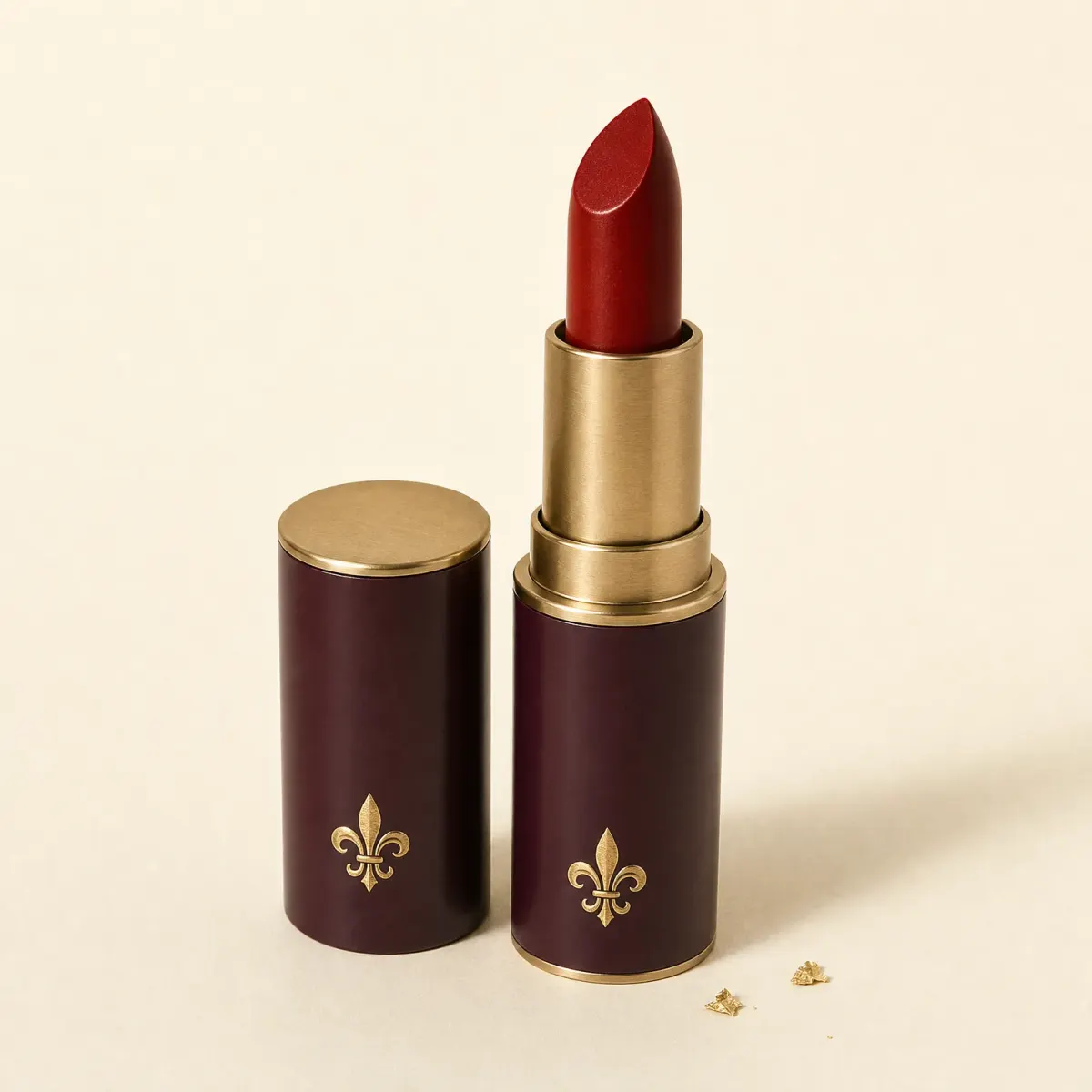
A bullet lipstick is lip colour — pigment held in a blend of waxes and oils — moulded into a stick and set in a twist-up case, applied straight from the tube or with a lip brush.
Our picks
Chosen to cover the finishes — matte, satin and glow — budgets from drugstore to prestige, and houses from New York and Paris to Tokyo. Each opens where its maker sells it, on Amazon or at the house’s own shop, and you choose your shade on that page.
As an Amazon Associate I earn from qualifying purchases. Affiliate links — we may earn a commission at no extra cost to you. How this works
Three finishesPrestige Dior
Rouge Dior
The house’s signature bullet, in a matte veil, a luminous velvet or a creamy satin — one range, three ways to wear it.
- Velvet, satin or veil
- Refillable
- 24-hour comfort
Everyday satinDrugstore L'Oréal Paris
Colour Riche Original Satin Lipstick
A comfortable satin bullet at a drugstore price, easy to reapply without a mirror.
- Satin
- Argan oil
- Creamy
Modern mattePrestige Charlotte Tilbury
Matte Revolution Lipstick
A matte that stays creamy on the lips — the one to try if flat mattes have felt dry on you.
- Matte
- Up to 10-hour wear
- Vitamin E
Matte classicMid-range MAC Cosmetics
M·A·Cximal Silky Matte Lipstick
MAC’s reworked matte: a strong, flat colour in more than forty shades.
- Silky matte
- 40+ shades
- Up to 12-hour wear
Luminous satinPrestige Chanel
Rouge Allure
Full colour with a satin glow, for a strong lip that still looks polished rather than flat.
- Satin
- Intense colour
Budget matteDrugstore wet n wild
MegaLast Matte Lip Color
Full-coverage colour with a semi-matte finish, for the price of a coffee.
- Semi-matte
- Full coverage
- Vegan
Radiant satinPrestige Clé de Peau Beauté
Lipstick
A radiant satin from Shiseido’s luxury house, made to moisturise as well as colour.
- Satin
- Up to 8 hours
- Argan oil
Heritage redMid-range Bésame Cosmetics
Blood Red – 1922 Lipstick
From a house that reissues historic shades, a brick red it dates to 1922, in the kind of metal case the decade carried.
- Matte
- Vitamin E
- Gold metal case
Caring satinPrestige YSL Beauty
Rouge Pur Couture
A creamy satin with full colour, made with ceramides for lips that dry out under matte formulas.
- Satin
- Ceramides
- 20 shades
Soft matteMid-range Rare Beauty
Kind Words Matte Lipstick
A short range of everyday shades, each paired with a liner of the same colour — the simplest way to get the two to match.
- Soft matte
- 11 shades
- Matching liners
Velvet mattePrestige Tom Ford Beauty
Lip Color Matte
Full coverage and a velvet finish, in shades that run from neutrals to bold colours.
- Velvet matte
- Full coverage
Low-cost satinDrugstore e.l.f. Cosmetics
O Face Satin Lipstick
A creamy satin at one of the lowest prices on this page, for trying a strong colour before committing.
- Satin
- Squalane
- Vegan
Japanese glowPrestige Decorté
Rouge DECORTÉ Cream Glow
A moisturising bullet from a Japanese skincare house, for a lip that looks hydrated rather than shiny.
- Glow finish
- Hyaluronic acid
Two finishesMid-range Anastasia Beverly Hills
Matte & Satin Lipstick
The same colours in a matte and a satin finish, so a shade you like can be worn either way.
- Matte or satin
- Pigmented
Rich satinPrestige Bobbi Brown
Luxe Lipstick
A creamy, strongly pigmented satin that stays comfortable through the day.
- Satin
- Chamomile oil
Clean formulaMid-range ILIA
Color Block Lipstick
Full, bleed-resistant colour from a clean-beauty house, for strong shades that stay inside the line.
- Full coverage
- Long-wear
- Bleed-resistant
Blurred mattePrestige Lancôme
L’Absolu Rouge Intimatte Lipstick
A soft, blurred matte that is lighter on the lips than a classic matte bullet.
- Soft matte
- Ceramides
- Lightweight
Bright colourDrugstore Milani
Color Statement Lipstick
An inexpensive bullet for vivid pinks and reds, the colours a drugstore lipstick does best.
- Vitamin C
- 15 shades
Jewel casePrestige Guerlain
Rouge G Customizable Ultra-Care Lipstick
A refill and a case bought separately, so the case is kept and only the colour is replaced.
- Satin or velvet matte
- Refillable
- Choice of case
Artist satinMid-range Makeup by Mario
SuperSatin Lipstick
A creamy, comfortable satin from a makeup artist’s own line, in a short edit of wearable shades.
- Satin
- 18 shades
- Creamy
Refillable satinPrestige NARS
Explicit Lipstick
Full colour in a satin finish, in a case built to be refilled rather than thrown away.
- Satin
- Refillable
- Smudge-resistant
A bullet lipstick is lip colour moulded into a stick and wound up and down in a case. The stick is a balance struck in wax. Waxes with a higher melting point give it the strength not to snap when it is pressed against the lips; those with a lower one let it soften as it touches them; oils and fats let it spread rather than drag; and the colour, finely ground pigment and sometimes a staining dye, is milled into that base before it is moulded.[1] The proportion of oil to wax decides most of what separates one lipstick from another.
Its neighbours are defined by what they give up. A liquid lipstick trades the stick’s softness for a film that sets and stays; a lip crayon puts similar colour into a fatter pencil you can draw with; a tinted balm keeps the stick but thins the colour to a wash. The bullet sits in the middle: opaque enough to change the colour of the mouth, soft enough to reapply over itself through the day, and small enough to carry.
Matte, satin or sheen
The finish is the first decision, and it is mostly a decision about oil. A matte lipstick carries more pigment and powder and less oil: it holds its colour and its edge longest, and shows every dry patch. A satin or cream finish is the middle — a soft sheen, full colour, and comfortable for most of a day. A sheer or high-shine formula carries the most oil and the least pigment: the easiest to wear and to reapply without a mirror, and the first to move.
Test a shade on the lips rather than the back of the hand, because the lips’ own colour shows through and shifts it. If mattes feel tight, a satin in a deeper shade gives most of the intensity with less of the dryness.
How to wear it
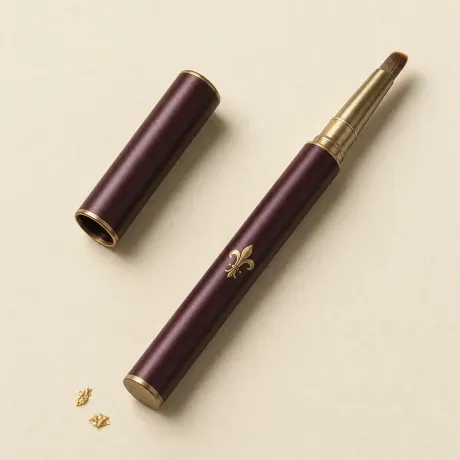
Start with lips that are smooth but not slick: a balm put on well beforehand and blotted off lets colour grip rather than slide. For everyday wear, apply straight from the bullet, working from the centre of each lip outward and using the angled tip along the edge. For a deep or precise shade, use a lip brush: it pushes colour into the lines of the lips and gives a cleaner edge at the corners and the cupid’s bow, where a bullet is too blunt.
To make it last, blot and repeat. Press a tissue between the lips, then apply a second thin layer: blotting lifts the oil and leaves the pigment, so two thin coats outlast one heavy one. A liner in the same shade, drawn along the edge and shaded a little inward, stops strong colours creeping into the fine lines around the mouth.
Keeping it
Wind up only as much as you need, and wind it down before capping: a bullet left raised is the usual way to break one. Keep it out of the heat: a lipstick left in a car or on a sunny windowsill softens, beads with oil and loses its shape. Wipe the tip with a tissue now and then, do not share it, and replace one that has begun to smell stale — the oils in it have turned.
Where it came from
Coloured lip salves and liquid rouges were nineteenth-century goods; the stick is the idea of holding the colour in enough wax to stand up. Guerlain is widely credited with the first stick lip rouge, Ne m’oubliez pas, said to date from 1870 — but Cosmetics and Skin, working from trade literature, found no first-hand evidence for the claim.[2] What can be dated is the case. Blondeau et Cie sold its Vinolia Lypsyl in a metal tube no later than 1892, and a Dorin catalogue of 1893 shows lipsticks in nickel cases, pushed up with a finger or on a slide; Scovill’s American case of 1915, often called the first metal lipstick case, was not.[2]
The twist that makes the modern bullet came next. James Bruce Mason Jr., of Nashville, Tennessee, filed a patent in July 1922, granted in October 1923, for a holder in which turning a knurled head worked a threaded rod that raised the stick’s cup out of its casing and drew it back.[3] It is the earliest known patent for a swivel mechanism, which is not the same as proof that no one made one before.[2] By the end of the decade the case was an accessory in its own right: the Victoria and Albert Museum holds an evening bag of about 1929 that hides a lipstick in a brass case inside its silk tassel.[4]
War changed the case and the colour at once. Metal shortages sent makers back to cardboard and early plastics, and many women moved their sticks into old metal cases rather than use the substitutes.[2] Red became a uniform issue: when the United States Marine Corps Women’s Reserve was formed in 1942, Elizabeth Arden’s Vibrant Red, matched to the red piping and chevrons of its uniform, became Montezuma Red, the standard lipstick in every recruit’s kit.[5] After the war the argument moved to wear. Hazel Bishop’s long-lasting lipstick went on sale in 1950 on the promise that it would not eat, bite or kiss off, and by 1953 it had a quarter of the American lipstick market.[6] Colour that stays put is still what most bullets are sold on — and the reason the liquid lipstick exists.
The techniques
- Fill
- Colour inside an outline so the shape reads as solid.
- Blot
- Press against tissue or blotting paper to lift excess oil or product.
Sources
- [1]Lipstick Formulation Cosmetics and Skin.View source (opens in a new tab) Accessed 2026-09-22.
- [2]Lipsticks Cosmetics and Skin, 2009.View source (opens in a new tab) Accessed 2026-09-22.
- [3]US Patent 1,470,994 - Toilet article United States Patent Office, 1923.View source (opens in a new tab) Accessed 2026-09-22.
- [4]Bag and lipstick, J.A.C., about 1929 (museum no. T.30&A-1981) Victoria and Albert Museum, London.View source (opens in a new tab) Accessed 2026-09-25.
- [5]Montezuma Red: Women Marines in WWII National Museum of the Marine Corps.View source (opens in a new tab) Accessed 2026-09-22.
- [6]Hazel Bishop Cosmetics and Skin.View source (opens in a new tab) Accessed 2026-09-22.
What to apply it with
Other kinds of lipstick

Liquid lipstick
An opaque fluid lipstick that dries to a long-wearing film, usually matte.
Read the guide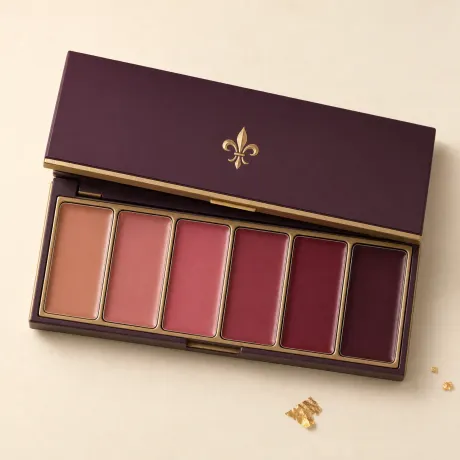
Lip palette
Cream lip colours in pans, for mixing a custom shade with a brush.
Read the guide
Beni
Red extracted from safflower and dried onto the inside of a porcelain cup; it dries an iridescent green and turns red when touched with a wet brush.
Read the guide