Beni
Red from safflower, dried onto the inside of a porcelain cup until it shines green, and turned red again by a wet brush. How to use it, why it was prized, why no American shop can sell it, and where it came from.
Beni is a red lip and cheek colour extracted from safflower petals and dried onto the inside of a porcelain cup, where it shines an iridescent green; touched with a wet brush it turns red, and it is layered from sheer pink to deep red.
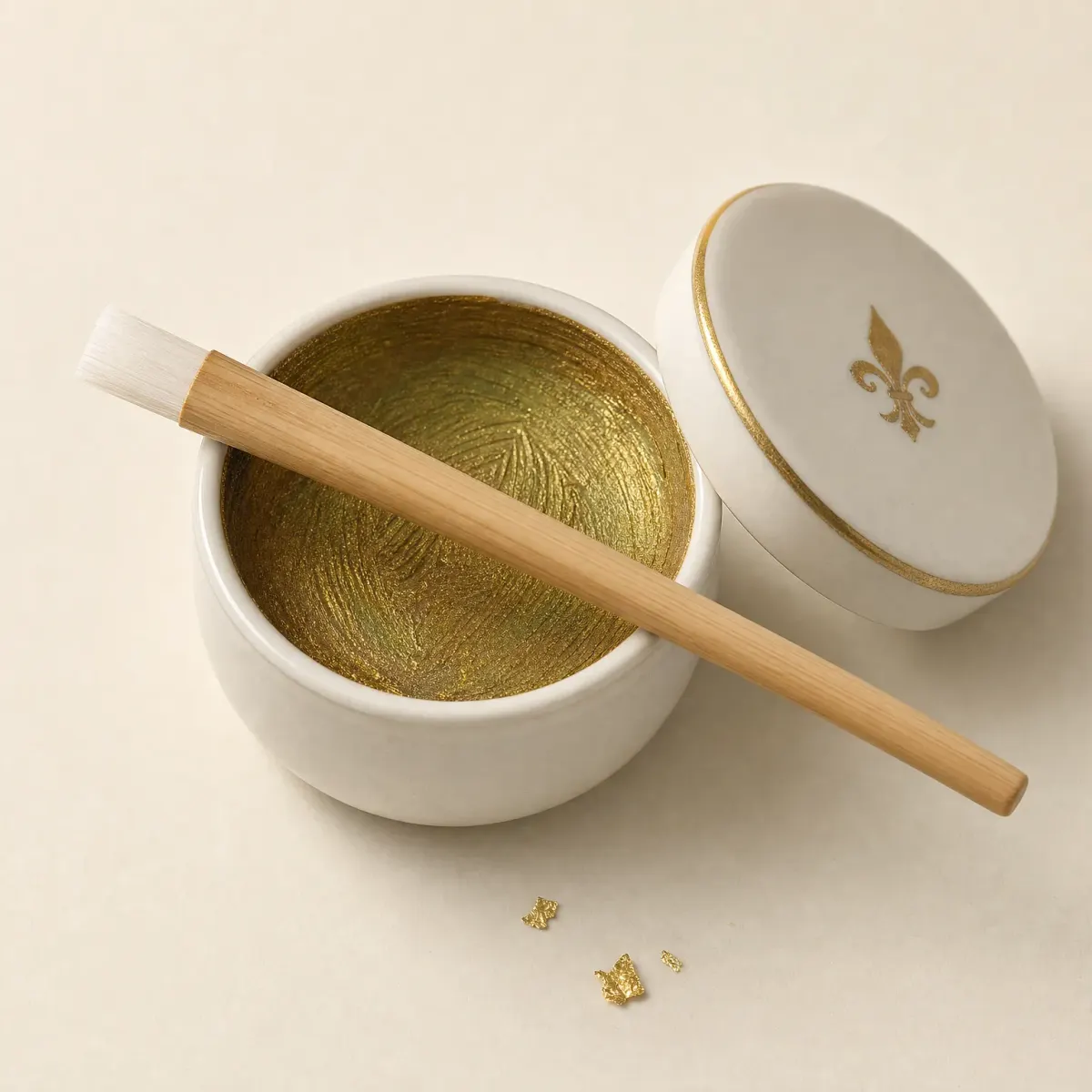
Beni is the red of safflower, Carthamus tinctorius, painted inside a small porcelain cup and left to dry. Good beni does not look red in the cup. It shines an iridescent green-gold, a sheen its makers have long taken as the sign of quality, and it turns red the moment a wet brush touches it. Laid on the lips in thin coats it runs from a sheer pink to a deep red; built up thickly, it shows its green again.[1]
It is not a lipstick. There is no wax or oil in the cup, only the dried colour, so it sits on the mouth as a stain rather than a coat, and, as its maker points out, the same beni reads differently on every mouth.[1] It was sold painted inside small cups and dishes, benichoko and benizara, which were turned face down after use to protect the colour.[2]
How to use it
Isehan, which still makes it, gives the method. Moisten a lip brush and wipe the excess water off on the rim of the cup; tilt the cup so that water cannot run onto the colour; dissolve a little beni, about five millimetres square, at the rim; and paint the lips. More water and more coats deepen it, and layer upon layer brings back the green. For the cheeks, the company suggests dampening the skin with a sponge, taking a little beni on the brush and patting it in with a finger.[3]
The thick green was once a fashion in its own right. In the Bunka and Bunsei years, 1804 – 1830, women built beni up on the lower lip until it turned a metallic green, sasa-iro, and left the upper lip red; those who could not spare so much beni laid down a ground of ink or soot and dabbed a little beni over it.[3][4] To suggest the look with makeup sold in the United States, colour a small mouth at its centre with a true red, and top the lower lip with a green-gold duochrome gloss or pigment.
Forms and keeping
Isehan sells beni in three forms: brushed inside a porcelain cup of Arita ware, in a small refillable case, and in a paper case with a mirror, made for carrying.[5] The cup is the classic, and the one to use at a dressing table; the cases carry the same colour for touching up. Whichever you have, use a clean brush that is damp rather than wet, and dissolve only what you need at the rim, so that water never pools on the rest of the film.[6]
Keep it in its box, away from heat, humidity and direct sunlight. Because it contains nothing but the colour, the green slowly turns red with the years; the company says the change does not affect its quality.[6]
Why we link none
Beni cannot be bought as makeup in the United States, for two separate reasons. The first is supply. Isehan, founded in 1825 by its own account and describing itself as the last remaining beni shop,[7] sells Komachi-beni at its museum in Tokyo and through an online shop that, in its own words, takes Japanese yen only, ships only within Japan and works only in Japanese.[8]
The second is the law. Colours in American cosmetics need the FDA’s approval before they can be used,[9] and safflower is not on its list of colour additives permitted in cosmetics, for the lips or anywhere else.[10] The agency enforces the point at the border: in July 2026 its import alert for colour-additive violations listed an eyebrow tint made in Austria whose colours included “safflower flower”, marked non-permitted, and it treats a cosmetic that declares a non-permitted colour as adulterated.[9] Sold to American readers as makeup, the rouge in Isehan’s cups would be one.
Where it came from
Isehan’s own account has safflower travelling the Silk Road to China, and the plant and the method of extracting its red reaching Japan around the middle of the third century.[11] The Chinese record is firmer. Manuscripts from Dunhuang show safflower used for dye, food and offerings as well as for rouge, and the sixth-century agricultural manual Qimin yaoshu already describes how the red was separated.[12] The chemistry explains the price. The petals are rich in a yellow that dissolves in water and poor in the red, carthamin, which is recovered from what is left once the yellow has been washed away.[13] In Edo Japan the saying went that a momme of beni was worth a momme of gold.[14] Nor was it only a cosmetic: in Isehan’s telling, red was the colour of life, and red dye, makeup and food colouring marked births and weddings.[11]
The house that remains gives its founding as 1825, at Kobuna-cho in Nihonbashi, by Hanemon Sawada: the company’s own account of itself, told through the museum it runs.[15] It now makes Komachi-beni from safflower grown in Yamagata, by a method it says it has kept since the Edo period.[11] Everyday makeup moved on. After the war lipstick displaced the old powder-centred routine altogether,[14] and beni became a specialist’s red. The museum lets any visitor try it, free, on their own lips,[16] which is now the surest way to see the green turn red.
The techniques
- Paint
- Brush or dab liquid colour directly onto the skin or lips.
Sources
- [1, 3, 6, 11]About Beni: Beni, a special red colour extracted from safflower Isehan Beni (English site), 2026.View source (opens in a new tab) Accessed 2026-09-26.
- [2]Beauty Secrets in Japanese Prints Asian Art Newspaper, 27 October 2020, 2020.View source (opens in a new tab) Accessed 2026-09-22.
- [4, 14]Kaleidoscope of Books No. 29: Make-up Then and Now — Cosmetic Culture from Edo to Showa National Diet Library, Tokyo, 2021.View source (opens in a new tab) Accessed 2026-09-22.
- [5, 8]Products: Traditional Japanese Rouge “Komachi-beni” Isehan Beni (English site), 2026.View source (opens in a new tab) Accessed 2026-09-26.
- [7, 16]Isehan Beni: Foundation in 1825, The Last Remaining Beni Shop Isehan Beni (English site), 2026.View source (opens in a new tab) Accessed 2026-09-26.
- [9]Import Alert 53-06: Detention Without Physical Examination of Cosmetics That Are Adulterated and/or Misbranded Due to Color Additive Violations U.S. Food and Drug Administration, Office of Regulatory Affairs, 2023.View source (opens in a new tab) Accessed 2026-09-22.
- [10]Color Additives Permitted for Use in Cosmetics, 21 CFR Parts 73 and 74View source (opens in a new tab) Accessed 2026-09-22.
- [12]Cooking, Dyeing, and Worship: The Uses of Safflower in Medieval China as Reflected in Dunhuang Documents Asia Major, third series, volume 24, 2011.View source (opens in a new tab) Accessed 2026-09-22.
- [13]US Patent 5,750,379 — Process for the production of carthamin United States Patent and Trademark Office; assigned to Toyo Ink Manufacturing, 1998.View source (opens in a new tab) Accessed 2026-09-22.
- [15]Japanese Traditional Craft: Beni for Cosmetics Google Arts & Culture.View source (opens in a new tab) Accessed 2026-09-22.