Brow stencil
A thin, flexible guide with a brow-shaped opening, for filling the brows to a shape you can repeat. How to choose one that fits, how to use it without a printed-on edge, and how a patent for drawing false brows became a guide for keeping real ones.
A brow stencil is a thin, flexible sheet with a brow-shaped cut-out, held against the brow so that powder, pencil or pomade fills only the opening, giving a defined and repeatable shape and a matching pair.

Our picks
Four stencil sets, from the drugstore to prestige, which is as far as the market goes: most stencils on sale are unbranded sets, and most branded ones come boxed with a powder. Each opens where its maker sells it — on Amazon or at the house’s own shop. The shapes and materials are the makers’ claims.
As an Amazon Associate I earn from qualifying purchases. Affiliate links — we may earn a commission at no extra cost to you. How this works
Alignment marksMid-range Anastasia Beverly Hills
Brow Stencils
The brow salon’s own set: five shapes, each marked to line up with the three points of its method.
- Five shapes
- Three alignment marks
- Flexible plastic
Drugstore setDrugstore Ardell
Brow Perfection Stencils
A plain drugstore set of four shapes, from the false-lash maker.
- Four stencils
Washable plasticPrestige By Terry
Tool-Expert Eyebrow Stencils
The Paris house’s five reusable shapes in flexible, washable plastic.
- Five shapes
- Washable, recyclable plastic
- Reusable
Natural shapesMid-range Laura Geller
Precision Brow Shaping Stencils
Five reusable shapes, sold as giving a natural-looking brow.
- Five stencils
- Reusable
A brow stencil is a thin, flexible sheet, usually of plastic, with a cut-out in the shape of a brow. Held against the brow, it lets powder, pencil or pomade through the opening and nowhere else, so that the colour takes the stencil’s outline: a quick way to a defined shape, and to two brows that match. Many are sold in sets of four or five shapes, some marked to line up with points on the face.
It is a guide, not a colour. The colour comes from whatever you already use, and the stencil only decides where it goes. A brow stamp, by contrast, prints a ready-shaped block of powder in one press. Stencils are also used as guides for tweezing, showing which hairs lie outside the chosen shape.
Choosing a shape
Choose the stencil for the brow you have, not the one in fashion. Hold each shape in the set over your brow: the right one covers most of your own hairs and follows their line, so that the colour fills gaps rather than drawing a second brow above or below the first. A shape much thinner than your brow leaves hairs outside it that you will be tempted to pluck; one much larger lays colour on bare skin, where filled colour looks most obviously made. Try the fit on both sides, since two brows are rarely identical.
Then look at the material and the markings. A flexible sheet that curves over the brow bone lets less colour creep under its edge than a stiff one. Marks that line up with points on the face make it easier to set the two brows at the same height and angle. Washable plastic can be cleaned between uses, and a set with several shapes lets you soften a shape over time rather than committing to one.
Using one
Brush the brows up first. Place the stencil as its maker directs, press it flat against the brow bone and hold it still with one hand. Tap a brush into powder, tap off the excess, and fill the opening with light strokes, keeping the front of the brow the lightest; an overloaded brush pushes colour under the edge. Lift the stencil straight off rather than sliding it, then turn it over for the other brow, which most are made to allow.
A stencilled brow gives itself away by its hard outline. Brush through the colour with a spoolie, flick a few strokes upward at the front, and set the hairs with a clear gel. Used as a guide for tweezing, a stencil works best filled first: take out only the hairs plainly outside the colour, and fewer than you think, since a hair plucked away cannot be put back.
Keeping it clean
Wipe the stencil after each use and let it dry flat, so that it keeps its curve. The FDA’s checklist for eye cosmetics asks that anything placed in the eye area be clean and that cosmetics not be shared, since another person’s bacteria may be hazardous to you.[1] A stencil that has cracked or lost its shape no longer lies flat, and colour will creep under it.
Where it came from
The brow stencil was patented as a way of drawing a brow where there was little to begin with. In 1959 Fred Ferrar of Hicksville, New York, patented a flexible sheet with a brow-shaped cut-out and an adhesive back, “so that a false eyebrow may be produced on a face by the application of eyebrow pencil”. His problem was the one users still have, putting it in the right place: one mark was to sit above the inner corner of the eye, and a line through another, extended, was to meet the ear.[2] Five years later Max Factor was selling a brush-on brow powder as giving brows “with never a hint of the penciled, the stenciled, the harsh”.[3]
Other guides followed. A patent filed in 1964 for a guide to mark the lines for tweezing described the routine it meant to shorten: tissue cream, cotton soaked in hot water, then tweezers pulling each hair “in the direction in which they grow out of the hair follicle with a quick jerking motion”.[4] In 1978 a guide assigned to Revlon rested on the bridge of the nose and pivoted a slotted arc over the brow.[5]
One of the sets below comes out of a brow salon. Anastasia Soare, who began shaping brows in a rented room in a Beverly Hills salon in 1992, has said she worked from the golden ratio she learned while studying art; her company’s products followed in 2000.[6] Inventors kept at the old problem of holding the thing still. A patent of 2007 complained that adhesive stencils were inconvenient, that one held by hand left too little room for the other, and that stencils held on with a headband mussed the hair, and proposed a pair of guides joined by a saddle on the nose.[7] When WWD surveyed the brow boom in 2014, the new products it listed included “tweezing stencils”.[8] A tool first patented for drawing a false brow is now sold, too, as a guide to how much of a real one to keep.
The techniques
- Stencil
- Fill through a cut-out guide for an exact, repeatable shape.
Sources
- [1]Eye Cosmetic Safety US Food and Drug Administration.View source (opens in a new tab) Accessed 2026-09-22.
- [2]US Patent 2,917,058 — Eyebrow stencil United States Patent Office, 1959.View source (opens in a new tab) Accessed 2026-09-26.
- [3]Max Factor (post 1960) Cosmetics and Skin, 2013.View source (opens in a new tab) Accessed 2026-09-25.
- [4]US Patent 3,300,864 — Eyebrow measuring and marking guide United States Patent Office, 1967.View source (opens in a new tab) Accessed 2026-09-26.
- [5]US Patent 4,118,870 — Eyebrow contour guide (assigned to Revlon, Inc.) United States Patent and Trademark Office, 1978.View source (opens in a new tab) Accessed 2026-09-26.
- [6]Meet the Woman Behind Anastasia Beverly Hills, a Self-Made Billionaire 'Eyebrow Queen' Who Fled Communism in the '80s to Start a Beauty Empire Money, 18 July 2018, 2018.View source (opens in a new tab) Accessed 2026-09-26.
- [7]US Patent 7,219,674 — Template and method for applying makeup to eyebrows United States Patent and Trademark Office, 2007.View source (opens in a new tab) Accessed 2026-09-26.
- [8]The Brow Boom WWD, 7 November 2014, 2014.View source (opens in a new tab) Accessed 2026-09-26.
What it is used with
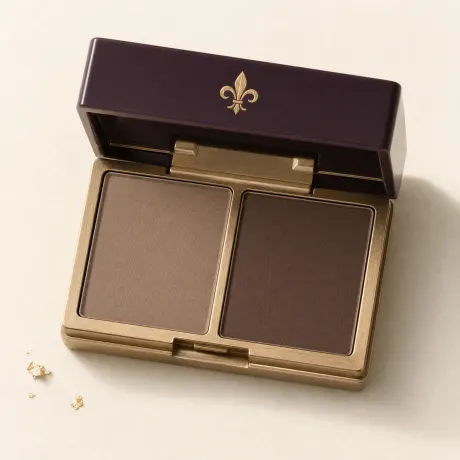
Other kinds of lash & brow tools
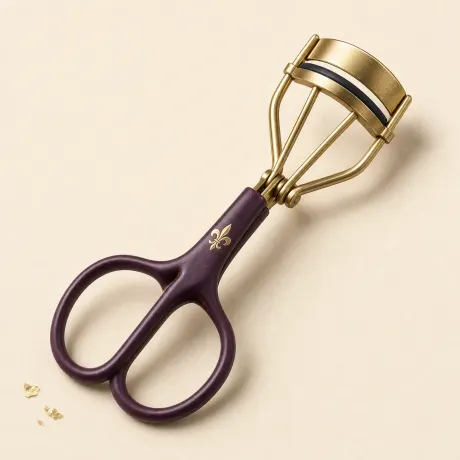
Eyelash curler
A scissor-action clamp with a curved, padded jaw that bends the lashes upward.
Read the guide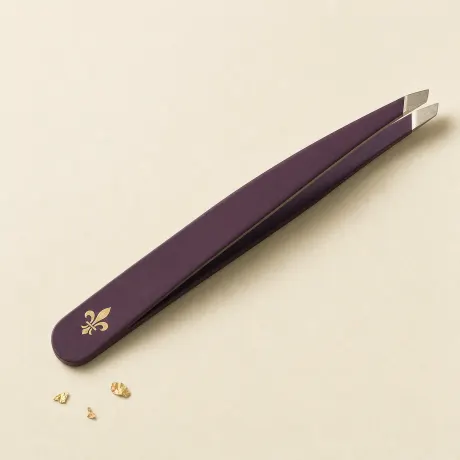
Slant tweezers
Tweezers with slanted tips, for shaping brows and placing false lashes.
Read the guide
Brow razor
A tiny guarded blade for tidying stray brow hairs and fine facial hair.
Read the guide