Brow razor
A short, usually guarded blade for tidying the stray hairs around the brows and the fine hair on the face. How to choose one, how to use it without nicks, what it does and does not do to hair, and how the guard came to be there.
A brow razor is a small single-bladed razor, usually with a guard along its edge, used to tidy stray hairs around the brows and to remove fine facial hair by cutting it at the surface of the skin; its face-wide version is sold as a dermaplaning razor.

Our picks
Eleven brow and face razors, from the drugstore and the mid-range, where the kind is sold: guarded disposables, a folding razor, refillable metal handles, a dual-ended razor and one made for men. Each opens where its maker sells it — on Amazon, at the house’s own shop or at Sephora. What each blade is for is the maker’s claim.
As an Amazon Associate I earn from qualifying purchases. Affiliate links — we may earn a commission at no extra cost to you. How this works
Guarded disposableDrugstore Dorco
Tinkle Eyebrow Razor
From the Korean blade maker Dorco: the single-blade disposable named in The New York Times’s 2015 report on women shaving their faces.
- Protective cover
- Three razors
FoldingMid-range Tweezerman
Folding Facial and Brow Razor
A reusable razor that folds shut over its blade for a bag, from the tweezer maker.
- Folding handle
- Reusable
Brow coverDrugstore Schick
Hydro Silk Touch-Up
A guarded disposable sold with a precision cover for shaping the brows.
- Precision cover for brows
- Three razors
Dual-endedDrugstore Real Techniques
Face and Brow Razors
Two blades on one handle: a larger one for the face and a smaller one for brow detail.
- Two blade sizes
- Protective caps
- Three razors
RefillableMid-range Flamingo
Refillable Dermaplane Razor
A weighted metal handle with replaceable blades, for less waste than disposables.
- Weighted metal handle
- Replaceable blades
Travel capDrugstore Japonesque
Eyebrow Razor
A small brow razor from the tool maker, sold for brows and fine facial hair alike.
- Stainless-steel blades
- Travel cap
Handle and refillsDrugstore Gillette Venus
Venus Dermaplaning Tool
Gillette’s women’s line, applied to the face: a handle with replaceable dermaplaning blades.
- Two refill blades
- For brows and face
Metal handleMid-range Sephora Collection
Metal Facial Razor
A curved metal handle with refillable blades and a case, which its maker says to use on damp skin.
- Zinc-alloy handle
- Refillable blades
- Travel case
Mesh bladeDrugstore KISS
Silky Edge Facial Hair Dermaplaner & Brow Shaper
A face and brow shaper with a stainless-steel mesh blade, sold as tug-free.
- Stainless-steel mesh blade
- Two spare blades
For menDrugstore Dorco
Line-up Eyebrow Razor for Men
A brow razor made for men, with a longer blade for brows, sideburns and beard lines.
- Long blade
- Brows, sideburns and beard
Twelve-packDrugstore Kitsch
Dermaplane Razor
A twelve-pack of disposable face and brow razors, from the hair-accessories brand.
- Twelve razors
- For brows and face
A brow razor is a single short blade on a slim handle, usually with a guard along the edge, made for tidying the stray hairs around the brows and the fine hair elsewhere on the face. It cuts hair at the surface of the skin rather than pulling it out, which is why it is quick and painless, unless it nicks, and why its results do not last long.[1] The same blades are sold, under the name dermaplaning, for removing fine facial hair and, their makers say, dead skin with it.
It fills a gap between tweezers and the ordinary razor. Tweezers take one hair at a time from the root; threading and waxing take many at once; an ordinary razor is too broad to follow the edge of a brow. The small blade can follow a line, and the guard is there to keep it from biting into the skin. What it cannot do is thin a brow hair by hair: it clears whatever it passes over, so it belongs outside the line of the brow, never across it.
Choosing one
Most brow razors are disposable: a plastic handle and a short stainless blade behind a guard or a cover, sold several to a pack. Some fold shut for a bag. Refillable ones have a metal handle and replaceable blades, which gives a steadier hold and throws away less. Dual-ended razors carry a larger blade for the face at one end and a smaller one for the brow at the other, and at least one disposable comes with a cover shaped for detail work on the brows. There are brow razors made for men, with a longer blade for brows, sideburns and beard lines. Sonic dermaplaning devices, which vibrate the blade, are a different tool and are not among the picks.
How to use it
Brush the brows up and mark the shape you want with a pencil, so that you can see what to keep. Hold the skin taut with one hand and the razor at a shallow angle with the other, and use short, light strokes in the direction the hair grows; the American Academy of Dermatology calls shaving with the grain an important step in preventing razor bumps and burns.[2] Follow the maker’s instructions on wet or dry use: Sephora’s own-label metal razor, for example, is to be used on damp or moisturised skin, with minimal pressure.
Change blades often. The Academy advises changing the blade, or throwing away a disposable razor, after five to seven shaves to limit irritation, and storing a razor where it can dry completely, never in the shower;[2] the NHS advises against using a blunt razor.[3] Put the cover back on after use and keep the blades away from children.
Skin and regrowth
Shaving does not make hair grow back thicker. The Mayo Clinic says it changes neither the thickness, the colour nor the rate of growth; the cut hair has a blunt tip, which can feel stubbly and look darker or thicker while it grows out.[4] Shaving has its own costs: frequent shaving can irritate the skin, cuts, nicks and razor burn happen, and some people develop ingrown hairs.[5] Never try to shave off spots.[6] And a sudden increase in facial hair is a reason to see a doctor rather than to buy a razor, since it can be a side effect of medication or a sign of an underlying condition.[4]
Where it came from
The brow razor is a design problem with a paper trail. In a patent granted in 1938, Clara F. Sampson of Chicago argued that the razors then on the market would not let anyone shave their own brows in a mirror “with any degree of uniformity of contour”. Her answer was a miniature blade a quarter to three-eighths of an inch wide, left deliberately without a safety guard so as not to block the view, for a brow “usually arcuate as dictated by present styling”.[7] A patent of 1951 went the other way, mounting a blade about a quarter of an inch long in a guide so that it could be “handled readily without danger of cutting”, with a brush at the other end for the cut hairs.[8] In 1987 a throw-away trimmer patented in Florida set a narrow blade between front and rear guards. Its patent explained why: women either plucked their brows, which hurt, or borrowed men’s safety razors, whose large, unguarded blades cut the skin.[9] Most of the razors here are guarded disposables of that kind.
In Japan the small razor came out of the cutlery trade. Kai, which began in 1908 as a maker of folding knives, says it made Japan’s first replaceable-blade razor in 1932, launched a long-handled razor for women, Beauty L, in 1972, and a line of disposable razors for women in 1984.[10]
In 2015 The New York Times reported women shaving their faces as a beauty routine, among them a celebrity facialist, and a reality-television contestant filmed shaving off fine facial hair, which the paper noted resists laser removal because it lacks pigment, with a single-blade disposable called the Tinkle. Its American distributor said sales in the first three months of that year were up 53 per cent on the same months of 2014.[11] The small blade Sampson wanted to see around has become a thing kept beside the tweezers.
The techniques
- Shave
- Hold the skin taut and the blade at a shallow angle, and stroke in the direction of growth.
Sources
- [1, 5]6 ways to remove unwanted hair American Academy of Dermatology Association.View source (opens in a new tab) Accessed 2026-09-26.
- [2, 6]Hair removal: How to shave American Academy of Dermatology Association.View source (opens in a new tab) Accessed 2026-09-26.
- [3]Ingrown hairs NHS (England).View source (opens in a new tab) Accessed 2026-09-26.
- [4]Shaving hair: Does shaved hair grow back thicker? Mayo Clinic, 14 June 2024, 2024.View source (opens in a new tab) Accessed 2026-09-26.
- [7]US Patent 2,127,010 — Eyebrow razor United States Patent Office, 1938.View source (opens in a new tab) Accessed 2026-09-26.
- [8]US Patent 2,547,376 — Eyebrow shaver United States Patent Office, 1951.View source (opens in a new tab) Accessed 2026-09-26.
- [9]US Patent 4,700,477 — Eyebrow trimmer United States Patent and Trademark Office, 1987.View source (opens in a new tab) Accessed 2026-09-26.
- [10]Timeline | About KAI Group KAI Group.View source (opens in a new tab) Accessed 2026-09-26.
- [11]Sometimes, Even Women Need a Smoothly Shaved Face The New York Times (Skin Deep), 9 June 2015, 2015.View source (opens in a new tab) Accessed 2026-09-26.
Other kinds of lash & brow tools
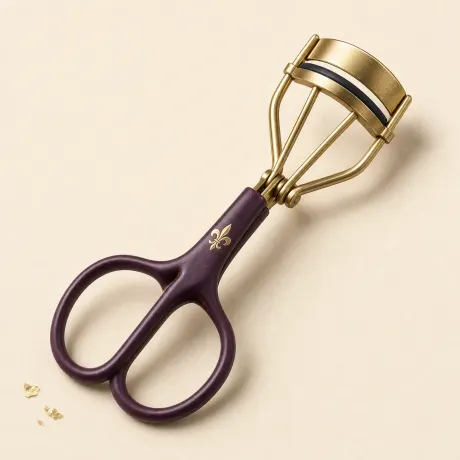
Eyelash curler
A scissor-action clamp with a curved, padded jaw that bends the lashes upward.
Read the guide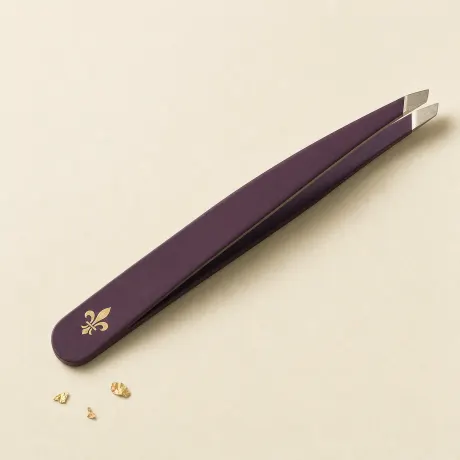
Slant tweezers
Tweezers with slanted tips, for shaping brows and placing false lashes.
Read the guide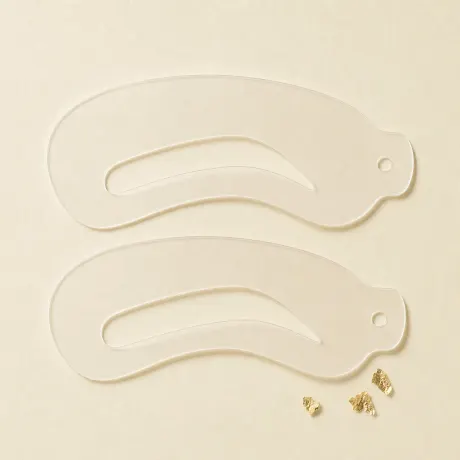
Brow stencil
A thin, flexible guide with a brow-shaped cut-out, for a repeatable shape.
Read the guide