Body makeup
Foundation for everything below the chin: sheer tints and wash-off bronzers, face-and-body foundations, and camouflage creams for scars and tattoos. How to choose the coverage, how to make it stay put — and where body makeup came from.
Body makeup is foundation made for the body — a tint, liquid or cream, usually sold as water- or transfer-resistant — spread over large areas such as the legs, arms and back to even skin tone or to cover veins, scars and tattoos.

Our picks
Chosen across the three strengths of body makeup — sheer tints and wash-off bronzers, face-and-body foundations, and camouflage creams and tattoo covers — and across budgets from drugstore to prestige. Each opens at the maker’s own US shop, or on Amazon where the listing is sold by Amazon itself. Water, sweat and transfer resistance are the makers’ claims.
As an Amazon Associate I earn from qualifying purchases. Affiliate links — we may earn a commission at no extra cost to you. How this works
Runway basePrestige Dior
Dior Backstage Face & Body Foundation
Sold by Dior as the go-to foundation for its runway shows, on face and body, from a sheer glow to full cover.
- Face and body
- Water- and heat-resistant
- Buildable
Leg sprayDrugstore Sally Hansen
Airbrush Legs Leg Makeup Spray
A drugstore leg makeup, sprayed into the hand and smoothed over the legs to even out veins and freckles.
- Spray
- Water-resistant
- Transfer-proof
Full coverMid-range Dermablend
Leg and Body Makeup
A full-coverage body foundation for scars, stretch marks, veins and tattoos, sold with an SPF.
- SPF 25
- Covers tattoos and scars
- Up to 16 hours set
Satin sheerPrestige MAC Cosmetics
M·A·C Studio Face and Body Foundation
A thin, flexible face-and-body fluid for evening out tone without looking made up.
- Sheer, buildable
- Satin finish
- Waterproof
Wash-off blurMid-range Vita Liberata
Original Body Blur
Body makeup for a day or an evening, with a soft-focus finish that rinses off in the shower.
- Wash-off
- Soft focus
- Legs and arms
CamouflageMid-range Kryolan
Dermacolor Body Camouflage
A camouflage cream for the body, for vitiligo, veins, age spots and other marks, that comes off with warm soapy water.
- Weatherproof
- Smudge-resistant
- No powder needed
Glow tintPrestige Fenty Beauty
Body Sauce Body Luminizing Tint
A sheer body tint that blurs and warms rather than covers, with a little shimmer.
- Seven shades
- Transfer-resistant
- Subtle shimmer
Instant tanMid-range St.Tropez
Instant Glow Face & Body Bronzer
A tan that lasts until the shower, for colour on the day without a self-tan’s commitment.
- Wash-off
- Smudge-proof
- Face and body
Tattoo creamMid-range Mehron
Tattoo Cover
A dense cream from a theatrical house for covering ink and birthmarks, patted on in layers.
- Tattoos and birthmarks
- Castor-oil base
- Set with powder
Radiant sheerPrestige MAC Cosmetics
Studio Radiance Face And Body Radiant Sheer Foundation
The glowing version of MAC’s face-and-body fluid, for skin that should look lit rather than matte.
- Sheer, buildable
- Radiant finish
- Waterproof
Tattoo wheelMid-range Graftobian
Skin Corrector and Tattoo Cover Makeup Wheels
Correctors and skin shades in one wheel, arranged in the order a tattoo cover is built.
- Fair or deep wheel
- Correctors included
- Instructions
Body makeup is foundation for the body, and it comes in three strengths. Sheer tints and wash-off bronzers even out tone and add colour for a day, like a tinted moisturiser for the legs. Face-and-body foundations are thin, flexible liquids that cover more and are sold to survive heat and water. At the far end are camouflage creams, dense with pigment and made to hide veins, scars, vitiligo and tattoos.
All of them solve the same problem. The body moves, sweats and rubs against clothes, and it is far larger than a face, so body makeup has to spread thin over a wide area, dry before it meets fabric and stay put when it does. It is not self-tan, which colours the top layer of skin for days, nor a shimmer oil or luminiser, which adds light rather than coverage.
Choosing the coverage
Choose by what you are covering. For uneven tone, a fading tan or freckled legs, a sheer tint or wash-off bronzer is enough, looks most like skin, and comes off in the shower. For redness, bruises and small veins, a face-and-body foundation or a leg makeup spray gives more cover while staying thin. For tattoos, scars and vitiligo, use a camouflage cream: heavily pigmented, applied in thin layers and set with powder. Dark ink usually needs a corrector first — an orange or peach shade to cancel blue-black — before the skin-coloured layer, which is how tattoo-cover wheels are arranged.
Match the shade to the body, not to the face. Legs and arms are often paler or more tanned than the face, and the chest is often redder; test on the inside of the knee or the forearm, in daylight. And read the claims as claims: water, sweat and transfer resistance are the makers’ own, and depend on the product being set as they direct.
Putting it on
Exfoliate the day before rather than the hour before, so that the skin is smooth but not raw, and moisturise lightly well ahead, so that the makeup grips instead of slipping. Work in sections — one shin, then the other — with a mitt, a large kabuki brush or the hands, spreading a little product thinly and going lightly over knees, ankles and elbows, where dry skin grabs colour. Sprays are best sprayed into the palm or onto a mitt and smoothed on, not aimed at the leg. Build a second thin layer only where it is needed.
Let it dry fully before dressing: most body makeup is sold as transfer-resistant once set, not while wet. Press loose powder over creams and camouflage with a puff, and mist a setting spray over a tattoo cover that has to last. Wash your hands and check your palms. At the end of the day take it off with soap and water or, for waterproof formulas, an oil or makeup remover, and keep pale sheets and collars out of reach until you do.
Where it came from
Body makeup is older than the stocking shortage that made it famous. At the end of the nineteenth century women whitened the neck, shoulders, back and arms that evening dress left bare with liquid powders, applied with a sponge; in 1893 a theatrical costumier told a magazine that many used “a sort of enamel—sold liquid in bottles” on their shoulders and arms, adding that “theatrical grease paints cannot be used in daylight; they are too crude.” On the stage the equivalent was wet white, a water-based make-up less likely than greasepaint to come off on contact, which made it the body make-up of dancers and chorus girls.[1] The Berlin greasepaint house Leichner made one, Eau de Lys, for exactly that trade.[2]
Colour for the legs came next. Doraldina’s Leg Make-up of 1927 was sold to replace stockings; in 1929 a London store’s “hosiery cream” was being worn by actresses and by girls on seaside holidays; and lotions such as Dorothy Gray’s Finishing Lotion of 1929 and Elizabeth Arden’s Velva Beauty Film of 1933 gave legs the look of a tan. The wartime chapter, when stockings vanished and cosmetic houses large and small sold leg make-up in their place, taught chemists much of what went into post-war foundations; afterwards leg make-up shrank back to a way of looking tanned.[3] Leichner’s London company added Island Tan, “a cream make-up in large tubes”, in 1949, and later Tan Klear, a liquid body make-up.[4] When cosmetics moved into aerosol cans in the 1950s and 1960s, make-up was, in the historian James Bennett’s words, “a noticeable omission, with the possible exception of a spray-on leg make-up”.[5]
Covering marks on the body grew out of covering them on the face. Lydia O’Leary, who devised Covermark for her own port-wine stain, had by 1936 added a Waterproof Covermark that would “remain intact throughout the day no matter how wet it becomes” and was “therefore also recommended for blemishes on the hands”, and her creams were used on birthmarks, X-ray burns, varicose veins and vitiligo.[6] The airbrush came from the cinema: it was first used to apply liquid make-up on Ben-Hur in 1959, to tan the cast and extras.[5] Today’s leg sprays, body blurs and tattoo covers are those lines — the stage, the tan and the cover — sold side by side.
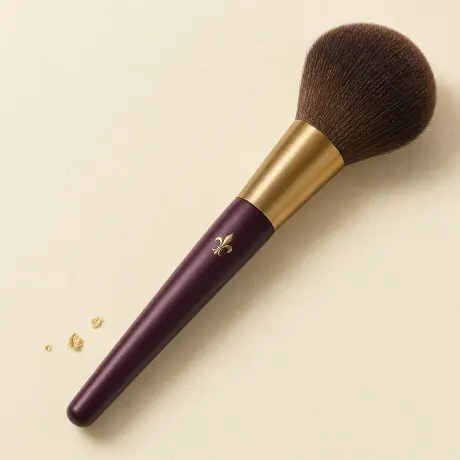
The techniques
- Sweep
- Long, light strokes that deposit a veil of product.
- Buff
- Work in small circles with a dense brush until no edge remains.
Sources
- [1]Liquid Face Powders Cosmetics and Skin, 2014.View source (opens in a new tab) Accessed 2026-09-25.
- [2]Leichner Cosmetics and Skin, 2020.View source (opens in a new tab) Accessed 2026-09-26.
- [3]Cosmetic Stockings (Leg Make-up) Cosmetics and Skin, 2012.View source (opens in a new tab) Accessed 2026-09-25.
- [4]Leichner (post 1945) Cosmetics and Skin, 2020.View source (opens in a new tab) Accessed 2026-09-26.
- [5]Aerosol Cosmetics Cosmetics and Skin, 2017.View source (opens in a new tab) Accessed 2026-09-26.
- [6]Covermark Cosmetics and Skin, 2012.View source (opens in a new tab) Accessed 2026-09-25.