Water-activated face paint
The pressed cake of colour that a wet brush turns into paint, for children’s faces, festivals, body art and the stage. What makes one safe to use, how to paint with it — and where the cake, and the rules for its colours, came from.
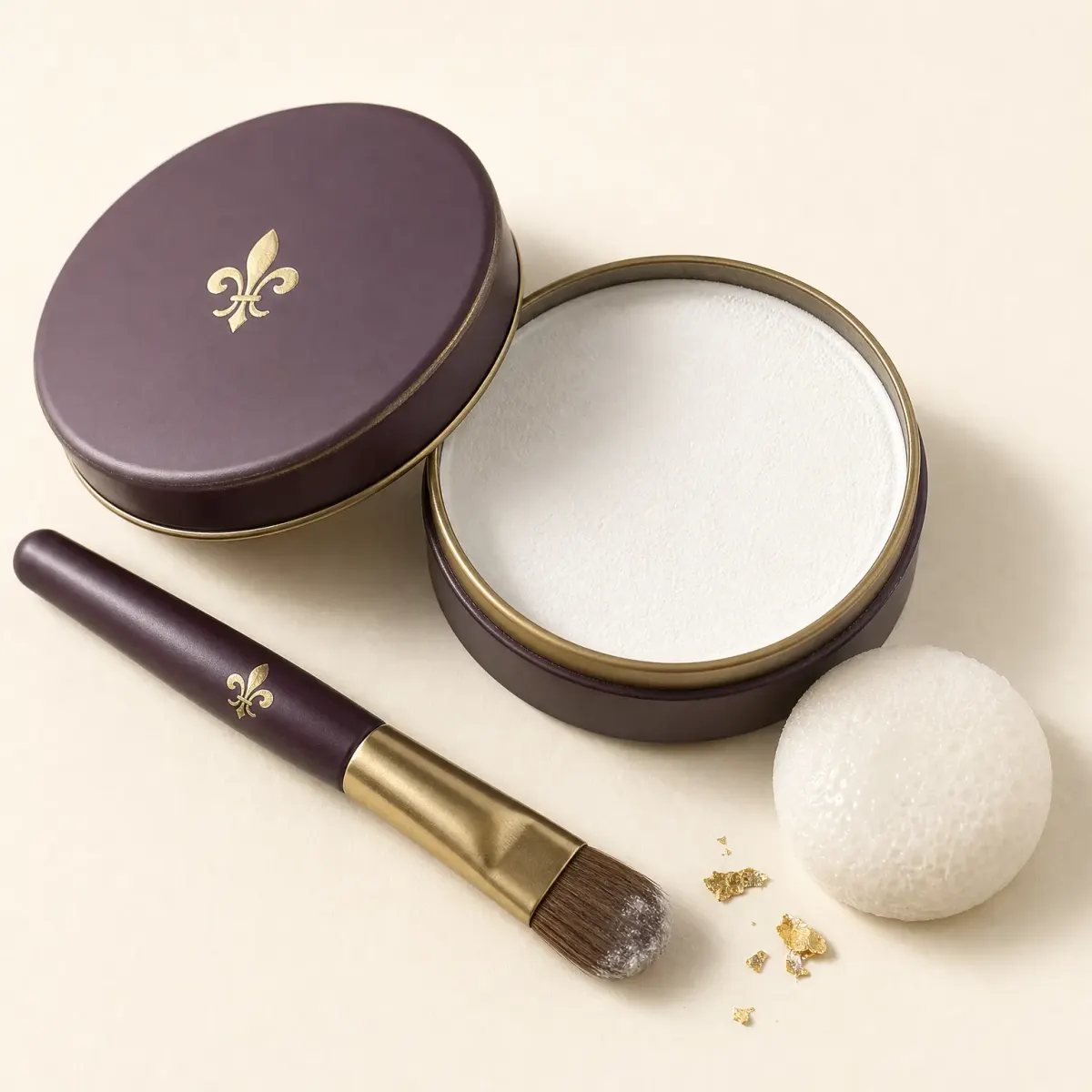
Water-activated face paint is colour pressed into a cake with binders such as glycerin, soaps or waxes; a damp brush or sponge turns its surface into paint that dries to a flexible, matte film and washes off with soap and water.
Our picks
Chosen across the cakes a face painter reaches for — single colours, palettes and split cakes; matte, metallic, pearl and sparkle finishes; and a stage cake that also works dry — from houses that sell them as cosmetic face paint, at budgets from party paint to professional. Each opens at the maker’s own US shop; Kryolan’s asks new visitors to accept its cookies first. Wear and smudge-resistance claims are the makers’.
Affiliate links — we may earn a commission at no extra cost to you. How this works
Party whiteDrugstore Snazaroo
Classic Face Paint, White
A white for skulls, clowns and highlights, from a house that makes face paint for children’s parties.
- Base white
- Washes off with soap
- Made in the UK
Pro singleMid-range Mehron
Paradise Makeup AQ
Mehron’s standard face and body paint: sheer with more water, opaque with less.
- Water-activated
- Crack-resistant
- Vegan
Glycerin cakeMid-range Kryolan
Aquacolor
Kryolan’s face and body paint for stage and body art, buffed after drying rather than powdered.
- Glycerin-based
- Smudge-proof
- Not powdered
Split cakeDrugstore Snazaroo
3-Colour Split Cake, Tiger
Three stripes in one cake, for tiger faces made in a few strokes.
- Three colours
- Split cake
No powderMid-range Graftobian
ProPaint Face and Body Paint
A creamy, fragrance-free paint that its maker says dries smudge-proof without setting powder.
- Glycerin-based
- Made in the USA
- Smudge-proof
Wax baseMid-range WolfeFX
Hydrocolor Essential
A wax-based cake sold as flowing with the skin rather than cracking, from a taster size upward.
- Wax base
- Dense pigment
- Four sizes
Six-shade splitMid-range Mehron
Paradise Makeup AQ Prisma BlendSet
Six blending shades in one sweep, for quick gradients, highlights and shadows.
- Six shades
- Split cake
MetallicDrugstore Snazaroo
Metallic Face Paint, Electric Blue
A metallic cake for superheroes, scales and stars, from the same children’s range.
- Metallic finish
- Easy removal
PaletteMid-range Kryolan
Aquacolor Palette
Aquacolor in palettes, for painters who work across many colours at once.
- 6, 12 or 24 colours
- Face and body
PearlMid-range WolfeFX
Hydrocolor Metallix
A pearl finish for scales, wings and highlights over a matte base.
- Pearlescent
- Wax base
- Four sizes
SparkleDrugstore Snazaroo
Sparkle Face Paint, Sparkle White
A sparkling white for frost, fairies and snow, painted over a design once it has dried.
- Sparkle finish
- Washes off with soap
Pro whiteMid-range TAG Body Art
Face and Body Paint, White
A regular white from a house that makes paint for professional face painters, sold as covering many faces a cake.
- Water-activated
- Meets EU and FDA rules
- 60–150 designs a cake
Stage cakeMid-range Mehron
StarBlend Cake Makeup
A theatre cake that works dry as a powder and wet as a paint, sold as standing up to hot stage lights.
- Dry or wet
- Long wear
- Skin tones and colours
Starter paletteMid-range WolfeFX
Hydrocolor 12 Color Palette
Twelve small Hydrocolor cakes, a first professional palette for a new painter.
- Twelve colours
- Wax base
Crisp linesMid-range Mehron
EDGE Face & Body Makeup
Made not to blend, for outlines and colour blocking that stay where they are painted.
- Blend-resistant
- Opaque
- Vegan
Refillable paletteMid-range Mehron
Paradise Makeup AQ 8-Color Palette
Eight Paradise cakes in a magnetic palette, each replaceable as it runs out.
- Eight colours
- Magnetic refills
Water-activated face paint is makeup made like a watercolour. Pigment is bound with glycerin, soaps or waxes and pressed into a cake; a damp brush or sponge worked across the surface lifts a creamy paint that dries in a minute or two to a flexible, matte film. More water gives a sheer wash, less an opaque line. It needs no powder and comes off with soap and water, which is why it is the paint of children’s parties, festivals and body painting.
It is not greasepaint, which is oil-based, stays soft and must be powdered, nor the liquid body paint sponged or sprayed over whole bodies, though the same houses often make all three. Within the kind, single cakes come in matte, metallic and pearl finishes, palettes hold a set of colours, and split cakes press several stripes side by side, so that one stroke of a flat brush lays down a gradient.
Reading the label
Face paint goes on skin, often on children, so read the box before choosing colours. In the United States every colour additive in a cosmetic must be approved by the Food and Drug Administration, face paint and theatrical makeup included, and approved colours come with limits on where they may be used.[1] The agency suggests checking each colour in the ingredient list against its summary of approved additives: if one is missing, “the company that made it is not obeying the law”.[1] A Colour Index number on its own does not show that a colour has been certified for use in the United States.[2] For children, choose a paint whose maker publishes its full ingredient list and sells it as face and body paint, not as a craft colour.
Neon and glow effects need the most care. Fluorescent “day-glow” colours are approved only with limits, and none for use near the eyes; the only glow-in-the-dark colour approved for cosmetics is meant for occasional use, and never around the eyes.[1] Never paint a face with craft paint, markers or anything else not made for skin, and throw away a cake that smells bad, which can be a sign that it is contaminated. If a paint is new to you, the FDA suggests trying a dab on the arm for a couple of days first.[1]
How to paint with it
Wet the brush or sponge, not the cake. Work the damp tool across the surface until it carries a creamy paint, thicker for a base and thinner and inky for line work, and test it on the back of your hand. Sponge a base on in thin, even layers and let each dry before the next; paint lines and details with a round brush held upright, and blend while the paint is still wet, because once dry it holds. Work from light to dark: pale bases first, darker shapes over them once they are dry, then black outlines and white highlights last. To load a split cake, sweep a flat brush or sponge across all its stripes at once.
Keep a clean sponge and fresh rinse water for each face, let wet cakes dry before closing them, and store them clean, dry and covered. Makers warn against red, orange and yellow around the eyes and blue and green on the lips; follow the label. When the day is over, remove the paint the way the label says — for most cakes, soap and warm water — gently around the eyes, and never sleep in it.[3]
Where it came from
The water-activated cake began as a base for actors. In 1936 the Max Factor company patented a make-up for Technicolor film; first used on screen in 1937, it was sold to the public as Pan-Cake in 1938 — a powder bound into a dried cream that a wet sponge brought back to life. Its success gave the name cake make-up to a whole class of products, and in 1952 the secretary of the American Medical Association’s committee on cosmetics said that cake make-up “was first developed to replace greasepaint for theatrical use”. An earlier attempt had failed for a practical reason: paste make-ups hand-pressed into porcelain jars in the early 1910s dried out, came loose and were sent back to the factory rattling in their jars.[4]
Colour brought the law. The Federal Food, Drug, and Cosmetic Act of 1938 regulated cosmetics for the first time, required coal-tar colours to be listed as “harmless and suitable”, and made batch certification compulsory. After children fell ill in 1950 from an orange Halloween sweet coloured with a listed dye, and Congress held hearings on additives, the agency re-examined every listed colour, and the Color Additive Amendments of 1960 allowed only those listed as “suitable and safe” for a particular use.[5] Theatrical and Halloween makeup are cosmetics under those rules.[6]
Special effects came later. In August 2000 the FDA approved luminescent zinc sulfide for facial makeup, at no more than a tenth of the product and for “limited, infrequent occasions, e.g., Halloween”, with “Do not use in the area of the eye” on the label.[7] In March 2005 and May 2009 face paints were recalled after causing rashes, itching and minor swelling where they had been applied.[8] The cake itself is a simple object; what it is made of is the part with a history.
The techniques
- Paint
- Brush or dab liquid colour directly onto the skin or lips.
- Stipple
- Bounce the tips of the brush against the skin for an airbrushed, dotted-in finish.
Sources
- [1, 3, 8]Novelty Makeup U.S. Food and Drug Administration, 2001.View source (opens in a new tab) Accessed 2026-09-26.
- [2, 6]Color Additives and Cosmetics: Fact Sheet U.S. Food and Drug Administration, 2022.View source (opens in a new tab) Accessed 2026-09-26.
- [4]Cake Make-up Cosmetics and Skin, 2014.View source (opens in a new tab) Accessed 2026-09-26.
- [5]Color Additives History U.S. Food and Drug Administration (reprinted from Food Safety Magazine, October/November 2003), 2003.View source (opens in a new tab) Accessed 2026-09-26.
- [7]21 CFR 73.2995 - Luminescent zinc sulfide Code of Federal Regulations, title 21, part 73, subpart C, 2026.View source (opens in a new tab) Accessed 2026-09-26.
