Thanaka
The pale yellow paste ground from bark and worn on the face across Myanmar. How it is made and worn, what laboratories and regulators have and have not said about it, why we link none, and what the record shows of its past.
Thanaka is a pale yellow paste made by grinding the bark of the thanaka tree with water on a flat stone, worn on the face and hands, often in circles or leaf shapes on the cheeks, by women, men and children in Myanmar.
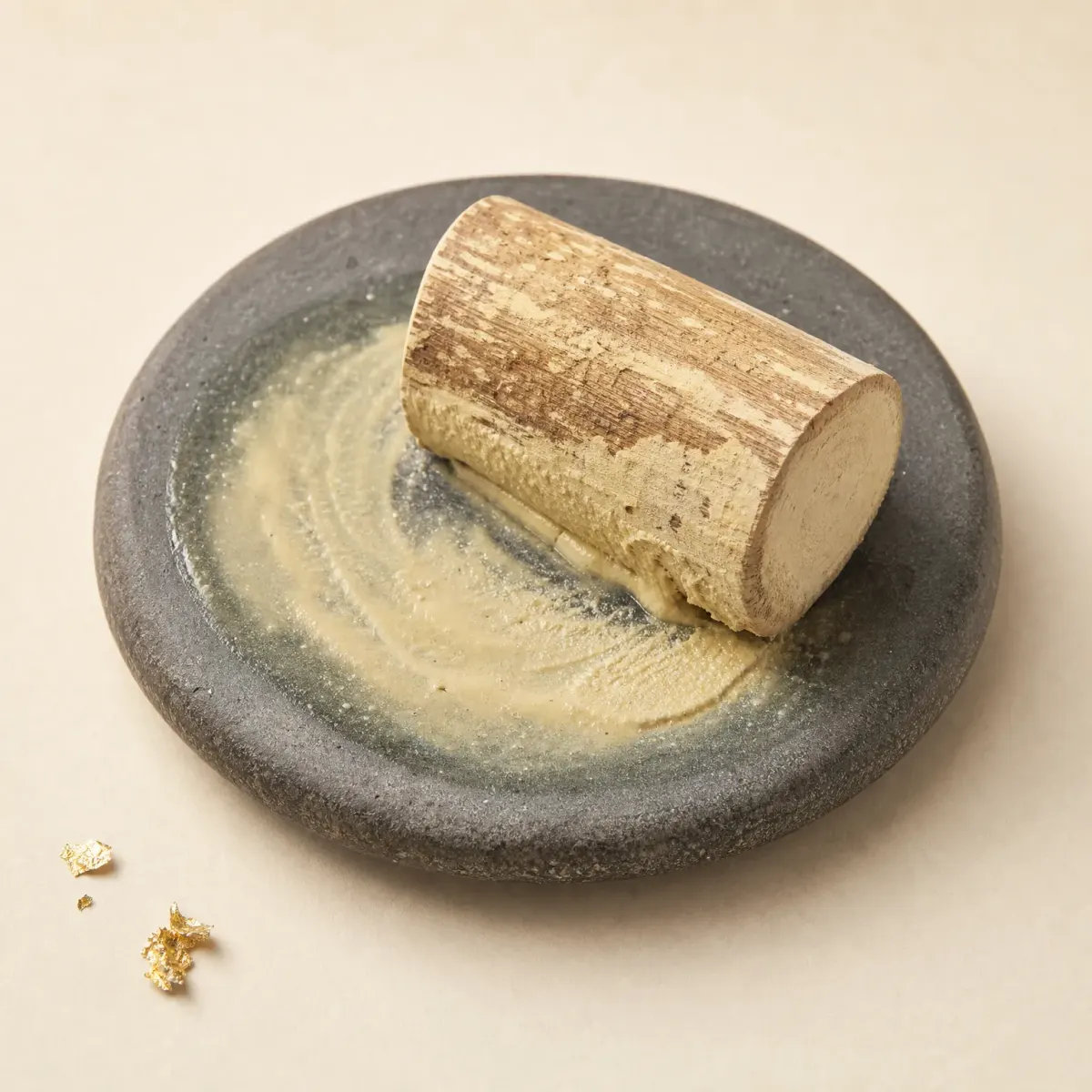
Thanaka is a pale yellow paste made from the bark of the thanaka tree. A length of the wood is rubbed with a little water on a circular stone slab until the bark gives up a creamy paste, which is put on the face and hands and sometimes the whole body; on the face it may be laid on in a circle, a leaf or a flower.[1] Men, women and children of all ages wear it, across Myanmar’s ethnic groups and communities, for beauty, for skin care, for what the UNESCO file on the practice calls traditional medicine, and for its cooling feel and fragrance; farmers and construction workers, the file notes, cover themselves in it in summer.[1]
Several trees supply it, most often Hesperethusa crenulata, also called Naringi crenulata, and Limonia acidissima;[2] in Myanmar they are grown in the dry zone at the centre of the country.[1] It is not a foundation. It does not match the skin but sits on it, visibly, and it is worn in daily life rather than saved for occasions.
Making and wearing it
The traditional kit is a short log of the wood and a flat, round stone, like the three-legged grinding stone collected in a village near Yangon in 1957–58 that is now in Harvard’s Peabody Museum.[3] Wet the stone, rub the cut end of the log over it in circles with a few drops of water until a smooth, pale paste gathers, and lift it with the fingertips. Paint a circle on each cheek, or a leaf or a flower, or spread it thinly over the whole face;[4] it dries to a pale, matt film and washes off with water.
In families it is also a lesson. Elders who put it on young children use the moment to teach them manners, ethics and values, the UNESCO file records, and in festivals the fragrant bark is burnt in bonfires to warm the Buddha, whose image is cleansed with the paste.[4] Ready-ground powders and creams save the grinding; if you buy one, look for a label that names the bark and little else, and pass over any that promise to lighten the skin. Laboratory tests of the bark’s extracts found no genotoxicity and very low toxicity to cells,[5] but any new product deserves a small test on the skin first, and none belongs in the eyes.
What science and the rules say
Thanaka is often called Myanmar’s sunscreen, and the evidence is more cautious than the name. A laboratory study of the bark found anti-inflammatory and antioxidant activity in its extracts, and a mild effect on tyrosinase, an enzyme of pigmentation;[6] a short dermatology paper describes it, in its title, as traditional Burmese sun protection.[7] Neither is a measured sun protection factor on skin, and none of this page’s sources reports one. A systematic review of eighteen studies lists antioxidant, anti-inflammatory and other activities of the extracts, reports low toxicity to human cells, and offers thanaka as a candidate ingredient for future sunscreens,[8] which is a direction for research rather than a result.
American regulators have said nothing about thanaka in particular, but their general rules apply to it. Makeup sold with sun-protection claims is a drug as well as a cosmetic and must meet the rules for both, and a claim to change the skin’s production of pigment makes a product a drug.[9] Some of the thanaka powders sold online in America make one claim or the other. The European Union’s ingredient database lists an extract of the bark, Hesperethusa crenulata bark extract, as a skin-conditioning ingredient, with no restriction recorded against it.[10] Wear thanaka for what it is, then, and keep using a sunscreen that is sold and tested as one.
Where it came from
How old thanaka is depends on whom you ask, and the numbers shrink as the evidence firms. A dermatology paper of 2014 says that it has been worn for over two thousand years, citing ancient Burmese lyrics and royal grinding equipment in museums;[11] a pharmacology study of 2010 says more than a thousand.[12] The nomination Myanmar put to UNESCO claimed archaeological evidence of preparing and wearing it back to the twelfth century.[13] The firmest object cited here is recent: the Peabody’s stone, with white pigment still on it, was collected in 1957–58 by Hazel Hitson Weidman, who gave it to the museum half a century later,[14] together with seven pieces of thanaka and other fragrant woods, perhaps padauk, from the same village.[15] Some regions keep a festival for thanakha, the Thanakha Par Toe Pwe.[13]
In December 2021 UNESCO’s committee referred that nomination back to Myanmar. It accepted that thanaka is deeply connected to the country’s history and to religious and family life, but found the file top-down, unclear about how the communities concerned had consented, and without a word on the risk of over-commercialisation.[13] Myanmar has submitted it again, and the committee is due to examine it at the end of 2026.[16] Whatever it decides, the practice does not depend on the list: the stone, the log and the circle on the cheek are part of ordinary days.
The techniques
- Grind to a paste
- Rub the raw material against a wet stone and apply the paste it makes.
- Paint
- Brush or dab liquid colour directly onto the skin or lips.
Sources
- [1, 4, 13]Decision 16.COM 8.b.27: Practice of Thanakha culture in Myanmar (nomination no. 01720) UNESCO, sixteenth session of the Committee (online, December 2021), 2021.View source (opens in a new tab) Accessed 2026-09-26.
- [2, 8]Thanaka (H. crenulata, N. crenulata, L. acidissima L.): A Systematic Review of Its Chemical, Biological Properties and Cosmeceutical Applications Cosmetics 8(3): 68, 2021.View source (opens in a new tab) Accessed 2026-09-26.
- [3, 14]Grinding stone for thanaka (object number 2007.4.75.1) Peabody Museum of Archaeology and Ethnology, Harvard University.View source (opens in a new tab) Accessed 2026-09-26.
- [5, 6, 12]Biological activities and safety of Thanaka (Hesperethusa crenulata) stem bark Journal of Ethnopharmacology 132: 466–472, 2010.View source (opens in a new tab) Accessed 2026-09-26.
- [7, 11]Thanaka: traditional Burmese sun protection Journal of Drugs in Dermatology 13: 306–307, 2014.View source (opens in a new tab) Accessed 2026-09-26.
- [9]Is It a Cosmetic, a Drug, or Both? (Or Is It Soap?) United States Food and Drug Administration, 2024.View source (opens in a new tab) Accessed 2026-09-26.
- [10]CosIng: Cosmetic Ingredient DatabaseView source (opens in a new tab) Accessed 2026-09-22.
- [15]Thanaka wood and other samples (object number 2007.4.75.2) Peabody Museum of Archaeology and Ethnology, Harvard University.View source (opens in a new tab) Accessed 2026-09-26.
- [16]Files 2026 under process UNESCO, 2026.View source (opens in a new tab) Accessed 2026-09-26.

