Henna cone
A small cone of henna paste, squeezed like icing to draw patterns that stain the skin. How to use one, how to tell henna from the pastes that injure, what American law says about henna on the skin, and where the cone came from.
A henna cone is a small cone of plastic or cellophane filled with henna paste, squeezed to pipe fine lines onto the skin, where the paste dries and the dye of the henna leaf stains the skin orange-brown.

A henna cone is a narrow cone of plastic or cellophane filled with henna paste: the leaves, stems and flowers of the henna plant crushed to a powder and mixed with liquid. Snip the tip and squeeze, and the paste comes out in a fine line that can be drawn over the hands and feet like icing; as it sits, it releases its dye, lawsone, which binds to the protein of the skin and stains it, darkest on the palms and soles, where that protein is most concentrated.[1] The cone is what makes fine work possible. The writer Shoba Narayan, learning mehndi in India, was taught to hold it like a pencil and squeeze gently, and found that her first teacher rolled her own cones from plastic while most artists bought theirs ready-made.[2]
Henna stains brown, orange-brown or reddish-brown. Anything sold as black or blue henna, or promising a darker or longer-lasting stain, may have something else in it.[3]
What the law allows
In the United States henna is a listed colour additive for one use only: colouring the hair, and not the eyelashes, the eyebrows or the area around the eyes.[4] The Food and Drug Administration states that it is not approved for direct application to the skin, “as in the body-decorating process known as mehndi”, that this unapproved use makes such products adulterated, and that an import alert is in effect for henna intended for the skin.[5] The alert is enforced. Its red list names firms whose henna products have been subject to detention since as early as 1997, among them makers of cones: a “Henna Mehendi Cone” from 2004, an “Instant Mehandi Cone” from 2014.[6]
“Black henna” is a separate and more serious matter. The darkening ingredient is often a coal-tar hair dye containing p-phenylenediamine, which the FDA says is not permitted in cosmetics intended for the skin;[5] the European Union allows it only in hair dyes and, for professionals, in eyelash tints.[7] Pure henna rarely causes allergy, and the reactions dermatologists see are mostly caused by what is added to it.[8] The American rule restricts the plant; the harm lies mostly in the additives.
Two gaps matter to anyone having henna done. Paste applied by a professional, at a salon or a booth at a fair, is exempt from the rule that retail cosmetics must list their ingredients, so the only way to know what is in it is to ask; and the practice of temporary tattooing is left to the states, some of which regulate it and some of which do not.[5]
Using a cone
If you have henna applied, ask what is in the paste, and expect a plain answer: henna and a liquid, perhaps with lemon juice, tea or an essential oil, which some traditions add to deepen the colour or make it last.[9] If you are learning, practise first in a paste of wheat flour, which does not stain, as Narayan’s teacher had her do. Hold the cone like a pencil and keep the pressure even, so that the paste comes out as one thin line rather than a run of blobs; leave the design on for hours, and dab it with sugar water and lemon juice as it dries, as she did, to deepen the colour.[10]
The worst risks come from what is added. Products sold as henna have contained as much as 64 per cent p-phenylenediamine; and henna itself has been linked to the breakdown of red blood cells in people with G6PD deficiency, a reason to avoid it for anyone known to have the condition.[11] If a design itches, blisters or turns black, wash it off and see a doctor. A reaction to black henna usually shows within one to three days in someone already sensitised to it, and within four to fourteen days in someone the design has just sensitised,[12] and the FDA warns that black henna may increase the risk of allergy to hair dyes later.[13]
Where it came from
Henna itself is old and widespread, though its origin and early history are poorly recorded. The Natural History Museum describes a plant believed to have come from the Middle East and North Africa and spread across Asia thousands of years ago; Egyptian mummies have been found with hair dyed with it; and it was important in the Mughal empire, which ruled India between roughly 1526 and 1857. Its use as mehndi, the museum adds, crosses religious groups and cultures so thoroughly that it is hard to say where it began.[14]
The cone’s own history is thinner still. In Rajasthan in 2016 a Jaipur host told Narayan that professional mehndi women had been unheard of until about fifteen years before, when women still applied henna to one another’s hands, singing folk songs; and the older south Indian design, a large circle on the palm with the fingertips capped, needs no fine nozzle at all.[15] When the ready-made cone took over is not recorded in the sources used here. It is now the form in which henna is sold for the skin, and the form American enforcement names: the FDA kept an import alert headed, plainly, “Detention Without Physical Examination of Henna Based Skin Color”,[16] and its firms, cones and all, now sit on the general alert for colour additives.[17]
The techniques
- Pipe
- Squeeze a fine line of paste from a cone to draw a pattern on the skin.
Sources
- [1, 9, 14]The henna plant: transcending time, religion and culture Natural History Museum, London, 2026.View source (opens in a new tab) Accessed 2026-09-22.
- [2, 10, 15]A Quest to Master the Art of Henna Smithsonian Magazine, 17 February 2016, 2016.View source (opens in a new tab) Accessed 2026-09-26.
- [3, 5, 16]Temporary Tattoos, Henna/Mehndi, and "Black Henna": Fact Sheet United States Food and Drug Administration, 2024.View source (opens in a new tab) Accessed 2026-09-26.
- [4]21 CFR 73.2190: Henna Electronic Code of Federal Regulations, Title 21, Part 73, Subpart C, 2026.View source (opens in a new tab) Accessed 2026-09-22.
- [6, 17]Import Alert 53-06: Detention Without Physical Examination of Cosmetics That Are Adulterated and/or Misbranded Due to Color Additive Violations U.S. Food and Drug Administration, Office of Regulatory Affairs, 2023.View source (opens in a new tab) Accessed 2026-09-22.
- [7]Annex III (restricted substances) to Regulation (EC) No 1223/2009 on cosmetic products, consolidated text of 3 December 2020 Official Journal of the European Union (consolidated version 02009R1223-20201203), 2020.View source (opens in a new tab) Accessed 2026-09-22.
- [8, 11]Dermatoses Due to Indian Cultural Practices Indian Journal of Dermatology 60(1): 3–12, 2015.View source (opens in a new tab) Accessed 2026-09-26.
- [12]Henna Tattoo: From Cosmetic Purposes to Dermatological Reactions Indian Dermatology Online Journal 15(3): 454–459, 2024.View source (opens in a new tab) Accessed 2026-09-26.
- [13]Hair Dyes United States Food and Drug Administration, Office of Cosmetics and Colors, 2026.View source (opens in a new tab) Accessed 2026-09-22.
Other kinds of hand, foot & face paint

Alta
Red dye painted around the edges of the feet for weddings, festivals and classical dance, above all in eastern India.
Read the guide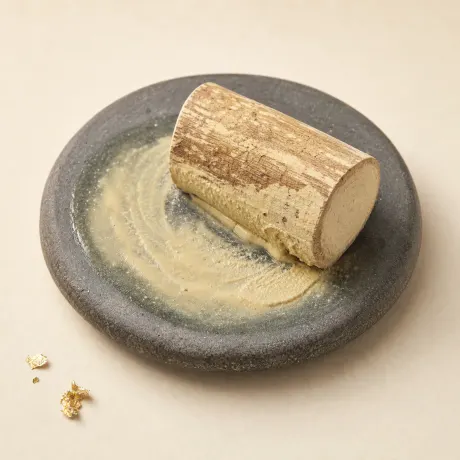
Thanaka
A pale yellow paste ground from the bark of thanaka wood on a wet stone and worn on the face in Myanmar, for adornment and, by tradition, against the sun.
Read the guide