Curling mascara
Mascara made to lift the lashes as well as colour them, with a curved brush, a quick-setting formula or both. How it works, how to use it with or without a curler, and where it came from.
Curling mascara is mascara made to lift the lashes into an upward curve, usually with a curved brush that follows the lash line and a quick-setting formula that holds the shape as it dries.
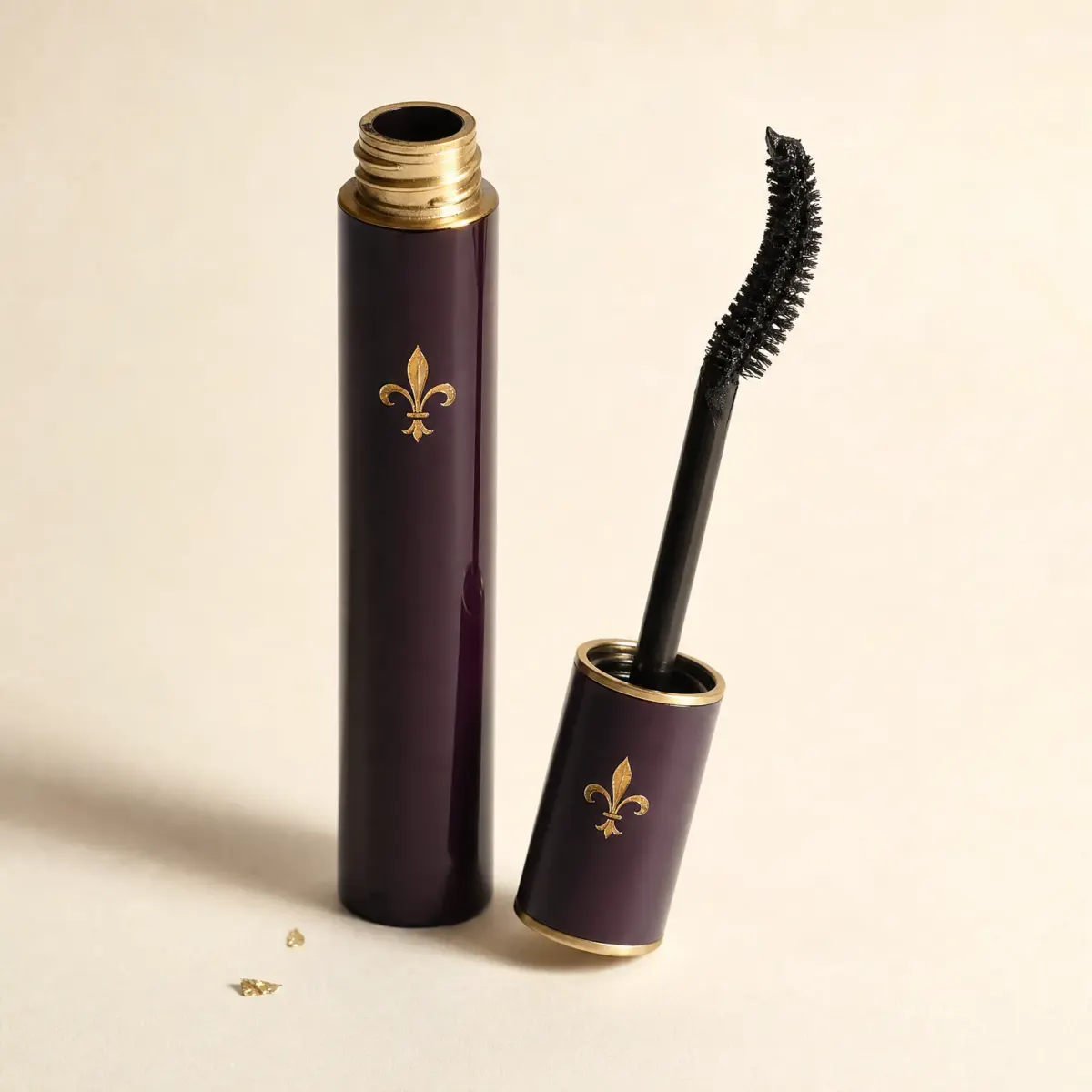
Our picks
Chosen to cover both routes to a curl — a curved, hooked or shaped brush, and a formula that sets the lift — across budgets, including the waterproof curl-holding mascaras from Korea. Each opens where its maker sells it: on Amazon, at the house’s own shop, or at Sephora where the house’s shop could not be checked. You choose your shade on that page.
As an Amazon Associate I earn from qualifying purchases. Affiliate links — we may earn a commission at no extra cost to you. How this works
Curl and volumePrestige Dior
Diorshow Iconic Overcurl Mascara
Dior’s curling Diorshow, sold as holding curl and volume all day; the case can be refilled.
- Curl and volume
- Claims 24-hour wear
- Refillable
Budget curlDrugstore e.l.f. Cosmetics
Lash 'N Roll Curling & Lifting Mascara
The inexpensive way to find out whether a curling formula holds on your lashes.
- Curl and lift
- Long-lasting
- Vegan
Hooked brushMid-range Benefit Cosmetics
Roller Lash Curling & Lifting Mascara
A brush of tiny hooks made to catch short, straight lashes, and a formula sold as setting the curve.
- Curl and lift
- Claims 12-hour hold
Curved brushPrestige Clarins
Supra Lift & Curl Mascara
A curved brush and plant polymers from linseed and chia, sold as giving a lash-lift look without a curler.
- Lift and curl
- Curved brush
- Water-resistant
Peanut brushDrugstore essence
Lash Princess Curl & Volume Mascara
A peanut-shaped fibre brush sold as reaching the hard-to-reach lashes and curling them with the rest.
- Curl and volume
- Fibre brush
Tubing curlPrestige Kevyn Aucoin
The Curling Mascara
Curl from the formula rather than a curved brush: a tubing mascara sold as curling and lengthening without smudging.
- Curl and length
- Tubing
- No-smudge
Korean curl holdMid-range CLIO
Kill Lash Superproof Mascara
A Korean formula made to keep straight lashes curled, sold as waterproof, smudge-proof and flake-proof.
- Curl hold
- Waterproof
- Sensitive eyes
Waterproof curlDrugstore rom&nd
Han All Fix Mascara
A Korean curling mascara sold as fixing a natural curl in place; the linked shade is a soft hazel brown.
- Curling
- Waterproof
- Smudge-proof
No curler neededPrestige Lancôme
Lash Idôle Curl Goddess Curling & Volumizing Mascara
A twisted brush and a fast-setting formula sold as locking the curl at the root, made to stand in for the curler.
- Curl and volume
- Fast-setting
- Sensitive eyes
Curl fixDrugstore Etude
Curl Fix Mascara
Sold as holding a lifted curl while adding defined volume, in a vegan waterproof formula.
- Holds curl
- Waterproof
- Vegan
Silicone brushDrugstore Sephora Collection
Love The Lift Curling + Volumizing Mascara
A double-sided silicone brush and a wax-rich formula sold as curling at once and holding for 12 hours.
- Curl and lift
- Silicone brush
- Vegan
A curling mascara has to do two things a plain mascara does not: push the lashes upward and keep them there. The first is the brush's job. Many curling brushes are bent into a crescent that follows the curve of the eyelid, so that one stroke meets more lashes at once and presses them up as it passes.[1] The second is the formula's. Its film formers contract as they dry, and that shrinking film helps to lift the lash and hold it in place.[2]
That sets it apart from its neighbours in a practical way. An eyelash curler bends the lash and a curling mascara sets the bend: used together, the curler shapes and the mascara keeps. A lengthening mascara can leave straight lashes looking longer but still pointing forward, and a heavy volumising coat can weigh a curl back down. Straight, heavy or downward-growing lashes are the ones that gain most from a curling formula.
Curved brush or curling formula
Not every curling mascara has a curved brush, and not every curved brush curls. Some curling mascaras use a straight brush and rely on a quick-setting film to hold the lift; some curved brushes come on volumising mascaras that curl very little. Read the claim for the formula as well as the shape of the wand.
A curve also takes some learning. A brush bent to the eyelid has to be held the right way round, with the inside of the curve against the lashes. A patent filed in 1990 set out the difficulties plainly: some people used curved brushes upside down, a straight brush worked better in the corners of the eye, and a brush curved to fit the upper lid did not fit the lower one.[3] Use the curve on the upper lashes, and turn the brush onto its tip for the corners and the lower lashes.
There is a third route between the two. Brushes with hooks or rubber teeth, rather than soft bristles, catch short lashes at the root and hold them up while the formula sets, which is why several of the curling mascaras here use one. They lay down less product per stroke, so build them in two light coats.
Holding the curl
If you use a curler, curl first, on clean, dry lashes: clamp near the base for a few seconds, then again halfway along, so the lash bends in a soft arc rather than a sharp angle. Never curl over mascara. Lashes stuck to the curler's pad can be pulled out when it opens.
Then work quickly. Quick-setting curling formulas are made to go on in several light coats, each combed upward as it dries so that the film hardens round the lash in its lifted position.[4] Hold the curve against the lash line, press the bristles into the roots for a second, and roll the brush upward and out to the tips. Two thin coats hold better than one thick one, whose weight pulls the lash back down.
Heat, humidity and removal
Heat sets a curl faster, which is why heated lash curlers are sold and why some people warm an ordinary curler with a hairdryer. Test it on the back of the hand first: metal that feels only warm there can still burn the thin skin of the lid. Humidity works the other way, loosening a curl as the day goes on, and several of the curl-holding mascaras here, among them the Korean ones, are sold as waterproof or smudge-proof.
A waterproof curl has to come off, though. Hold an oil or two-phase remover against the closed eye until the film softens, then wipe downward; a lash set stiff in its curve is better softened than scrubbed. Replace the curler's rubber pad when it cracks or grooves, since a worn pad crimps the lash into an angle instead of a curve.
Where it came from
Curl began as a way of holding the brush. A beauty book of 1926 told readers to brush the lashes upward and outward from the roots, the upward movement inducing the curl and the outward keeping the lashes apart, and warned that it took skill and practice.[5]
The eyelash curler came from Rochester, New York. The Stickel Company was founded there in 1923 to sell the Kurlash, a curler invented by Charles W. Stickel whose first patented form was nicknamed the bear trap, and a redesigned model followed within a year. It was advertised as curling without heat, though in 1926 the Hollywood make-up artist Perc Westmore wired one to batteries to warm it. The company's own routine, published in 1936, was to curl the upper lashes and then touch its stick mascara to their tips while they were still held in the curler. Once the patents had expired, after the Second World War, close copies followed.[6]
Formulas caught up later. Cosmetic chemists had noticed that the water in cream mascaras could be absorbed by the lashes and occasionally make them curl,[7] and among the later refinements of the wand mascara were polymers added to induce a curl.[8] By 1990 a patent could describe the curved brush, a spiral brush bent in manufacture to the approximate curve of the eyelid, as one of the major changes in the evolution of mascara brushes.[9] The shape of the brush and the chemistry of the film have taken on much of the curler's work since, though neither has retired it.
The techniques
- Zigzag
- Wiggle the wand at the roots, then draw it out through the tips.
- Comb through
- Comb product through the hairs to separate and set them.
Sources
- [1, 4]US Patent 6,237,609 — Curved longitudinal profile mascara brush (assigned to Bridgeport Metal Goods Manufacturing Co.) United States Patent and Trademark Office, 2001.View source (opens in a new tab) Accessed 2026-09-25.
- [2]Lashing Out: Contemporary Mascara Formulations UL Prospector, 2017.View source (opens in a new tab) Accessed 2026-09-25.
- [3, 9]US Patent 5,137,038 — Adjustable curve mascara brush (assigned to Maybe Holding Co.) United States Patent and Trademark Office, 1992.View source (opens in a new tab) Accessed 2026-09-25.
- [5]Cake (Block) Mascara Cosmetics and Skin, 2013.View source (opens in a new tab) Accessed 2026-09-25.
- [6]Kurlash Cosmetics and Skin.View source (opens in a new tab) Accessed 2026-09-25.
- [7]Liquid and Cream Mascara Cosmetics and Skin, 2014.View source (opens in a new tab) Accessed 2026-09-25.
- [8]Automatic Mascara Cosmetics and Skin, 2018.View source (opens in a new tab) Accessed 2026-09-25.
Other kinds of mascara
Volumising mascara
Mascara with a full, dense brush that deposits a thick coat on every lash.
Read the guide
Lengthening mascara
Mascara with a slim, comb-like brush that separates lashes and extends the tips.
Read the guide
Lash primer
A white or clear base coat that thickens and conditions the lashes under mascara.
Read the guide
Cake mascara
A solid cake of mascara, wetted and brushed on — the form mascara took before the wand.
Read the guide