Cake mascara
The form mascara took for most of its first century: a solid cake, wetted and brushed on. What it is, how to use it well and cleanly today, and where it came from.
Cake mascara is a solid block of pigment in a soap or wax base, activated with a wet brush and brushed onto the lashes or brows; it was the usual form of mascara before the tube and wand.

Cake mascara is dry until you wet it. The colour sits in a small pressed block, usually in a slim case with a little brush; a damp brush worked over the surface lifts a thin paste, which is brushed through the lashes and dries in place as the water evaporates. Until the 1960s it was the most popular form of mascara there was.[1]
Against a tube mascara it is slower and more controllable. There is no wet reservoir, so how much reaches the lashes is decided by how much water you use and how long you work the cake: one pass gives a soft, matte tint, several give real depth. The same cake darkens the brows, a use as old as the product itself. What it cannot do is add much thickness, since there is no heavy film to build.
How to use it
The instructions Maybelline once printed for its cake still hold.[2] Wet the brush and shake out the excess: a brush that is too wet lays down a thin, greyish coat, one that is barely damp picks up dense colour. Rub it over the cake until the edge of the bristles is evenly covered. Tilt the head back and stroke the upper lashes from base to tip, holding the brush against them for a moment at the roots if you want lift. For the lower lashes, tilt the head forward and use a downward or crosswise stroke.
Let each coat dry before the next. A second, clean brush or a small comb separates any lashes the first coat has stuck together, an old trick that some makers encouraged by packing a second brush or comb in the box.[2] On the brows, use less water and short strokes in the direction the hair grows. A folded card held behind the upper lashes keeps stray colour off the lid, as the mascara shields of the 1930s did.[2]
Water, not saliva
The old habit of spitting on the cake to wet it gave the product the nickname "spit black", and it is the one part of the tradition to leave behind.[3] Bacteria from the mouth can grow in an eye cosmetic and cause an infection. The US Food and Drug Administration advises never moistening mascara with saliva, washing your hands before applying eye cosmetics, never sharing them, and throwing away any you were using when you had an eye infection. Its warning against adding water is aimed at tube mascaras, whose preservative water dilutes; a cake is made to be wetted, so use clean water, fresh each time.[4]
The brush needs the most care. Rinse it in warm water after use and let it dry in the open before it goes back in the case: a damp brush shut in against a cake gives microbes a place to grow, the weakness the historian James Bennett points out in a cake mascara of 1937 whose wet brush screwed back into its case.[3] Replace a brush whose bristles have splayed, and a cake whose surface has cracked or changed smell.
Where it came from
Cake mascara began as a men's grooming product. Nineteenth-century perfumers sold "water cosmetique", pigment milled into soap, for darkening moustaches, beards and brows. In 1855 the perfumer George William Septimus Piesse described the one sold by Eugène Rimmel as a scented soap strongly coloured with lamp-black or umber, cut into oblong pieces and applied with a small brush and water. Rimmel is often credited with inventing it, though no one knows when he did so; what seems likely is that he was the first to sell it boxed with a brush and a mirror, and a newspaper of 1859 already lists one so boxed among a pickpocket's takings.[5]
The theatre moved it to the eyes. Actors called it mascaro and used it on their brows and facial hair; actresses extended it to their lashes, probably by the 1890s, and from the stage it reached other women. A French magazine credited the actress Cécile Sorel with the idea in 1933, which is doubtful, since others very likely had it first. By 1905 and 1906 the beauty culturists Mrs Pomeroy and Eleanor Adair were selling it, Helena Rubinstein followed in 1907, and in the 1920s "mascara" became the ordinary word.[5]
The great commercial success was Maybelline's. In 1917 the Chicago mail-order firm began selling a cake eyelash and eyebrow beautifier, in black and brown, in a small box holding the stamped cake, a bristle brush and a mirror in the lid.[6] Early cakes were essentially black soap, alkaline enough to sting; in the 1920s makers replaced the sodium soaps with gentler ones such as triethanolamine stearate, advertised the results as containing "no soap", and added oils against flaking and waxes against running.[7] They also worked at the cake's two practical nuisances, water and mess. Kurlash's Lashpac of 1930 wound a stick of mascara up like a lipstick, its Lashtint Compact carried a small sponge as a water supply, and guards of cork, celluloid or tortoiseshell, patented in numbers through the 1930s, were held behind the lashes to keep the brush off the skin.[7] The cake stayed the commonest mascara until Helena Rubinstein's Mascara-Matic of 1957 began the move to the wand. It was never quite abandoned, and the case, cake and little brush still on sale follow a pattern set in the nineteenth century.[7]
The techniques
- Comb through
- Comb product through the hairs to separate and set them.
Sources
- [1, 2, 3, 7]Cake (Block) Mascara Cosmetics and Skin, 2013.View source (opens in a new tab) Accessed 2026-09-25.
- [4]Eye Cosmetic Safety US Food and Drug Administration.View source (opens in a new tab) Accessed 2026-09-22.
- [5]Mascara Cosmetics and Skin, 2025.View source (opens in a new tab) Accessed 2026-09-25.
- [6]Maybelline Cosmetics and Skin, 2010.View source (opens in a new tab) Accessed 2026-09-25.
Other kinds of mascara
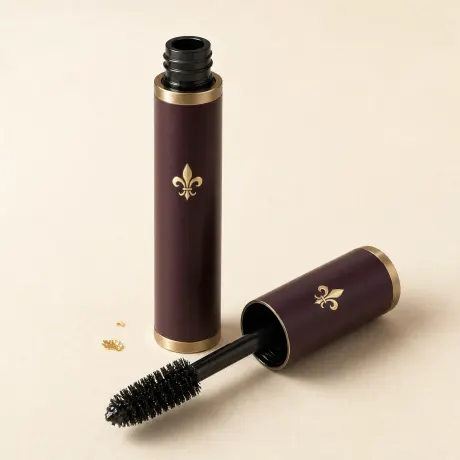
Volumising mascara
Mascara with a full, dense brush that deposits a thick coat on every lash.
Read the guide
Lengthening mascara
Mascara with a slim, comb-like brush that separates lashes and extends the tips.
Read the guide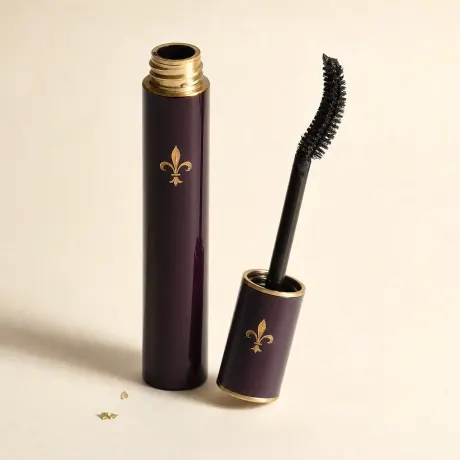
Curling mascara
Mascara with a curved brush that lifts the lashes as it coats them.
Read the guide
Lash primer
A white or clear base coat that thickens and conditions the lashes under mascara.
Read the guide