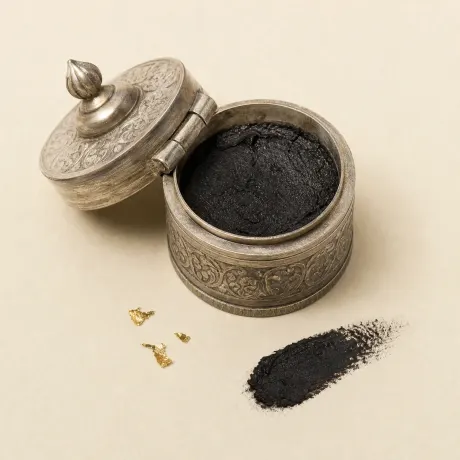
Kohl pot and stick
Powdered kohl, kept in a small pot or flask and drawn along the rim of the eye with a slim rod: one of the oldest forms of eye makeup still in use. What goes into the pot now, why American law and health agencies warn against it, how to get the line more safely, and where the vessel came from.
A kohl pot and stick is a small vessel of powdered kohl with a slender rod that is dipped in the powder and drawn along the inner rim of the closed eye, lining the waterline above and below in one movement.
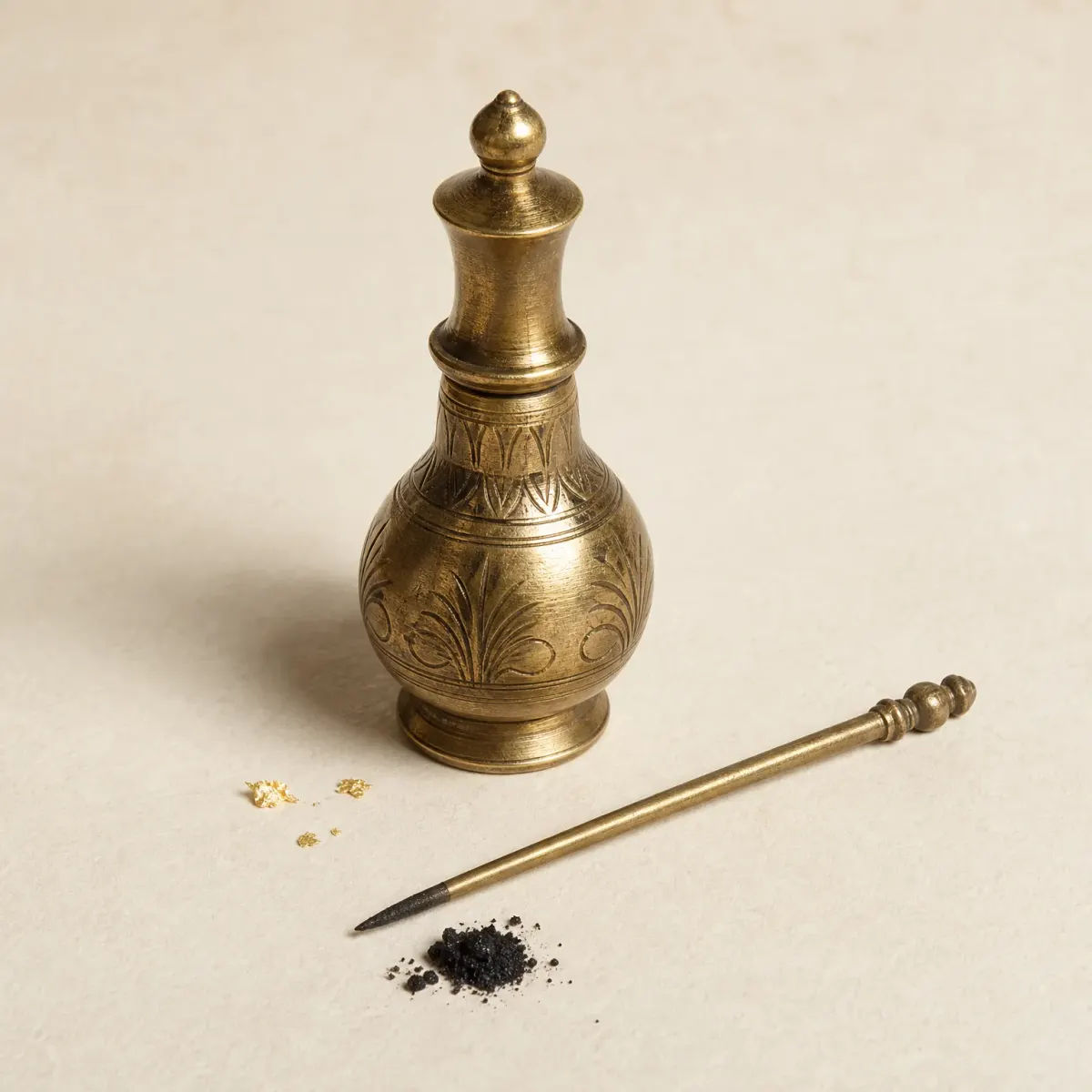
A kohl pot holds a dark eye powder and a slender rod. The rod is dipped, the eye is closed on it and the rod is drawn out, lining the waterline above and below in one movement. The vessel may be a jar, a flask or a narrow tube: an Egyptian faience tube in the Metropolitan Museum, five and a half centimetres high, is catalogued with its haematite stick, and a vessel that narrow is reached with the rod, not a finger.[1]
Its neighbours share the look, not the form. The kohl pencil is a Western invention that borrowed the name;[2] kajal, in South Asia, is often soot worked into fat or oil.[3] Nor has the word ever fixed a recipe. In a survey of forty-seven kohls sold in Oman, lead ore, carbon and iron oxides were among the main ingredients, and antimony sulphide, the mineral the word is often taken to mean, was the main ingredient of none.[4]
What is in the pot
Too often, lead. The US Food and Drug Administration warns that kohl, kajal, surma and related products often contain high levels of it, usually as lead sulphide, sometimes more than half the product’s weight.[5] Of the traditional eyeliners that public-health researchers gathered in King County, Washington, in 2022 and 2023, from families, community events and online shops, those sold as kohl had a median of 170,000 parts per million of lead, surma 1,500 and kajal 1.6; dry powders ran far higher than creams; and some labelled lead-free held 610,000.[6] Testing in New York City between 2013 and 2022 likewise found far more lead in surma and kohl than in kajal.[7]
A recall shows what that means on a shelf. In November 2013 every lot of Hashmi Surma Special Eyeliner, a powder in a twelve-gram gold bottle sold in shops in four states, was recalled after testing in Connecticut found lead as high as 167,387 parts per million.[8] At its worst, the powder was about one-sixth lead.
What the law says
In the United States these powders are not lawful cosmetics. The FDA has identified kohl, kajal, surma and similar materials as colour additives it has never approved, which makes their use in any cosmetic illegal, and eye cosmetics that declare them can be refused at the border under an import alert, partly because some have been falsely labelled as FDA-approved.[9] The alert’s red list names surma and kajal from firms in Karachi, Peshawar, Mumbai, Delhi and Chennai.[10]
The word itself is not the problem. The FDA notes that some eye cosmetics use kohl only to name a shade, and that a properly labelled one can be checked against its list of colours approved for the area of the eye.[11] A kohl pencil sold that way is an ordinary cosmetic. A loose black powder sold as kohl or surma is the traditional material the agency means, and we found none made with permitted colours and sold to American readers by its maker.
If you wear kohl
Kohl is kept for reasons that matter more than fashion. Afghan parents in Washington State, public-health researchers note, often apply surma to bring out a child’s eyes, to ward off the evil eye or for what they hold to be its medicinal benefits,[12] and in the hadith collections the Prophet Muhammad is reported to have applied kohl to each eye before sleep.[13] The evidence argues for changing the powder, not the meaning. Children are the most exposed: the FDA notes that in some cultures parents put these products on infants’ eyes, and that babies of mothers who use them sometimes have raised blood lead.[14]
If you or your children have used a kohl, surma or tiro of unknown make, the FDA advises stopping at once, keeping it out of the home, and asking a doctor to test children and anyone pregnant or breastfeeding for lead.[14] A lead-free label is no assurance.[12] For the line itself, use a soft black pencil or kajal stick sold for the waterline, with its colours declared on the label. Wash your hands first, never share it, and throw it away after an eye infection.[15]
Where it came from
The pot and the rod are older than any recipe that has gone into them. Kohl pots and sticks were found at Mohenjo-daro, where nearly all the pots have a spout-like mouth; the metal sticks are 4.4 to 5.5 inches long and rounded at both ends, and the Indologist Moti Chandra, following the excavator Ernest Mackay, thought the paint was poured out and mixed with water on a palette. In the Pali monastic code eye ointment is kept in boxes and applied with a stick, anjana-salaka, of gold or silver for the rich.[16] The V&A catalogues a bronze needle from Kausambi, of the early centuries CE, as a surma or kohl needle.[17]
Islamic metalworkers made the vessel an object in its own right: a three-legged brass flask cast in Khorasan between 800 and 900, which the V&A catalogues as a kohl flask, sormedan, is among the earliest pieces from Islamic Iran in any Western institution.[18] The Metropolitan Museum has a silver-and-wood kohl flask from North Africa, probably of the nineteenth century.[19] Western houses borrowed the form: Helena Rubinstein sold a powdered kohl with an ivory stick in 1907, and Elizabeth Arden one in urn-shaped flacons with a wand in 1955.[20] In Kalidasa’s Kumarasambhava, as Chandra reads it, a woman who has lined only her right eye runs to the window to watch Shiva’s wedding procession, the stick still held beside her left.[16] The vessel has barely changed. What is put into it is now the whole question.
The techniques
- Rim
- Run the applicator along the closed waterline so colour lines the inside rim of the eye.
Sources
- [1]Kohl Tube and Applicator, accession number 30.8.150 Department of Egyptian Art, The Metropolitan Museum of Art.View source (opens in a new tab) Accessed 2026-09-22.
- [2, 20]Kohl Cosmetics and Skin, 2012.View source (opens in a new tab) Accessed 2026-09-25.
- [3, 6, 12]Lead in traditional eyeliners: An investigation into use and sources of exposure in King County, Washington PLOS Global Public Health 5(6): e0004643, 2025.View source (opens in a new tab) Accessed 2026-09-26.
- [4]Composition of eye cosmetics (kohls) used in Oman Journal of Ethnopharmacology 60(3), 223-234, 1998.View source (opens in a new tab)
- [5, 9, 14]Kohl, Kajal, Al-Kahal, Surma, Tiro, Tozali, or Kwalli: By Any Name, Beware of Lead PoisoningView source (opens in a new tab) Accessed 2026-09-22.
- [7]Traditional Eye Cosmetics and Cultural Powders as a Source of Lead Exposure Pediatrics 154 (Supplement 2), e2024067808O, 2024.View source (opens in a new tab) Accessed 2026-09-25.
- [8]New Reliance Traders, Inc. Voluntarily Recalls Hashmi Surma Special Eyeliner Due to Elevated Lead Levels FDA Recalls, Market Withdrawals, & Safety Alerts (firm press release of 15 November 2013), archived by the Internet Archive, 2013.View source (opens in a new tab) Accessed 2026-09-26.
- [10]Import Alert 53-06: Detention Without Physical Examination of Cosmetics That Are Adulterated and/or Misbranded Due to Color Additive Violations U.S. Food and Drug Administration, Office of Regulatory Affairs, 2023.View source (opens in a new tab) Accessed 2026-09-22.
- [11, 15]Eye Cosmetic Safety US Food and Drug Administration.View source (opens in a new tab) Accessed 2026-09-22.
- [13]Ash-Shama'il al-Muhammadiyya, chapter on the kohl of the Messenger of God Sunnah.com edition.View source (opens in a new tab) Accessed 2026-09-22.
- [16]Cosmetics and Coiffure in Ancient India Journal of the Indian Society of Oriental Art 8, 62-145, 1940.View source (opens in a new tab) Accessed 2026-09-22.
- [17]Needle (surma or kohl needle), bronze, Kausambi, museum number IM.67-1943 Victoria and Albert Museum, London.View source (opens in a new tab) Accessed 2026-09-26.
- [18]Kohl flask (sormedan), cast brass, Khorasan, 800–900, museum number 527-1876 Victoria and Albert Museum, London.View source (opens in a new tab) Accessed 2026-09-26.
- [19]Kohl Flask, North Africa, probably 19th century, accession number 67.145.20 Department of Islamic Art, The Metropolitan Museum of Art, New York.View source (opens in a new tab) Accessed 2026-09-26.