Brow tint
A dye for the brow hairs themselves, lasting until they grow out. What it is, what American rules allow, how a professional tint is done, and how brow dye reached the salon and the statute book.
A brow tint is a semi-permanent dye for the eyebrow hairs, mixed with a developer or applied in two steps, that darkens the hairs themselves for several weeks until they are shed and replaced.

A brow tint is the one brow product that changes the hair instead of coating it. Two chemistries do the work. Oxidative tints, the chemistry of permanent hair colour, are mixed just before use with a developer, a weak hydrogen peroxide, and small colourless molecules react inside the hair to form colour. Silver-nitrate tints go on in two steps, a base and an activator; the silver nitrate, itself colourless, reacts with the hair and stays in it as black-brown metallic silver.[1] Either way the colour lasts until the tinted hairs are shed, usually several weeks, and many tints stain the skin beneath for a few days as well.
A tinted gel colours the hairs until they are washed; a brow pen or a peel-off tint stains the skin for a day or a few days; brow henna stains skin and hair together, and in the United States henna is listed for colouring the hair only, with the eyebrows, eyelashes and eye area excluded.[2] A tint colours only the hairs that are there. It makes pale or fine brows visible, but it cannot put a hair where none grows.
What the rules allow
No brow product is regulated more tightly, because none is used so close to the eye. In the United States every coal-tar hair dye, the category most hair dyes belong to, must carry the warning that it “must not be used for dyeing the eyelashes or eyebrows; to do so may cause blindness”, and the Food and Drug Administration states that eyebrow and eyelash dyeing “are not permitted uses of coal-tar hair dyes”. Its page on hair dyes still says that “no color additives are approved for dyeing the eyebrows or eyelashes”.[3]
Its page on eye cosmetics records the single exception, added in 2021: silver nitrate, “in professional-use only cosmetics, to color eyebrows and eyelashes”, at no more than 4 per cent in a thick gel, not for anyone under 16, left on for no longer than a minute, and “not for distribution or direct sale to consumers”.[4][5] The same page warns that permanent brow and lash tints “have been known to cause serious eye injuries, including blindness”.[4]
The route American rules provide for, then, is a professional with a silver-nitrate tint. Kits sold online for home use fall outside it: those whose ingredients we read list either silver nitrate, sold direct, or the oxidative dyes of hair colour. Never put hair dye on the brows, and do not tint over inflamed skin or during an eye infection.[4]
Having it done
A careful tint begins with a patch test a day or two before, as most makers direct, and a word about any reaction to hair dye, a henna tattoo or an earlier tint. The brows are cleaned of oil and make-up, and a barrier such as petroleum jelly goes on the skin around them, never on the hairs, so that colour marks only where it should.
The tint is brushed through against the growth to reach the roots, then smoothed back into shape. Timing sets the depth: a silver-nitrate tint stays on for no more than a minute before it is removed, while an oxidative tint develops for several minutes. It is then wiped away and any stain lifted from the skin; if tint reaches the eye, it is rinsed out at once, as the label of every silver-nitrate tint must say.[6] The colour is at its strongest in the first days and fades as the tinted hairs are shed.
Choose the shade against the brow and the hair on the head together; very fair brows usually suit a soft, ashy brown better than black. RefectoCil’s silver-nitrate range for American salons, introduced in 2022, came in four browns, from Ash Brown to Black Brown.[7] Start lighter than you think: colour is easier to deepen at the next visit than to take away.
Where it came from
People have dyed their brows for centuries, and the chemistry has come round in a circle. The Toilet of Flora, a book of recipes printed in London in 1779, had the brows washed with a decoction of gall nuts and then brushed with green vitriol and a little gum arabic, leaving them, when dry, “of a beautiful black colour”: the reaction that makes iron-gall ink, done on the hair in two steps.[8] In 1874 The Ugly-Girl Papers dismissed hair dyed with nitrate of silver as “unnatural, greenish, and rusty in the light”, and suggested chloride of gold for brows much paler than the hair, warning that it “stains the skin as well as the hair” and that the brows “should be first carefully oiled”.[9]
Between the wars, salon dye did real harm. Lash Lure, an “eyebrow and lash dye” made from 1933 and sold only through beauty salons, left women with ulcerated eyes and some blinded; in 1934 the Journal of the American Medical Association reported the death of a woman whose plucked brow had been treated with it. It was the first product seized under the Federal Food, Drug, and Cosmetic Act of 1938,[10] which spared coal-tar hair dyes its ban on harmful cosmetics only if they warned against use on the brows and lashes, and laid down that “the term ‘hair dye’ shall not include eyelash dyes or eyebrow dyes”.[11]
The exception came from a salon supplier. In 2018 GW Cosmetics, the company behind RefectoCil tints, petitioned the FDA to allow silver nitrate on brows and lashes; the agency agreed in October 2021, for professional use only.[12] Silver nitrate, dismissed in 1874 as greenish and rusty, is now the one colour additive American law provides for dyeing the brows.
The techniques
- Comb through
- Comb product through the hairs to separate and set them.
Sources
- [1, 5, 6, 12]Listing of Color Additives Exempt From Certification; Silver Nitrate (final rule) Federal Register, vol. 86, no. 191, 6 October 2021, pp. 55494–55498 (FR Doc. 2021-21755; Docket FDA-2018-C-0617), 2021.View source (opens in a new tab) Accessed 2026-09-26.
- [2]21 CFR 73.2190: Henna Electronic Code of Federal Regulations, Title 21, Part 73, Subpart C, 2026.View source (opens in a new tab) Accessed 2026-09-22.
- [3]Hair Dyes United States Food and Drug Administration, Office of Cosmetics and Colors, 2026.View source (opens in a new tab) Accessed 2026-09-22.
- [4]Eye Cosmetic Safety US Food and Drug Administration.View source (opens in a new tab) Accessed 2026-09-22.
- [7]RefectoCil Launches First FDA Compliant Brow and Lash Tinting Modern Salon, 8 July 2022, 2022.View source (opens in a new tab) Accessed 2026-09-26.
- [8]The Toilet of Flora; or, A Collection of the Most Simple and Approved Methods of Preparing Baths, Essences, Pomatums, Powders, Perfumes, and Sweet-Scented Waters J. Murray and W. Nicoll, London (a new edition, improved); Project Gutenberg eBook #44276, 1779.View source (opens in a new tab) Accessed 2026-09-26.
- [9]The Ugly-Girl Papers; or, Hints for the Toilet Harper and Brothers, New York; Project Gutenberg eBook #75279, 1874.View source (opens in a new tab) Accessed 2026-09-25.
- [10]Lash Lure and Paraphenylenediamine: Toxic Beauty Past and Present American Academy of Ophthalmology.View source (opens in a new tab) Accessed 2026-09-22.
- [11]21 U.S.C. 361 — Adulterated cosmetics (Federal Food, Drug, and Cosmetic Act, section 601) United States Code, 2010 edition, US Government Publishing Office, 2010.View source (opens in a new tab) Accessed 2026-09-26.
Other kinds of brow colour
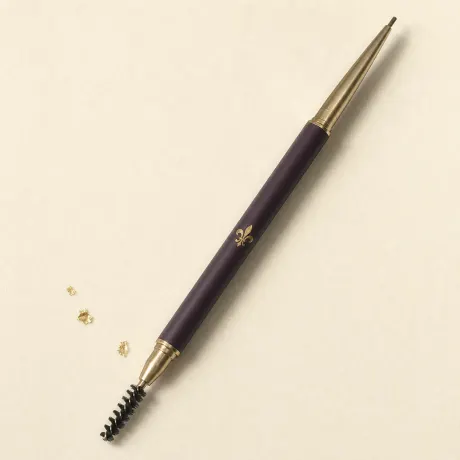
Micro brow pencil
An extremely fine retractable pencil, with a spoolie at the other end, for drawing individual hairs.
Read the guide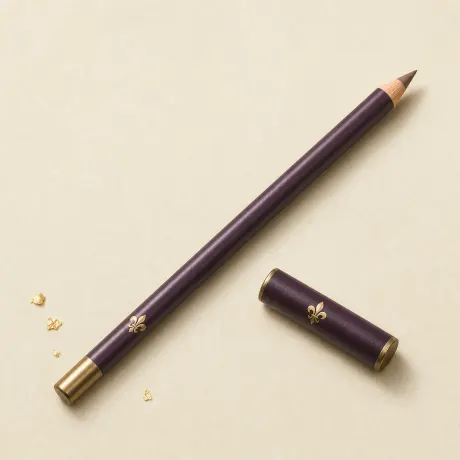
Brow pencil
A firm, waxy wooden pencil, sharpened to a fine point.
Read the guide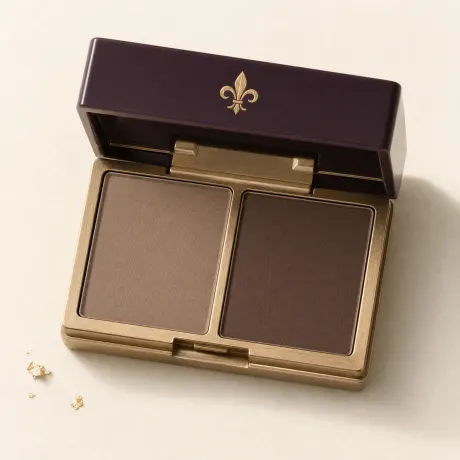
Brow powder
Matte pressed powder in brow shades, for a soft, filled-in finish.
Read the guide
Brow pomade
A dense, waxy brow colour that fills, shapes and holds at once.
Read the guide
Brow pen
A felt-tip brow pen, often with a split tip that draws several hair-fine strokes at once.
Read the guide